Friday, May 13, 2011

A few of my favorite movie songs

A lot of great songs come out of movies, and a lot of others get used in movies. Johnny Cash's fab "The Man Comes Around" has been in more movies than some movie stars.

You Tube's made reliving the musical moments from old films possible since soundtracks are sometimes hard to come by. Below are a few of my melodic favorites.

Tomorrow, tomorrow
"Tomorrow is the Song I Sing" from Richard Gillis is one of several tunes that punctuate the offbeat Sam Peckinpa Western The Ballad of Cable Hogue. It's catchy an infinitely hummable. It, happily, is available from iTunes as part of the Gillis album Blow the Gates of Heaven.


Reachin' to the sky
Folk genius Leonard Cohen's melancholy "The Stranger Song" opens another offbeat Western, Robert Altman's McCabe and Mrs. Miller. It really is a perfect tone-setter for the Warren Beatty outing. It's also found on The Essential Leonard Cohen.


I can almost see that old Bandera Highway...
Barry De Vorzon's "San Antone" is actually on a couple of movie soundtracks that I know of, both of which he served on as musical director.  He's best known for Nadia's Theme.

The tune is the homecoming song that opens the revenge flick Rolling Thunder. It's more wonderfully moody and nostalgic in contrast to the opening scenes of William Peter Blatty's The Ninth Configuration, aka Twinkle, Twinkle Killer Kane. Sadly it doesn't seem to be available for purchase in a pristine MP3.


Over the hills and far away
The television adaptations of Bernard Cromwell's swashbuckling Sharpe novels adopted a John Tams rendition of the 17th century British song "Over the Hills and Far Away."

 It's catchy and a wonderful mesh for the excellent films with Sean Bean. I don't think it's on iTunes, but The Music of Sharpe CD is available in the U.S. on Amazon.


I could go on, but that's a pretty good playlist for a blog post. I'll forego the theme from Kelly's Heros and The Osmonds?! performing "Chilly Winds" on the risque Rock Hudson/Angie Dickinson thriller Pretty Mains All in a Row from Gene, but I kind of like both of those too.

Tuesday, May 10, 2011

Indiana, Indiana and The Lovely Secrets

(Contains Some Spoilers)
Indiana, Indiana (the dark and lovely portions of the night) from Coffee House, 2003, is one of two novels by Laird Hunt that I read for school last year, and it's stayed with me.

It's a novel with a very basic through story. It is given the heft and richness of a book-length work by the author’s stylistic, poetic approach in exploring his central character’s thoughts and soul.

To say Indiana, Indiana is a simple story, however,  is to do it disservice. It is brief with only a few characters, and most of the tale unfolds from the protagonist’s pouring over mementos from his life.

Yet it is a complex exploration of the simple-minded man and his rural life. His reflections on his past and longing for his institutionalized wife, Opal, open up the narrative to incidents and intrigue.

Hunt’s approach is meditative, yet as he delves into the mind of Noah Summers and dissects his reflections, he offers a certain objectivity. We are often allowed to interpret Noah’s reality from within Noah’s perspective, with some revelations withheld for narrative impact.

We see Noah Summers lacks something. He’s capable of serving as a postman, yet incapable of the discernment that it’s inappropriate for a civil servant to sit down with people he happens on at mealtime.

Simple gifts
Noah has other gifts that stand in for what he lacks. Psychic abilities allow him to help the local sheriff with unsolved crimes, and he’s wise enough to bargain with his abilities and eventually to imitate Opal’s behavior in an attempt to be institutionalized with her.

Since the book unfolds through Noah’s memories, stimulated by mementos, Hunt offers additional narrative touches that further enhance and open up the story. Sprinkled throughout the chapters are letters from Opal, for example. These hint at her sensitivity and perhaps some delusion, yet the spirit of what makes Noah miss her so much is evident.


“Yesterday, I got out of the bath. While I was in there, all of the leaves had fallen off the trees. I was sad when I saw they had already raked all the pretty leaves up.”

In another letter, she observes:

“I had hoped I would see humming birds at the new feeder but none came. Least ways not while I was watching. … They’re so tiny—like pretty thoughts.”

Another interesting addition to the narrative is an outline of the entire work found at the opening of each chapter, with that chapter’s events or letters highlighted and others grayed.

In the box
The lines feel at first almost like a 19th century novel approach, but they are appropriate, since the narrative is an amalgamation of memories and mementos. The outline is like the box of memories through which Noah sifts, reliving his life, and it helps organize and unify the meditation.

Indiana, Indiana is a moving portrait of the type of a man not often given fictional scrutiny. To delve into it and to gain entry into Noah’s world is a fascinating and emotionally haunting journey, a little like Noah’s contemplative evening with his memories.

Wednesday, May 04, 2011

Giveaway 1 Is Over

Thanks for everyone who followed or even visited during Giveaway 1.

It's now officially over, and a winner has been randomly selected from all followers and those who commented on the review of Steven Sidor's Pitch Dark.

I wrote all the names on a pad, cut the sheet up and drew from my Fund for Animals mug.

I've sent a private message to the winner and will post a notice when I get a confirmation.

Friday, April 29, 2011

Cool Stuff To Watch Instantly: The Cry of the Owl

Patricia Highsmith is noted for a grim and unique outlook. Her recurring series character was not a detective hero but sociopathic killer Tom Ripley brought to life with dark charm by Matt Damon in The Talented Mr. Ripley. She's also famous for Hitcockian treatment in her queen-mother-of-misunderstandings tale, Strangers on a Train.

The Cry of the Owl, a 2009 film is based on a lesser-known Highsmith novel, but it's a great example as well of her dark perspective. It's available on Netflix Watch Instantly by way of Starz, which means it won't be streaming forever, so catch it while you can.

It's as twisty as it is dark, and it's wonderfully unusual. You haven't seen this before in quite this way.

The story focuses on Robert Forrester (Paddy Considine), who's going through a horrible divorce. He's left New York for a small town in presumably Pennsylvania where he works as a designer in an aeronautics firm.

In a chance glimpse, he catches the seemingly blissful Jenny Thierlof (Julia Styles) doing dishes. What he perceives as her happiness is comforting, so he returns to watch her, innocently and chastely from afar. Things like that never go well. Soon he's caught the attention of her boyfriend, Greg, and then of Jenny herself, who surprisingly invites him into her home.

Jenny believes in fate, romance and harbingers. Soon she's broken up with Greg and is pursuing connection with Robert, even as he struggles to disentangle him from his wife, a witch of twisty dimensions played wonderfully by Caroline Dhavernas. She comes into one arbitration meeting saying she's changed her mind and wants to make up before a "Just kidding."

Before long, a jealous Greg attacks Robert then disappears, and Robert's run of bad luck so far has been mild for what's ahead. Confusion, misunderstanding and terror ensue.

Adapted and directed by Jamie Thraves, the film is relentless in its realization of that Highsmith sensibility. It's not about crime and detection but about situations that spiral around strange characters.

It's very dark, but engrossing and a must for Highsmith fans.

See also
Earlier adaptation: Le cri du hibou


Wednesday, April 27, 2011

Giveaway One

Sometimes I get cool stuff from various corners of the blogosphere, and I have items from my backlist of books and comics as well. I thought it might be fun to give some away, so watch for occasional contests.

I'll probably tweet any giveaways also, so you can follow me on Twitter, @Sidney_Williams

Giveaway 1

Here's an ARC of the recently-reviewed Pitch Dark by Steven Sidor, a new release that blends horror and crime-thriller elements. 

All you have to do is follow the blog using the button at the right, and we'll do a drawing one week from today. Or you can comment on this post or the review of Pitch Dark below. Maybe you'll be the lucky winner.

I'll post the winner on the blog, and we'll arrange a drop of the swag at that point.

If you can't wait to read the book, of course, it's now available in stores and online shops everywhere:

Check Amazon here.


Sunday, April 24, 2011

Midnight Eyes - Cover For My Thriller


Here's the cover art for my first new book in a while. It's propagating on the usual sites such as Amazonnow, and it's on the Crossroad Press website. Crossroad will issue a paper edition as well in the future.

It's the story of Wayland Hood, a former FBI behavioral science unit agent who's called back to his home town to help his father, the sheriff in a small Louisiana city, deal with a brutal series of murders.

Wayland is scarred emotionally by his family history and his relationship with his father. The two have to put differences aside to get to the heart of the case, which has buried secrets that stretch back many years.

Check it out if you get a chance. A sample's here. Or here.

Also on: 


Thursday, April 21, 2011

New Fiction: Pitch Dark by Steven Sidor

A Chicago Tribune review heralding Steven Sidor's previous novel notes: "Crime fiction and horror fans alike will find The Mirror's Edge a dark, disturbing gem."

That line is applicable to Sidor's new outing, Pitch Dark, as well. A definite crime thriller feel permeates the set-up, while the plot revolves around a Lovecraftian McGuffin and builds to a supernatural-fueled climax. Think Elmore Leonard crossed with dark magic.

Much of the action occurs in a snowy Midwestern motel run by Opal and Wyatt Larkin, survivors of a shooting spree in the diner where Opal worked years earlier. Wyatt, then a police officer, helped stop the incident but took a bullet. Opal, then pregnant, almost perished.

As the story begins, Opal is experiencing mysterious visions, believed to be residual effects of the shooting, of which unanswered questions remain. Wyatt has long believed a second shooter was involved. The truth and much more will be revealed as their snowy Christmas Eve progresses.

Trouble has found them and more is on the way.

Max Caul, a writer of pulp novels and screenplays occupies one of the Larkin's rooms, carefully marking doors with protective symbols while holding up with his Irish Setter, Ann Margaret.

Vera Coffy is on the run and seeking refuge, having snatched a mysterious stone from her boyfriend, a thief hired to extricate it from a coven.

Max has a long history with the Pitch, the same mysterious figure Vera is fleeing. When Vera arrives at the Larkin's hotel at the same time their son, Adam, returns from college, fires, explosions and siege follow.

The novel's strongest element is its central villain. To describe too much about the Pitch would be spoiling, and Sidor has many twists it would be unfair to reveal. Some of the apocalyptic tropes are familiar, but there's freshness to the rendering.

Of those on the side of goodness, Max is the most intriguing. Elderly but alert, the Mountain Dew swilling writer lives and breathes. Vera, Wyatt and Opal, aren't quite as engaging, to me, though they serve the story and its action as it builds to frenzied chaos.

I might quibble also with the quickness of the conclusion, but in general Pitch Dark is a brisk excursion with distinct flourishes.

What writer's should watch for:
The subtle re-mixing of genre elements that breaks or at least pushes the sides of the horror box.

Further Reading

St. Martin's at the moment has a free short story for Kindle related to Pitch Dark's events: A Chunk of Hell

Monday, April 18, 2011

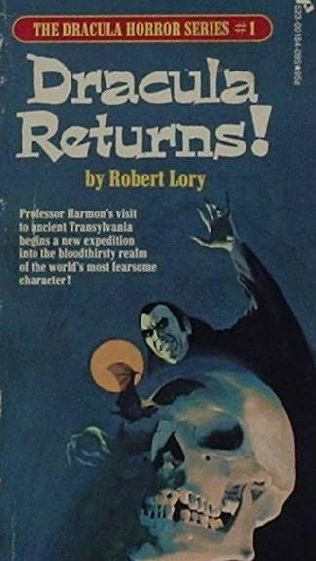
Interview: Robert Lory Author of The Dracula Horror Series

In the mid-1970s, the book rack at the local Eckerd's provided me a great deal of reading material.

Along with Doc Savage, Lew Archer and thrillers of the day sat a series of titles which brought Dracula, the prince of darkness, into the modern era.

A great deal of attention was focused on Dracula at that time. Magazines featured articles about the newly discovered tie between Vlad the Impaler and the Bram Stoker creation. Both the Christopher Lee Dracula films and Universal Films were also spotlighted frequently in Monster Times and Famous Monsters of Filmland, and the Aurora monster model kits were still on sale.

The Dracula Horror Series fit perfectly into that period, a blend of horror, science fiction and action adventure. In the tales, Damien Harmon, a paralyzed criminologist with telekinetic ability implanted a device with a tiny sliver of a stake near Dracula's heart. Controlled by the professor's thoughts, the device allowed him to harness Dracula's power for the forces of goodness. If Drac failed to comply with Dr. Harmon's wishes, the stake could be activated, sending him back into oblivion. With Harmon's bald, martial-arts-expert assistant Cameron Sanchez and Dracula's shape shifting friend Ktara, they were off to face super villains, lost worlds and much more.


Those titles were penned by Robert Lory, and I was thrilled to connect with him online a few years ago.

I've decided to do occasional interviews here on the blog, and he was the first person to whom I wanted to pose a few questions since those tales stimulated my imagination when I read them in junior high.  It was a lot of fun to learn details about not just the Dracula series but more of Mr. Lory's work at a very exciting time in science fiction, fantasy and horror publishing.


When I was first reading the Dracula novels, I discovered a copy of If with one of your stories among my cousin’s books. Tell us a little about your earliest writing, what first drew you to science fiction and writing for the digest magazines?

I started writing for dollars when in college in the late 1950s. Since my major was history/social sciences, I was heavily into research. I was drawn to science fiction because logically--at least to my mind--the future can't be researched. Similar case with fantasy: just make the stuff up.

You wrote some science fiction novels and horror novels as well. What was it like writing for Ace in the sixties and seventies? Did you work with one editor or more? Any interesting experiences?

Don Wolheim was my first editor at Ace, and he was terrific. Case in point: Because I came to novel writing from the short story scene, I’d learned to write "tight and terse." The result was a first novel (The Eyes of Bolsk) that turned out to be 10,000 words too short. Since I didn't have the stomach for adding a bunch of non-essential scenic views or conversations that went nowhere, I added a secondary plot line. Don liked it, but gave me some serious advice which boiled down to: Look, I like the multiple plot lines but, if you keep writing like this, you'll burn out after four, maybe five, novels. Relax and loosen up.  One of the best writing suggestions I ever got. Too bad I couldn't follow it.

My history with Fred Pohl began in the mid-60s when he was editing Galaxy and If magazines. He editorialized that he would never--repeat, never--buy a story that had astrology as a base. I took it as a challenge and wrote and sent him "The Star Party" with his editorial attached. The check he sent me had a transmittal note that said something like I shouldn't try pulling his chain a second time. I didn't rub it in when Ace Books republished the story in its Worlds Best SF anthology for 1965.

When Fred was at Ace in 1974, I sent him the first 40 pages of The Thirteen Bracelets, saying I had no idea where the story was going, but would he like to see it when done.  He said yes, but would I include two things: an underground battle scene and an insane computer. I had no problem with either, and am convinced they made the book stronger.

After you started having novels published, where did you first see one of your books on sale?

I honestly can't remember, but here's a related incident I remember well. In the late '70s I was on a flight to Hong Kong, which had to refuel on Guam. The airport passenger facilities at that time consisted of two Quonset huts, one of which was a jam-packed general store. I had three free-standing swivel racks of paperbacks. When I got back to the States, I couldn't wait to tell a writer friend of mine the "good news": he had two books on those racks. Then I told him the "better news": I had four.   

Do you have a favorite among the science fiction and stand-alone novels you wrote?

In science fiction it would have to be The Thirteen Bracelets, because in it I attacked every sacred cow I deemed worth attacking. A close second would be Master of the Etrax, a sort of sword and sorcery romp that ridiculed, among other things, bureaucratic decision-making. I laughed out loud writing both books, which makes me think that, in those days, I might not have been the most empathetic knife in the drawer.


The Dracula Horror Series was written with the book producer Lyle Kenyon Engle, right? How did you come to work on the Dracula series?

Lyle had read one of my Sham Odell SF novels and called me to work on a series which became John Eagle: the Expeditor. (The publisher wanted the books faster than the first writer could supply them.) I wrote the third and fourth in the series and then alternated books up to when the series ended at the eleventh entry.

When Dracula came up, he asked me if I'd do it. I was delighted to say yes.

Did you have an interest in Dracula before the series? Did you do special research for the series?

I'd read Stoker, of course, but had no really special interest in vampires per se.  My research was fairly skimpy--a few vampire stories as well as the classic In Search of Dracula by McNally and Florescu. I never did get into the Anne Rice thing.

Some of the promotional blurbs for the Dracula novels have different character names. I’ve always assumed those were from the original outlines and that the books morphed in the creative process. Am I right?

There really were no original outlines, just a few very rough ideas. One was for the Professor to tell the stories in the first person, and that was killed from the moment I signed on. There was no way that he could know all the details of Dracula’s history.

British edition of No. 4
 in the Dracula series.
What was that process like with Engle and how much freedom did you have in developing the stories? 

I had pretty much total freedom.  Lyle and I had a long dinner in New York where we covered several scenarios and some specific problems--like how do you control the beast now that you’ve got him? Back home in Houston, it took me about a week to develop Harmon and Sanchez (the prof would need a younger man to do the heavy lifting) and the cat-morphing Ktara--as well as a very sketchy back-story that began some time in the Age of Myth.

I outlined the first book, and it was a go. I also did outlines for the next two in the series, but when Lyle and the publisher saw that I never bothered to follow them, they told me not to bother producing them.

I always thought both Professor Harmon and Cameron Sanchez were great characters. How did they take shape?

I wanted brains (Harmon) and brawn (Sanchez), both of whom were fire-eaters on a mission and were hard-pressed to pull it off the way they originally intended (as badged public servants). Sprinkled in their psyches are some of my own traits. Harmon detests telephones; I only bought a cell when my wife had hip surgery (it now sits in my car, uncharged).  Cam hates airplanes; I avoid them whenever possible.

Did you have a favorite of the Dracula series?

Actually, I best-liked whatever one I was working on. As a writer/reader, I too was learning more about these characters as the type showed up on the page.

Would there have been any more in the series?

Probably--if the sales had held up. The Atlantis/Old Gods back-story could have been mined for at least another two or three books, but it was not to be. However, a series of nine isn’t all that shabby.

You did the second Boris Karloff Tales of the Frightened anthology. Any challenges in working in that somewhat brief form?

It was a great deal of fun. It not only took me back to the short story medium, which I realized I missed, but I also got to do a pretty good imitation of Karloff’s voice as I read my stuff aloud during the editing process.

Tell us a little about the Horrorscope series. Was that an interesting project also?

Initially, I didn’t think of it as a book series. What I proposed was a collection of short stories, each based on a Zodiac sign, so I started the book-length project with more than a little reluctance. As the products appeared in print, some of my friends allowed as how I “didn’t seem to be having much fun” with them. They were right, and I think the writing proved the point. In any case, when Pinnacle dropped that project (and others of its ilk), I felt very relieved.

Can you tell us a little about what you’re up to now?

Nine years ago, I retired early from my corporate (PR and advertising) job--and immediately started a consulting company, which I retired from about four years ago. These days I enjoy day-trading the financial markets. I’m also working on improving my tennis game. To date, Rafa Nadal has expressed no concern.

The Dracula books now sell at collectible prices. Any thoughts about having any of your work brought out on for Kindle in this burgeoning digital era?

I could hardly believe it when I first discovered my stuff was still being read and reviewed on several Web sites. I’ve gotten “thank-you” emails from people that were toddlers when my books were written. So, from an ego-feel-good perspective, the “digital era” has made my day many times over. Anything more is gravy.

Additional reading


Friday, April 15, 2011

Val McDermid BBC World Book Club

I can't always report top news here, but I have a bit of information that may be of interest to those in the UK.  On May 4, thriller writer Val McDermid will be visiting BBC World Services World Book Club, a radio show and podcast.

The program, recorded at Bush House, home of the BBC, spotlights an author discussing, reading from and answering questions about a single book. Past guests have included James Ellroy, Carlos Ruiz Zafron, Uberto Eco and many others. I subscribed a while back and have enjoyed the installments I've listened to. They're great discussions for writers to hear.

Wires and Execution
Ms. McDermid, who also authored the books on which the Wire in the Blood series was based, will be discussing her novel A Place of Execution. It's a multi-layered mystery thriller focusing on a present day television journalist who's at work on a documentary about a 1963 murder case. Of course, all is not what it seems with the case or the hero detective who handled the investigation. Or with the heroine for that matter.

Her pursuit of the truth leads to revelations that affect her on many levels.

I recently watched the Masterpiece Contemporary/ITV adaptation of the novel, which originally aired in the U.S. in 2009. It's a great mini-series, exciting and compelling with a stellar cast including Lee Ingleby and Juliet Stevenson.

I Tweeted that I was watching, which brought a message and invite from World Book Club's Twitter account.

If I were going to be in London, I could go to the recording of the episode, but since I can't make it, I've been asked to submit a question about the novel to be posed at the session. I'm trying to come up with something meaningful now. I'm leaning toward asking a character question about the journalist, Catherine Heathcote.

That should be fun. What a wonderful new world of communication we have these days. I'll let you know what my question is when I get it formulated and how things turn out.

You can submit a question too via WBC's twitter feed, @BBCWBC or by e-mail worldbookclub(at)bbc(dot)co(dot)uk.

Further reading

Mystery Fanfare: Val McDermid Place of Execution Interview

Variety review of Place of Execution mini-series

Addendum

The program airs blog post

Listen to the BBC broadcast which includes my question. 

Tuesday, April 12, 2011

Finally Seeing Red

A friend used to scan the new movie trailers on Apple's site regularly. One day he mentioned an upcoming flick called Red.

I realized he was talking about a Jack Ketchum adaptation. "I don't know if I have the stones for that," I said, because I knew it was the tale of a confrontation between an old man and the teens who'd killed his dog. (My vision, incorrectly, was of a hermit stalking unsympathetic but focal teen characters.)

I read Off Season when I was a kid without flinching, but like most viewers I do flinch if animals die on screen. I've almost recovered from Old Yeller, but it took a while.

 I kind of  avoided Red until it popped up recently as a Netflix watch instantly option. David Naill Wilson had mentioned Jack Ketchum's Crossroad Press titles, and I rather liked Red director Lucky McKee's ghost story The Woods.

So, bracing myself, I selected it and watched the credits roll. It's an impressive span of credits including Amanda Plumer and Freddy himself, Robert Englund.

A film not a flick
I can't really say a flick about a man's murdered dog was a pleasant surprise, but the film is, well, a film and not just a flick.

Starring Brian Cox who's tackled many tough roles and character turns, Red is a well realized achievement that does not take an easy path.

Cox is  Avery Ludlow a small town store owner, who's still mourning the brutal loss of his wife. Red, his dog, was her gift to him on his 50th birthday and all he has left of her.


While fishing, Avery encounters three young jerks led by Danny (Noel Fisher), a particularly nasty and violent rich kid. Danny and friends shoot Red out of spite, mercifully in an almost off-camera moment.

This is no, pardon me, rabid revenge film, though. Avery sets out to seek legal remedies for the wrong and to perhaps see Danny's spiraling course corrected.

Instead Danny's wealthy father played by Tom Sizemore backs his son and twists legal arms to thwart
prosecution. Kim Dickens as a reporter is on hand to note how often animal cruelty is lightly prosecuted.

Things go badly, with Cox maintaining a subdued demeanor as every attempt he makes for justice falls apart.

Things get violent, but never in an exploitive way as the conclusion arrives.

Red is not for all tastes, but if you are in the right place, it's an excellent watch instantly selection and an excellent realization of Jack Ketchum's dark vision.

Further Reading

The Woman  by Jack Ketchum and Lucky McKee, soon to be another major motion picture.

(Full disclosure: Crossroad Press has also brought out my e-book titles.)

Saturday, April 09, 2011

The Girl in The Trunk - Pulp Covers and How Bish's Beat can be dangerous

I now own a copy of the book above, The Girl in the Trunk, an early seventies pulp-noir mystery from Ace by Bruce Cassiday. It's the tale of a Honolulu cop who has to investigate, well, I think you get the idea from the cover.

I was browsing the fabulous Bish's Beat blog one day and caught sight of it in his vintage covers gallery.

They're snapshots of the Fawcett Gold Medal era though not limited to Gold Medals of course. Dell and many smaller publisher's get display, and you know how it is with covers. Once you glance at them, you wonder what the story's about.

I dutifully check the usual suspect spots when one's particularly intriguing. Sometimes those checks pay off. Mr. Bishop posted  Night Squad from David Goodis, author of such classics as Dark Passage and one-time litigant over the origins of The Fugitive, and it seems some of his books have crept into public domain and are readily available for e-readers.

Many other paperbacks are not available in any current form, sadly. That means seeking them out used. I got The Girl in the Trunk for probably a buck plus postage. Bye to some of my royalties from my e-book sales.

I'll let you know how it reads.

As you know, I'm Sid, and I'm a biblioholic.

Further reading

The Fugitive and David Goodis

More vintage covers

Monday, April 04, 2011

New Who


I've been so busy of late, I haven't had time to be excited about the new season of Doctor Who. It's kind of interesting how the phenomena has transformed. 

Took a year for Season 1 to air in the U.S. I can remember visiting the official site one day to discover the TARDIS materializing on White House lawn. 

Now we get the Christmas specials on Christmas night, and a new season is here almost as quickly as it airs in the UK. That's the force of demand and technology, I suppose. 

The lack of anticipation almost makes U.S. viewers take it for granted. 

Seeing the first U.S.-lensed scenes evidenced in the trailer helps with my excitement. Let the countdown begin.

Addendum
And what should arrive in my RSS feed this afternoon but an interview with lead writer Steven Moffat on the evolution of the series. Read it

New Who Wallpaper

Sunday, April 03, 2011

Tweaking the Synopsis - Midnight Eyes

I'm in what I find to be an awkward phase. It's time to write the jacket copy for Midnight Eyes, a thriller I just turned in to Crossroad Press for copy editing. Summing up 100,000 words in a few paragraphs that capture the relevant points isn't as challenging as, I don't know, math, but it's not just dashing off a few lines either.

I thought I'd toss out the first pass here.

A little background
The first version of Midnight Eyes was written several years ago, around a time when I seemed to have agents lining up to flame out for me, so the manuscript wound up going into the trunk for a while. I moved on to write other things.

As we recently began rolling out my horror novels as e-books, it seemed time to re-visit ME, and it seemed I had the juice to do it, if you will.

It's a non-supernatural tale set more or less in the universe of my previous books. It was written not long after I'd stopped being a reporter. I wondered how the police in a smaller city might cope when a persistent and hard-to-understand serial killer arrived. It started out, in one early draft, from the perspective of journalists, and one remains. But it eventually developed into a different story.

I think of the tale as more than a serial killer novel with several plot strands that weave together, but it all revolves around investigation and attempts to end a spree.

I've spent the last few months revising and updating it, changing the main character's job a bit and modifying situations to reflect the world we live in today. I gave some people cell phones, that is. Cells have definitely changed a few thriller tropes over the last few years, though based on the coverage I get with my iPhones, they've also created new and realistic challenges.

The summary of the story so far
Men are being lured to agonizing deaths in the small Louisiana city of Aimsley. Brutalized bodies are displayed on the riverbank and in little-travelled bayou country, and a mysterious dark-eyed beauty may be connected. It’s a case with tremendous human suffering and a challenging political labyrinth for Sheriff Ty Hood. It means calling on the last person he wants to for help—his son.


Former FBI agent Wayland Hood is a brilliant criminologist and writer. He’s immersed in a project to unravel the mysteries inside the minds of four of America’s most heinous serial killers. Only unresolved issues with his father can draw him into the dark quest for buried secrets that fuel modern bloodshed in his hometown. As father and son clash with each other and with canny reporter Jemy Reardon, who has her own goals and theories, the body count increases. Only a terrifying excursion into the darkest heart of midnight can hope to bring the nightmare to an end. 

Call for feedback
If you have any thoughts or reactions, feel free to leave them in the comments. I'm told a couple of synopsis variations for different seller sites might be in order, so tweaking will occur.

Friday, March 25, 2011

John D. MacDonald - The Crossroads

Anyone who's ever read a Travis McGee paperback has seen the long list of other John D. MacDonald novels that usually take up two tightly-spaced columns in the front. I read a lot of the McGee novels in my teens. They're action-packed mysteries with a cerebral touch, and they provided a slam-bang parallel reading experience as I also devoured Ross MacDonald's Lew Archer novels.

I wanted to read more of the non-series novels from those single-spaced columns in the front of the books, but they were hard to find. This was before Amazon or even Prodigy.

Weren't at the Waldenbooks, had often been published in paperback and weren't at the library, and they didn't even turn up at used book stores that much.

I found A Bullet for Cinderella on a paperback rack while visiting my mother's relatives in Camden, AR, as a rare exception. A first-person crime novel, it resembled a McGee and was a nice addition to my reading.

A discovery and a re-discovery
I thought of all that recently when I was browsing a local used shop that displays mostly nice used hardcovers. On one of the paperback spinners, I spotted some battered John D. MacDonalds. Took me back, and I grabbed a couple in spite of their tattered shape, excited to get the reminder of an author I hadn't experienced in a while.

The Crossroads is the first I cracked open, and it proved to be a rewarding excursion. It really anticipates those lauded literary novels that add a touch of crime to an otherwise character driven exploration.

There's a crime at the novel's core, but it's really a fascinating slice-of-life in one mid-fifties summer of an entrepreneurial family. It was great to imagine the characters in fifties fashions, occupying spaces decorated in mid-century modern.

The crossroads of the title is an intersection of well-traveled thoroughfares where the small business empire of the Drovek family has grown from the real estate acquisitions of their Polish-immigrant patriarch.

It's a son, Chip, who's the head of the business now, a cluster of leased gift shops, hotels, truck stops and restaurants. Chip's deteriorating marriage to a woman hopelessly mired in depression and alcoholism has driven him into the arms of one of the crossroads shopkeepers.

Others in the family are equally unhappy, including the irresponsible Pete, who's accidently entangled with Sylvia, former true crime magazine cover model. A Bettie Page perhaps?

A family so successful is not without enemies, and once the players and the playing field is established, MacDonald focuses on the revenge scheme of a fired employee. It's a seedy, brutal and realistic plan, and it unfolds at the novel's core.

Yet MacDonald keeps the family and their triumphs and foibles in the sharpest focus.

A few touches, that would be spoilers if revealed, suggest this might be a book that influenced Stephen King, who I believe is an acknowledge MacDonald fan. This book certainly weaves crime and character together much the way King has always melded domestic drama with supernatural incursions.

The Crossroads has reminded me what a joy a John D. MacDonald read can be, and it's a kick in the pants to find more used titles since the books are regrettably not available electronically. Except for one title that has perhaps slipped somehow into the public domain. Care to venture a guess which one that is? Yep, A Bullet for Cinderella. Get it in e-format here.


What writers should watch for:
  • MacDonald's flare for making the routine seem fascinating. 
  • The nuanced characters which suggest a keen eye for the human condition.
  • The slow-burn crime plot, a devilish strong arm crime enhanced by the dark players. 

Thursday, March 17, 2011

The Frightened Man - A Victorian Mystery


The ties to Jack the Ripper are peripheral in Kenneth Cameron's The Frightened Man, despite its iconic cover, but it's still a compelling Victorian thriller with many Ripper trappings. Denton, the hero, spends a lot of time prowling foggy streets, clashing with wrong-headed Scotland Yard detectives and digging for answers in the darkest corners of poverty-ridden 1900 London.

The Ripper case is in the past, but the frightened man of the title--who draws former U.S. sheriff Denton into the twisting, violent investigation of a new killing--believes he's seen a man who might be Springheel Jack. 

He calls on Denton, who's given up the military and law enforcement for a career as a Poe-esque author and has growing reputation on multiple fronts. The request wraps Denton into the case so tightly he can't escape.

The Cast
Denton is a wonderful creation, tough yet reeling from a broken heart and driven toward the truth even at great personal cost. Cameron, author of numerous books, backs his central character up with some great supporting players:

Atkins: his humorous but tough and pragmatic butler who's as given to get-rich-quick schemes as Ralph Kramden.

Munro, a friendly police official who's helpful but not always able to override Denton's enemies. Think Rockford's Dennis Becker.

Janet Striker, a crusading advocate for downtrodden women with a complex past that's almost mythic. She's a strong and compelling match for the lead.

Denton struggles through some tough spots and endures dangerous attacks as he works toward the truth, even going to personal expense to track down minute details. A particularly rigorous scene involves him working through brutal obstacles to enter a locked dwelling.

A few personal facts from Denton's past seem to come a little late in the story, but that's a quibble, especially when the story reaches its action-packed climax.

If you like Victorian tales, The Frightened Man isn't a pure mystery puzzler, but it hangs together well and offers page-turning thrills. I've already added the sequel, The Bohemian Girl, to my to-read list and to my Kindle.

What writers should watch for: 
  • The deft creation of characters.
  • The blending of mainstream and thriller plotting


Tuesday, March 08, 2011

Movies Worth a Look: Dolan's Cadillac

I know everyone's probably way ahead of me, but if not, here's a flick to check out.


I haven't read the Stephen King short story Dolan's Cadilac from the Nightmares and Dreamscapes collection, but the title rang a bell a while back when the movie adaptation popped up as a Netflix recommendation. I added to my queue and settled in to watch it recently.

At first blush, the film looks like a standard issue crime drama. It centers on one of those happy middle class couples who run afoul of criminals. There's the intense Wes Bentley (Robinson), of American Beauty and Ghost Rider,  and Emmanuelle Vaugier, from the Saw movies and more. They're school teachers. She's trying to get pregnant.

Unfortunately, while horseback riding, Elizabeth (Vaugier) happens upon Dolan (Christian Slater) and his crime crew. They ride around in Dolan's black and ominous Caddy SUV.

Moving the plot
Dolan's chief criminal activity is smuggling young women for the sex trade. A failed ventilation system in a truck has caused deaths and leads to additional murders while Elizabeth is watching.

She's soon targeted by Dolan and his existential sidekick played by Greg Bryk, also of Saw films. Mild spoiler here: 

 They kill her, and the devastated husband sets out for revenge.

That's where the spoiling stops, and where the film, realizing what I suspect is the meat of the King source material takes off.

Soul searching, confrontation and the execution of an ingenious plan unfold with surprises and subtext that you don't find in routine crime dramas or many direct-to-video flicks.

Performances
Christian Slater is at his over-the-top best as Dolan, who's devilish and intelligent, and Bentley's capacity of deep darkness is perfectly utilized.

A couple of minor characters who play a role in Robinson's resurrection also add flavor, and Bryk's  complex lieutenant is much greater than a typical henchman walk-on.

Is it perfect? Meh. Is it without implausibility? Well no, but it's all well-executed and enriched by character and explorations of grief, torment and even spirituality.

If you're going in cold, it's particularly entertaining and probably worthwhile as a watch-instantly choice if you've read the story.

Watch the trailer below, but know it spoils some surprises before you click: 


Sunday, February 13, 2011

What's On the iPod? - Last Call by Tim Powers

The strength in Last Call by Tim Powers, a contemporary fantasy or magic realism epic, is, first and foremost, in its fully realized fantasy universe. It is a world shaped by the Tarot and Arthurian legend, and it's the kind of immersive work that makes for a really fine audiobook experience.

As an aside: The App
I've begun using Audible's free iPhone app for its convenience, and because it's goal-oriented. It crosses foursquare badges, time tracking and sharing with friends. It's brilliantly or crassly commercial, depending on your point of view. It challenges you to listen more. It's also helpful, since I have an active imagination and have to exercise care to keep my mind wandering when listening to audio fiction. It's not the fiction's fault, just me.

The app provided perfect inducements for keeping me focused on Last Call, read brilliantly by Bronson Pinchot, most noted for comedic turns on film and TV. Yeah, it's Balki, but there's never a trace of over-the-top humor in his tone.

In the Last Call universe, where Bugsy Siegel was a wizard and Las Vegas swirls with subtle magic, Scott Crane is faced with a horror from his past.

Scott, who once worked as a gambler with his surrogate father, Ozzie, is the target of his real and powerfully magical father, a wounded king with multiple bodies and his disposal and a host of thugs as well.

Having once played a poker game with Tarot cards against his biological dad, Scott's primed to provide the old man a new body as the result of an assumption of a card hand.

The quest to prevent that loss of body and soul takes up most the novel's central action as Crane seeks the help and knowledge of the estranged Ozzie, who's steeped in gambling superstitions which have real validity in the universe of Last Call. He also has to cope with a ghostly ex-wife, an angry sister and a neighbor who's been given cancer by association with Scott's magical baggage. 

Chases, gun battles and intrigue keep the story moving, all while conveying more and more detail of the world and the rules in which it all takes place.

It's a fabulously consistent magical  landscape, shaped by myth and history, and it makes for several wonderful hours of listening. It's pretty much how I spent my January at the gym, and of course it's still available on paper or in e-book formats as well.

Look for On Stranger Tides by Powers as well, source for the next Pirates of the Caribbean movie.

Monday, January 31, 2011

Poe Returns

Note: This series didn't get picked up by ABC, but happily The Raven with John Cusak as Poe is coming to theaters in Fall 2011.

News that ABC's considering a series with Edgar Allan Poe as its detective lead is intriguing and exciting, especially with dark mystery investigations on the agenda.

 I'm sure the style, while the setting is historic, could resemble The X-Files and The Night Stalker revival with a little C. August Dupin-style ratiocination thrown in, but it's a little off-beat and innovative, and pays homage the father of many of the things I enjoy. I'll certainly sample it.

While it's to be written by Chistopher Hollier who's worked on Alias, the concept reminds me of a  novel I enjoyed as a kid, a time when the idea of  Poe and Poe's work were particularly thrilling.

I have mentioned it briefly here before though only in passing.

It's called Poe Must Die by the versatile Marc Olden who wrote thrillers of many stripes including a paperback series in the seventies, police procedurals and some wonderful Asian-themed thrillers including Dai-Sho, pitting a journalist against a Yukio Mishima-like adversary.

In Poe Must Die, the troubled Edgar Allan Poe is paired with boxer Pierce James Figg who's on the trail of a black magician. Said magician's in pursuit of an artifact known as the Throne of Solomon. It's legendary power is said to surpass Lucifer's, so its falling into the wrong hands could have dire consquences.

Poe's detective skills are utilized and ultimately Figg's pugilistic prowess comes into play, aided by a bit of mysticism. It's been years, but I remember it as a great, atmospheric adventure with mystical elements.

I suppose it's too much to hope that the pilot will be a 90-minute extravaganza based on the book. I'm sure it's possible to arrive at Poe as detective with paranormal cases independent of other sources, but it would be fun to see Poe Must Die brought to life.

Either way, Poe on TV is a good thing.


Friday, January 28, 2011

Genre Oscars

I've seen more of the Best Picture nominees this year than in some time. I've been making a point of getting off the sofa more and hustling out to the theater. I try to do my part to encourage the making of more movies.

It's interesting how many films have at least a drop of genre juice on them this year.


The King's Speech and The Kids are All Right are more likely Oscar contenders--human dramas with strong performances. I saw both, and I liked both.

Speech is the movie I'm rooting for, in fact. It is an emotional journey, finding drama as it deals with small, intense human strife against a backdrop of war and political crisis. It examines the toll of leadership on the individual and illustrates the importance and the power of words and symbolism on the world stage at a time when such consideration is particularly relevant. 

The genre side
The films that fit the notion of genre flicks are exceptional examples and not to be dismissed, however. I think they really are some of the best films of the 2010. In a year where safe, cookie-cutter fare was offered up, they stretched boundaries.

There are certainly lessons for all writers in this year's slate, opportunities to examine the development of character and the exploitation of cliche or previous works or myths.


The most obvious of the genre group is Black Swan with it's horrific elements, which surprised many people I've talked to, including Christine who hasn't gone to a real horror movie with me since walking out on Warlock a few weeks after we went to The Silence of the Lambs.

 Black Swan is definitely a study in how to enrich a thriller with character and a dose of subtext. Themes drawn from the ballet, to me, balance perfectly with the delusions of the central character.

Winter's Bone is set up on a mystery chassis with a few horrific touches. It does one of the best jobs ever of creating a realistic rural.
universe, in which the poor aren't caricatures and the accents seem real.

It has the well-woven strands of a mystery plot, enriched by its snapshot of a culture and its strong heroine.

 The Move Westward
True Grit's
a Western, of course, though one built from a literary novel. It really is a perfect adventure story, enhanced both by its use of arch types and its skewering of them. Mattie Ross is the precocious teen capable of outwitting adults, though she breaks the boundaries of Disney heroines easily, and Rooster Cogburn inverts the stalwart Western hero without sacrificing mythic acts.

Inception is the other genre entry, deceptively looking more like an epic thriller yet with a mind-bending labyrinth at it's core. It's still the more traditional in this mix, yet it stands out against the well-crafted but safe summer blockbusters that surrounded it last July. It was the one of the mix that made me want to go to the theater vs.waiting for the disk.

I enjoyed the set pieces including Joseph Gordon-Levitt's floating challenge more than the opportunities to interpret and re-interpret dream-within-a-dream possibilities, though I know those have been fun for some. I'm a Lost fan and apologist, but I'm not really up for multiple rehashes of  Inception. That's just me.

For a while, it looked like 2010 wasn't a great movie year, but, you know, looking back, maybe it was OK.


Sunday, January 02, 2011

Blood Hunter Sample

Blood Hunter proved to be my most popular ebook of 2010, so here's a sample to kick of the New Year.

Friday, December 24, 2010

Monday, December 13, 2010

Upcoming Movies I'd Rather Be Seeing

You ever go to the movies, and see trailers for flicks you'd rather be seeing than the show you just paid for?

I saw a perfectly fine holiday movie yesterday, but the trailers, always look better. They're the "what else is on?" of the theater experience, a couple of compressed minutes of pure imagination, revealing the best of a two-hour movie while sparking your imagination about possibilities as well:


And a Sci-Fi turn based on the novel from James Frey of "A Million Little Pieces" fame. The next Harry Potter?


Who's to say how these will pan out, but what a seven minute ride.

Saturday, December 04, 2010

Doctor Who Christmas Wallpaper


I know I haven't written a Doctor Who post in a while, but I'm a Whovian of a few years now and looking forward to having the Christmas special actually air in the U.S. on Christmas Day this year on BBC America.

That it's a Doctor Who look at "A Christmas Carroll" is an added bonus, because that Dickens classic is another of my holiday-season passions. For Harry Potter fans, there's that guy who replaced Richard Harris as well. OK, I know he's Michael Gambon.

Happily, to help decorate computers for the holiday season and to help with the wait, the BBC has released some Doctor Who wallpaper from the installment here.

My desktop's now decked for the holidays.

Also fun: Ferguson's lost Doctor Who Cold Open

Doctor Who Halloween Wallpaper From the Tennant era

Friday, December 03, 2010

The Young Adult Paranormal Thriller Novel Interview


Crossroad Press is posting videos about its e-book offerings. Here, I talk about the two of my young adult paranormal novels currently available in digital editions. These were originally written under my young adult pseudonym Michael August, which indicates a book suitable for younger readers. Adults can enjoy these as well, of course.

I had a lot of fun writing the YA's, which as I mention are a great opportunity to do  horror where the tension and suspense rely on atmosphere and mood more than visceral scenes. I particularly enjoyed re-editing The Gift for the e-edition.

These books are available from the publisher, Crossroad Press

Or most other e-book outlets and platforms including smart phones or as .pdfs:

Amazon
Deadly Delivery
The Gift

Smashwords
Deadly Delivery
The Gift

Or search Sidney Williams on iBooks, where The Gift is available.

Saturday, November 27, 2010

Her Fearful Symmetry - A Disturbing Literary Ghost Story

(May contain mild spoilers)
It's not, hopefully, giving away too much to say that the most disturbing elements of Her Fearful Symmetry, by The Time Traveler's Wife's Audrey Niffenegger, come late in the novel. That's an essential note to make for horror readers, just to keep expectations realistic.

This is not a haunted house tale, not a tale of rattling chains, cackling spirits or creaking doors. No visceral horror creeps into the mix.

It's a rich, character-driven narrative with a supernatural component that builds its disturbing storyline carefully, allowing the reader to realize what's ahead with a growing sense of tension and dread.

Symmetry's Sphere
Her Fearful Symmetry is first, however, a novel of complicated people and complicated lives from deeply obsessive-compulsive Martin to focal twins Julia and Valentina Poole to ghostly Elspeth Noblin, who spends most of the novel dead though very much a part of the narrative.

Elspeth is sister to the twins's mother, Edwina, and upon her death the mirror twins inherit Elspeth's flat on the edge of London'a Highgate Cemetery, provided they live a year in the residence.

Much of the plot revolves around their stay and their interaction with Martin, a crossword puzzle author upstairs whose wife has decamped. Unable to leave his apartment or give up his ritualistic obsessions, he languishes and befriends Julia, while Valentina becomes infatuated with Robert, Elspeth's significant other who is obsessed in his own right with a never-ending thesis on Highgate.

I've been intrigued of late, as a reader, with the blurring of the lines between genre and literary fiction. In "Stranger Things" (The Writer's Chronicle, September 2009) author Debra Spark examines works with genre elements in which--in her point of view--merit creeps in. She looks at the Michael Chabon thriller The Yiddish Policeman's Union with its alternate history, for example, and Magic for Beginners by Kelly Link.

Symmetry does that beautifully, incorporating elements of the Victorian ghost story into a study of people, relationships and manipulation.

It is a literary drama in its depiction of the relationships mentioned, but from those interactions and personalities, Elspeth's ghostly presence and sinister plans begin to emerge. The title is accurate in spite of Elspeth's seeming benevolence, and, if strong plotting is the stuff of genre, then Niffenegger utilizes the genre tool well in tightening the knots formed by the various strands.

For those interested in horror that stretches mind and imagination, Symmetry is a great choice.

Symmetry for Kindle

Related Posts

Thursday, November 25, 2010

Happy Thanksgiving!

Hope everyone has a great day!

Enjoy the stuffing.

Sunday, November 14, 2010

Sanctuary! Fantasy SF Paranormal Fun With Monsters


Is there a name for fans of Syfy/Canadia fantasy-thriller Sanctuary? You know like Trekker? I'm ready for my badge and membership card.

I glanced at the first episode when it aired on then Sci Fi, but didn't get to stay with the series, and I'll confess I was a little dismissive. Just another paranormal investigation show, I thought.

I returned for more sampling when the season became available on Netflix Watch Instantly. Episodes became a nice 45-minute break for the lazy part of Saturday afternoons just before time to start my grill for dinner while I was in school.

And I decided the premise was kind of fun and that Sanctuary wasn't just another X-Files. For the uninitiated, it's about Dr. Helen Magnus, Amanda Tapping, Stargate SG-1's Maj. Carter in a stunningly different persona. Dr. Magnus is immortal due to some Victorian magi-science, and she heads a network devoted to finding and protecting a generous supply of "abnormals" sprinkled around  the globe.

The mythology grows richer as the series moves along, even though there are obviously cost-conscious episodes in which Magnus and right-hand-man Dr. Will Zimmerman (Robin Dunn) are trapped in one-set confines such as the cabin of a crashed aircraft or the belly of an oil tanker. One ep was set entirely in a warehouse, viewed through the lens of a news crew's camera.

Myth, myth
Magnus is part of a circle that includes a misunderstood Jack The Ripper, Dr. John Watson and Tesla. The Sanctuary network is fraught with internecine political struggle, and there's a rival organization called Cabal. (Spoiler warning) One major character was killed off with stylish imagination.

The Season 2-ending, Season 3-beginning arc eschewed claustrophobic confines for a glob-spanning, world-threatening feature-like three-parter introducing Bollywood numbers and even more mythology, which seems headed in a Steampunk direction next. That's if an eye-candy holograph recently unlocked is any indication.

Happily with Netflix and Hulu, you can catch up quickly or just begin the series now and forge ahead at your own pace.

You never know what monster will crop up next.

Saturday, November 13, 2010

The Night Oliver Littlechap Spent in Jail

My indoor-outdoor cat, Oliver Littlechap, wandered onto our doorstep five years ago, a thin Oliver Twist for whom we couldn't find an adoptive home. If he wasn't wild, he was close to it.

He lived on our patio for a while and was eventually granted inside privileges around the time Hurricane Rita's inland bluster reached our neighborhood.

Domestic dispute
Oliver's domesticity has always been a little in question. For ages he's liked to prowl the wooded area behind our house and has on occasion been given to staying out all night.

Cats are just not that into doing what they're told.

He disappeared once around 8 p.m., didn't return the next morning and remained missing until Christine and I stood in the back yard calling him diligently in the early afternoon. The vocals finally disturbed him, and he came staggering, blinking and half-asleep, out of a flower bed.

With a little effort, Christine's curtailed some of his roaming, letting him out at night before mealtime. Usually he's been back in an hour, though more recently he's taken to going out the front door when we get home in the evenings.

Bolts out actually, allowing no time for greeting or discourse.

Tuesday was no different when we came home from the gym. An orange streak shot past us, and we went inside to shower and fix dinner.

The front mat remained empty a while later when I looked out. Usually Ollie plops down there after his rounds, waiting to be let in for dinner. Or perhaps for him its supper, the later meal, usually enjoyed after The Theater.

Call back
When he still hadn't shown up in another little while, I called for him. Front first. Then back yard. Nothing. I waited a few minutes and called again.

Still no sign. Shaking the Pounce bag didn't do any good either. Reluctantly, I went to bed without Ollie inside, though I took consolation in remembering he'd done this sort of thing before.

The next morning he still wasn't on the stoop. Christine and I walked up the street calling until we had to go to work, and we toured the neighborhood by car before driving in.

I was worried, but I kept consoling myself that he'd be OK. Maybe he had wandered into the woods again.

After a couple of hours at work, I realized I wasn't concentrating and decided to make a quick swing home.

I breathed a sigh of relief when I saw Ollie in one of those cat huddles on the front lawn. He'd finally decided to come home.

We pause now for a message from our jailer
But when I got out of my car, I noticed something on his collar. It's murder to keep a collar on Ollie. He's lost two dozen in five years. We had one of those chips implanted so that if he ever wandered too far there'd be a chance of getting called, but recently I found one I could keep on him without being too constricting.

I went over to him and rubbed his head, thinking, "My god has someone had him tied up?"

It wasn't a cord but a note secured by a twist tie.

"Your cat spent the night in my armadillo trap," an anonymous neighbor had written. Threats began after that. If he--though the note writer said she--returned to his/her property Ollie would be turned over to animal control.

Neighborly.

Five years I've worried about him, but Ollie's done fine in our quiet little cul-de-sac, 'till what I suspect is a newish neighbor with a landscaping fetish shows up.

It took Ollie a day to get back to being himself. His nose was red and his face seemed a little swollen, probably from trying to push the trap door open to free himself. Luckily it was chilly but not that cold the other night.

He's adapting to being indoor only fairly well so far, though there have been a few requests for a word with the management this a.m.


More Ollie

Thursday, November 04, 2010

Gnelfs And E-book Release Interview

David Burton, author of several fantasy thrillers, has an interview with me about Gnelfs posted on his Random Musings blog.

I got to talk a little about what I'm coming to think of as my "B-movies In Print" period of writing fast-paced thrillers.

Check it out and be sure to check out David's titles as well!
Related Posts Plugin for WordPress, Blogger...