I found a potentially useful tool at least for those of us who love words.
It's Wordie, described as Flickr without the pictures. It's a site that lets you create lists of your favorite words.
Got words you want to use in your writing?
Got words you want to remember to excise from your writing, like suddenly as Kate mentioned recently?
Wordie is the answer.
The Word So Far
So far I'm just getting started but I threw in a few Lovecraftian words as a start, another scary-sounding word and a word picked at random from a copy of The Hustler by Walter Tevis that was on the shelf by my desk.
It occurs to me that it could be useful in compiling words you want to use in describing a setting, or for brainstorming advertising copy.
"Write down everything you can think of about the product," an ad writing teacher once said. "Then use that to come up with your ad headline."
Word UP
Wordie's a great place to do just that, or to free associate in the quest for the ultimate metaphor.
Give it a try and see where it takes you.
(Special thanks: I discovered Wordie via 40 Unusual Websites You Should Bookmark and the collective efforts of all those who love and use Digg.)

Thursday, September 06, 2007


Life Imitates Emily
A woman lived with her mummified aunt for a year, according to a Reuters report.
It's almost like the tale of Miss Emily Grierson, though William Faulkner's "A Rose For Emily" is pure Southern Gothic and the real-life version is set in Vienna.
According to Reuters the modern case may involve financial coverups. I don't know that Miss Emily was motivated by benefits payments or anything so crass.
Is there a lesson in this?
Well, I guess it's - if you decide to rip from the headlines, make sure you're not ripping off someone who anticipated human behavior ahead of itself.
It's almost like the tale of Miss Emily Grierson, though William Faulkner's "A Rose For Emily" is pure Southern Gothic and the real-life version is set in Vienna.
According to Reuters the modern case may involve financial coverups. I don't know that Miss Emily was motivated by benefits payments or anything so crass.
Is there a lesson in this?
Well, I guess it's - if you decide to rip from the headlines, make sure you're not ripping off someone who anticipated human behavior ahead of itself.
Wednesday, September 05, 2007
If You're Going To Write About Murder...
...maybe it's a good idea not to write about one you committed.
According to news accounts, Krystian Bala has been convicted of a murder that bore strong resemblance to his novel Amok.
He claimed he read about the murder in news accounts and incorporated it into his work.
I don't know that the matter should really dissuade writers from finding inspiration in headlines for fear of being accused. Bala had ties to the victim that became apparent after a tip, and police said there were details in Amok that only the police or the killer would know.
Other dangers of ripping stories from the headlines are worth remembering:
Someone else--such as Law and Order--could be ripping as well, and your novel will not seem fresh.
Real life recounted in print is journalism. Make sure there's something worthwhile you can do with characters and situations to add meaning.
According to news accounts, Krystian Bala has been convicted of a murder that bore strong resemblance to his novel Amok.
He claimed he read about the murder in news accounts and incorporated it into his work.
I don't know that the matter should really dissuade writers from finding inspiration in headlines for fear of being accused. Bala had ties to the victim that became apparent after a tip, and police said there were details in Amok that only the police or the killer would know.
Other dangers of ripping stories from the headlines are worth remembering:
Someone else--such as Law and Order--could be ripping as well, and your novel will not seem fresh.
Real life recounted in print is journalism. Make sure there's something worthwhile you can do with characters and situations to add meaning.
Tuesday, September 04, 2007
Pay It Forward - Thriller Writing Tips
 I haven't seen the new Kevin Bacon thriller Death Sentence yet, but reading about it led me to an item I thought I'd share - Brian Garfield's Ten Rules for Suspense Fiction. Word up is they helped John Grisham with The Firm, so they can't hurt.
The new movie is based--loosely, I think--on Garfield's sequel to Death Wish, the novel and not the movie, and when I discovered that I bounced around Garfield links and found the thriller tips.
Unseen wonders
I can't tell you if the movie is any good, but once upon a time I liked the book. I found it in paperback on a variety store's rack. I'd read Death Wish because I couldn't see the movie. There was a time when I was too young for things.
I'd also read interviews in which Garfield expressed his dismay over Charles Bronson's portrayal as a hero in the film adaptation of Death Wish.
"Fill your hand," Bronson as Paul Kersey née Benjamin utters in the brutal final action set piece of the film, harkening back to a host of Western gunfighters.
Based upon
As I read, I discovered Death Sentence was Garfield's answer to his concern. Asides even featured characters voicing some of the same things he said about vigilantism in newspaper interviews.
Sentence focuses on Paul Benjamin's move to Chicago where he continues his vigilante ways until his notoriety spawns another vigilante more vicious than he.
He ultimately has to track down and face the other shooter and come to terms with his life and his losses.
It's far better than the inexplicably brutal Death Wish II, and worth a look if you enjoy a thoughtful page turner.
Other Garfield works I've enjoyed include Hopscotch inexplicably adapted for film by Garfield himself as a comedy; Recoil and if you can find back issues of Ellery Queen's Mystery Magazine look for his spy stories featuring cold war operative Charlie. Those are a load of fun.
Sunday, September 02, 2007
Of Dress Codes and Civil Disobedience
My senior portrait is a lie.
It features a me with a haircut far shorter than I wore it in those days. I had to get it cut before they put me it in the fake tux shirt and the hideously royal blue tux jacket, lest the high school journalism adviser cull my portrait from the yearbook. That's the yearbook that's stacked under some afghans and Halloween decorations in the front closet. It's pretty pointless as a memory of those days.
I should have kept my hair like I wore it, left the yearbook in the box and relied on Kodak moments, though my parents, ever celebrants of conformity and short haircuts, would have been embarrassed. (The, uh, haircut in photos of my dad's retirement party are not particularly indicative of how I wore my hair around that time of my life either.)
I thought of all that when Christine called my attention to these guys, who have contended all summer in "Letters to the Editor" that how they dress does not affect how they learn.
The pink ties and orange belts are their way of expressing their individuality. Power to the people, young dudes!
Maybe the lesson in nonconformity you're teaching yourselves is more valuable than the decorum of appropriate collars and pant-leg lengths could ever accomplish.
Maybe it will remind you to speak out when you learn your government is controlled by lobbyists paying fealty to the congressional leaders--too-long-entrenched and deaf to constituents--who demand it.
In a wonderful interview with actor/writer Ethan Hawke on a recent Studio 360, the host's comment prompted him to spout a few lines from his turn as Mikhail Bakunin in Tom Stoppard's Coast of Utopia.
I can't help but think of that remark now. "To be answerable to authority is demeaning to man’s spiritual essence. "
Maybe we all need orange ties and pink belts, eh?
It features a me with a haircut far shorter than I wore it in those days. I had to get it cut before they put me it in the fake tux shirt and the hideously royal blue tux jacket, lest the high school journalism adviser cull my portrait from the yearbook. That's the yearbook that's stacked under some afghans and Halloween decorations in the front closet. It's pretty pointless as a memory of those days.
I should have kept my hair like I wore it, left the yearbook in the box and relied on Kodak moments, though my parents, ever celebrants of conformity and short haircuts, would have been embarrassed. (The, uh, haircut in photos of my dad's retirement party are not particularly indicative of how I wore my hair around that time of my life either.)
I thought of all that when Christine called my attention to these guys, who have contended all summer in "Letters to the Editor" that how they dress does not affect how they learn.
The pink ties and orange belts are their way of expressing their individuality. Power to the people, young dudes!
Maybe the lesson in nonconformity you're teaching yourselves is more valuable than the decorum of appropriate collars and pant-leg lengths could ever accomplish.
Maybe it will remind you to speak out when you learn your government is controlled by lobbyists paying fealty to the congressional leaders--too-long-entrenched and deaf to constituents--who demand it.
In a wonderful interview with actor/writer Ethan Hawke on a recent Studio 360, the host's comment prompted him to spout a few lines from his turn as Mikhail Bakunin in Tom Stoppard's Coast of Utopia.
I can't help but think of that remark now. "To be answerable to authority is demeaning to man’s spiritual essence. "
Maybe we all need orange ties and pink belts, eh?
Saturday, September 01, 2007
A Fine, Fine Day on the iPod
I've waited for a while for the fine, fine day that Tony Carey's "A Fine, Fine Day" would turn up on iTunes.
Recently I discovered at least a version, though it's a live recording that sounds a little different and more gravelly than the '80s original.
That's a little disappointing, because it's not just the song but also the rendition from its time that makes me like and recall it fondly.
Orwell That Ends Well - I made it through 1984
When it was on the charts or at least on Top 40 radio, I was a young reporter, periodically running the police beat at night. That involved riding a creaking elevator up to the top floor of the parish court house to read the jail log, a public record and sometimes a news source. It was once the way we, and I'm really using the editorial we, learned a first degree murder suspect had been booked.
More often than not it was less interesting, a chronicle of cable TV theft, shoplifting and unauthorized use of movables. I never knew what the hell that last one meant.
When I made those trips, wondering if it would ever end, I'd ride with trustees on cleanup detail. They always wanted to borrow pens and note books and have you make phone calls for them.
I don't know all of the things you can make from a Bic ballpoint but Dirty Harry got out of Alcatraz with a spoon and some dimes, so I always declined.
All of the exposure to the world of crime got me interested in Elmore Leonard novels, though, starting with a paperback reprint of Unknown Man 89, followed quickly by Split Image, Swag, Stick and others.
Fine, Fine Day was the background music, frequently on the radio and a spiritual cousin of Leonard's work, to me at least, with its account of a con returning from a long prison stint.
Stick 'Em Up
I pictured the song's Uncle Sonny--veteran of apparently numerous scams and shady deals--more like a Leonard character than a gangster in a business suit as the song's video did.
He was like numerous Leonard hard-timers including Ernest Stickley from Stick and his buddy Frank Ryan from Swag aka Ryan's Rules, who died in prison between the two novels.
The song celebrates Sonny's release and his celebration by taking a cab ride to Central Park, and that hopeful note kept me going as I adjusted to the routine of reporting and the harshness of the world.
The police beat was part of my assignment for five years. I don't remember the last time I rode that elevator, but it was a fine, fine day.
Recently I discovered at least a version, though it's a live recording that sounds a little different and more gravelly than the '80s original.
That's a little disappointing, because it's not just the song but also the rendition from its time that makes me like and recall it fondly.
Orwell That Ends Well - I made it through 1984
When it was on the charts or at least on Top 40 radio, I was a young reporter, periodically running the police beat at night. That involved riding a creaking elevator up to the top floor of the parish court house to read the jail log, a public record and sometimes a news source. It was once the way we, and I'm really using the editorial we, learned a first degree murder suspect had been booked.
More often than not it was less interesting, a chronicle of cable TV theft, shoplifting and unauthorized use of movables. I never knew what the hell that last one meant.
When I made those trips, wondering if it would ever end, I'd ride with trustees on cleanup detail. They always wanted to borrow pens and note books and have you make phone calls for them.
I don't know all of the things you can make from a Bic ballpoint but Dirty Harry got out of Alcatraz with a spoon and some dimes, so I always declined.
All of the exposure to the world of crime got me interested in Elmore Leonard novels, though, starting with a paperback reprint of Unknown Man 89, followed quickly by Split Image, Swag, Stick and others.
Fine, Fine Day was the background music, frequently on the radio and a spiritual cousin of Leonard's work, to me at least, with its account of a con returning from a long prison stint.
Stick 'Em Up
I pictured the song's Uncle Sonny--veteran of apparently numerous scams and shady deals--more like a Leonard character than a gangster in a business suit as the song's video did.
He was like numerous Leonard hard-timers including Ernest Stickley from Stick and his buddy Frank Ryan from Swag aka Ryan's Rules, who died in prison between the two novels.
The song celebrates Sonny's release and his celebration by taking a cab ride to Central Park, and that hopeful note kept me going as I adjusted to the routine of reporting and the harshness of the world.
The police beat was part of my assignment for five years. I don't remember the last time I rode that elevator, but it was a fine, fine day.
Wednesday, August 29, 2007
Does This Remind You of Anyone We Know?
Did anyone else have flashbacks to Little Britain after seeing yesterday's news conference with Sen. Larry Craig?
Tuesday, August 28, 2007
Speaking of Horror Movies
An interesting article from Wired contends video game horror surpasses Hollywood horror these days.
I need to check out BioShock that he's talking about.
I've been playing Silent Hill again because the movie recently aired on cable. I do like the game better.
I need to check out BioShock that he's talking about.
I've been playing Silent Hill again because the movie recently aired on cable. I do like the game better.
Sunday, August 26, 2007
If Your DVD Players has A "Vacancy"...
 I suppose it's been out on DVD about 15 minutes now, so you may have seen Vacancy if you care about dark thrillers.
If not, check it out. It's a tight, nasty little nail-biter, made interesting in part by the casting of bigish names in what might otherwise have been a direct-to-video excursion.
We're talking Psycho meets Joe Lansdale's The Night They Missed the Horror Show or maybe sorta The Nightrunners with a little bit of Mountaintop Motel Massacre .
Luke Wilson, who's great in My Super Ex-Girlfriend, and Kate Beckinsale, who, OK, does her share of vampire hunting so she's not exactly not a genre star but still..., are a squabbling couple on a rushed trek home from a family gathering.
They get on one of those roads you never want to get on, stop at a quick stop where the charming mechanic (Ethan Embry) promptly sabotages their car and soon they're forced to stop over at one of those no-brand motels for the night.
Frank Whaley is the creepy innkeeper who sets them up in the honeymoon suite at no extra charge.
The water's bleak but even worse, the in-room VCR is stocked with snuff films. SHOT IN THEIR ROOM! (And a brutal, edgy stack of snuff films they are.)
Things don't let up from that point.
Here's why anyone who says this movie sucks is wrong.
1. Great performances.
2. Tight, disturbing direction.
3. A script that makes a few characters and pretty much a single location work to great advantage.
4. There are few stupid movie moments. Maybe a couple, but generally the characters make reasonable decisions. They still have a hell of a time, but they don't decide to take showers after discovering a stack of snuff films.
Maybe the troubled marriage could have been a little more nuanced, but you get to like the characters fairly well fairly quickly. Time spent on Lifetime Movie Channel flashbacks would detract.
I'll stipulate there's one decision where the filmmakers decided to play nice. Could have gone either way. Could have been really cold and cruel. They went for kinder gentler.
Overall, though, gritty and engaging.
I give it three Sid heads:

Really, because it deserved it. Not just because 3 means I don't have to make another graphic.
(No rights to Vacancy image implied.)
Friday, August 24, 2007
Tracking Henry and Fay
 A friend, at an office where they do cool things like have movie outings, was going to one of the said movie outings this afternoon.
"Have you seen anything good?" he asked. "I guess I could check your blog."
Bourne Again
He'd already read my Bourne thoughts so I guess he would have been disappointed, and as you might notice if you scroll down, the blog this week has been devoted to pimping my audiobook. (H.G. Wells War of the Worlds newly available from iTunes or Audible.com. All major credit cards accepted.)
I haven't gone to the movies lately, but I've been watching DVDs of the fabulous Hal Hartley films Henry Fool and its new-on-DVD sequel Fay Grim, called The Empire Strikes Back of the series.
Henry: Portrait of A Mysterious Stranger
I'd never seen Henry Fool, though it was released in 1997, and I had a bit of a wait getting it via Netflix, but it was worth it.
It's long and quirky and brilliant with stage actor Thomas Jay Ryan wonderfully charismatic in the title role and supported by Parker Posey and James Urbaniak (voice of The Venture Brothers' father) as the siblings Grim.
Fool is an unpublished writer and braggart but in a good way and inspires Urbaniak's Simon Grim, a garbage man, to pen an epic poem that rocks the world when Fay leaks it onto the Internet.
Everything plays out in and around the Grim's neighborhood, where many other strange and offbeat characters pass through the narrative.
It all builds to a suitably ambiguous ending picked up in...
Fay, Wry Spy
It's six or seven years later when Jeff Goldblum and that kid from Kids as G-men enter Fay Grim's world.
They want her to go and find Henry (so much for the ambiguous ending). Did I mention she married him in the first film? She took back her maiden name.
Anyway, wearing a wonderfully spy-looking coat, she sets off to Europe and the Near East, encountering international quirky characters, dodging bullets and bad guys.
Even though it's slightly more accessible being a spy-thriller parody, Fay Grim is the weaker of the two flicks but still a winning effort that sheds new light on Henry and adds new meaning to his stack of composition books.
So unless a movie outing means a couple of hours away from the office, my suggestion - rent these, stay in and curl up with a healthy snack. If you're not, you know, going to buy the dramatized H.G. Wells War of the Worlds.
I give it three Sid heads out of four:

(No rights to Fay Grim image implied.)
Monday, August 20, 2007
Writing Old Time Radio - The Sounds And The Fury
When I was writing comic book scripts for Roland Mann under the Silverline banner, he had me work in what was then--and possibly still--called the Marvel Comics style.
DC, at least once upon a time, had writers do full scripts -- action, dialog, the whole megillah in one package. Marvel had writers provide a script with just the action first.
The artist would then take that and draw the panels. Once those were done the writer would come back and decide what people were saying, trying to match the facial expressions as much as possible.
It's kind of like lip synching with line art. You have to come up with words that describe action too like Thwapp! Remember Batman, the Adam West one? Google it, Junior. It was a big hit in its day.
The thinking behind the Marvel style is that it involves the artist in the storytelling a little more and keeps him/her from worrying about where the word balloons are going to go.
So, when I was shifting gears to write for audio--which was not that hard because as my resume notes I'm incredibly versatile and adaptable though also modest and self-effacing--I read some material on how to tell stories in sound and then I set to work.
Step one is adapting expository material to dialog. "Look there's a green streak in the sky. It's going down behind those hills."
To punctuate that you need an appropriate sound effect, not unlike those Thwapps I was talking about earlier.
SFX: MARTIAN CRAFT CRASHING INTO GRAVEL.
I approached the adaptation of H.G. Wells War of the Worlds, now available at Audible.com and on iTunes, the way I approached comics. Tell the story - don't worry where the word balloons go.
Or in audio terms, write the sound effects needed, let the sound artists worry about the rest.
WARNING: That can make the producer a little frustrated:
"You put this many sound effects in again I'm going to kill you."
Fortunately it's a long drive from Utah, where he resides.
A large number of sound effects can also lead to arguments with the sound engineer.
"That's not what a telegraph sounds like. That's what a morse code transmitter in World War II sounded like," sez I.
"How do you know?"
"I watched Hellcats of the Navy on cable."
"Well what does it sound like?"
"What am I? Michael Winslow? Go watch the Big Valley or Bonanza or something. Eventually they'll have to go into Stockton or wherever the Cartwrights lived and send or receive one."
Eventually, once the artistic differences are worked out, you wind up with a nifty audio program with sound effects helping to paint the picture in your mind's eye.
It really is theater of the imagination.
Now it's time for to save this.
SFX: MOUSE CLICK
And hit SEND.
SFX: Keyboard thwick.
DC, at least once upon a time, had writers do full scripts -- action, dialog, the whole megillah in one package. Marvel had writers provide a script with just the action first.
The artist would then take that and draw the panels. Once those were done the writer would come back and decide what people were saying, trying to match the facial expressions as much as possible.
It's kind of like lip synching with line art. You have to come up with words that describe action too like Thwapp! Remember Batman, the Adam West one? Google it, Junior. It was a big hit in its day.
The thinking behind the Marvel style is that it involves the artist in the storytelling a little more and keeps him/her from worrying about where the word balloons are going to go.
So, when I was shifting gears to write for audio--which was not that hard because as my resume notes I'm incredibly versatile and adaptable though also modest and self-effacing--I read some material on how to tell stories in sound and then I set to work.
Step one is adapting expository material to dialog. "Look there's a green streak in the sky. It's going down behind those hills."
To punctuate that you need an appropriate sound effect, not unlike those Thwapps I was talking about earlier.
SFX: MARTIAN CRAFT CRASHING INTO GRAVEL.
I approached the adaptation of H.G. Wells War of the Worlds, now available at Audible.com and on iTunes, the way I approached comics. Tell the story - don't worry where the word balloons go.
Or in audio terms, write the sound effects needed, let the sound artists worry about the rest.
WARNING: That can make the producer a little frustrated:
"You put this many sound effects in again I'm going to kill you."
Fortunately it's a long drive from Utah, where he resides.
A large number of sound effects can also lead to arguments with the sound engineer.
"That's not what a telegraph sounds like. That's what a morse code transmitter in World War II sounded like," sez I.
"How do you know?"
"I watched Hellcats of the Navy on cable."
"Well what does it sound like?"
"What am I? Michael Winslow? Go watch the Big Valley or Bonanza or something. Eventually they'll have to go into Stockton or wherever the Cartwrights lived and send or receive one."
Eventually, once the artistic differences are worked out, you wind up with a nifty audio program with sound effects helping to paint the picture in your mind's eye.
It really is theater of the imagination.
Now it's time for to save this.
SFX: MOUSE CLICK
And hit SEND.
SFX: Keyboard thwick.
Sunday, August 19, 2007
War of the Worlds Is Now on Audible.com
 The radio-drama style adaptation I did of H.G. Wells' War of the Worlds is now available on iTunes and via audible.com.
It's kind of exciting even to be buried on iTunes, where it's interestingly easier to find if you search for Sidney Williams and look for the War of the Worlds (dramatized) title in the results mix.
You'll see there's a blues man named Sidney Williams, too. Although Mississippi Shivers sounds like something I'd come up with, thass not me, man. Would that I didn't have a tin ear.
Happily the price on the War of the Worlds adaptation is now around $10 and cheaper on iTunes or with an Audible membership plan.
As I've probably mentioned here before, the dramatic portions of the program were recorded in Great Britain. I got to talk to the actors, headed by Martyn Tott, in a phone conference while some scenes were recorded, which was kind of fun and exciting.
Check it out if you like.
Tuesday, August 14, 2007
The Sad State of Sci Fi Affairs
 I guess it's a sign of audience transition as much as anything, but it's a little sad and a little perplexing to read about ABC's Masters of Science Fiction, an anthology series narrated by Steven Hawking and based on great works of SF.
When I first saw it spotlighted in TV Guide, I assumed it was on The Sci Fi Channel or somewhere on cable.
Apparently the series was developed with an eye toward low-cost Saturday material for ABC. That it was developed at all goes against the current tide, I guess.
Not many people watched the first installment with Sam Waterston from Law and Order, though I've watched both episodes that have aired.
Last Saturday's featured Terry O'Quinn, Locke of Lost as a scientist dealing with an alien mummy that's demanding world peace. It was probably his presence that doubled the ratings between episodes one and two, but apparently only four of six--if that many--episodes will be seen on the network.
Both episodes so far have been cerebral tales, tied to limited sets. You can see the budget showing.
In tone, they remind me a lot of the modern Outer Limits, but any thoughtful and diverse programming is welcome and worthy.
Heinlein's ahead
A Robert Heinlein story is next, and Harlan Ellison is behind the fourth episode, if it turns up. Check it out, and join me in waiting for the DVD which will hopefully bring all six episodes to the forefront.
(No rights to image implied.)
Friday, August 10, 2007
If you were dissected tomorrow...
What would be the sum of your parts if you got kidnapped by Richard Widmark's character in Coma?
$3990.00
$3990.00
Mingle2 - Free Online Dating
Thursday, August 09, 2007
A Poem Found in Life?
Some free verse or just choppy prose. I don't write poetry much these days. Judge tenderly of me.
In A San Francisco Bookshop
I saw a man
In San Francisco
At a bookstore
Near The Purple Onion,
Squinting
Through two Pairs of spectacles
Double decker,
Stacked one on top of the other.
A scholar
A reader of books and thoughts
Struggling
Against body and
Time's degradation,
God's infinite jest.
In A San Francisco Bookshop
I saw a man
In San Francisco
At a bookstore
Near The Purple Onion,
Squinting
Through two Pairs of spectacles
Double decker,
Stacked one on top of the other.
A scholar
A reader of books and thoughts
Struggling
Against body and
Time's degradation,
God's infinite jest.
Tuesday, August 07, 2007
What Was Is On the iPod?
 I was on the road and listening to the radio yesterday when David Was came on to discuss the re-release of an album, Famous Blue Raincoat, in which Jennifer Warnes covers Leonard Cohen songs.
Objects may be closer than they appear
I was headed toward a local body shop to turn my car in for repair at the time. I was in an auto accident the other morning.
I caught a flutter of movement in my side mirror which directed my attention to my rearview.
A car was changing lanes behind me. I had the thought that perhaps I ought to put my foot to the floor because it was coming at a high rate of speed.
"She's going to cut it pretty close," I thought, right before she slammed into me.
The (Pick your own word from the Urban Dictionary) had to chase me down to hit me, but she got me. Tore up the back bumper because they make those out of cotton candy.
So Now I'm In a Rental
I haven't configured my iPod connector for the Chevy Malibu the rental agency gave me. Man I hate when they walk you around it and check for dings. "Better not be any more when you bring it back or there will be Hertz to pay.")
So this morning I was stuck with the radio presets. Oh, my God the humanity.
I'm risking dings trying to get it off the crap the previous renter had it on.
Would that I'd had my iPod rigged up. I discovered a little gem while Was discussed Leonard, you see.
Was, of Was (Not Was)--remember Walk the Dinosaur?--recorded a tune with Cohen on vocals once upon a time. Was mentioned it in his review, cleverly planting the seed in my ear.
And I now have a $1.29 DMR free version of "Elvis's Rolls Royce."
It's a great low-voiced tune about a trip at the wheel of Elvis's classic ride, with the voice of the King coming from the back seat.
Sounds like it would make a better ride than the Chevy, but I'll get by.
(No rights to image implied.)
Monday, August 06, 2007
Bourne Dizzy
 I had the thought, as many people did somewhere amid one of the kinetic chase/fight sequences. But it was Christine who articulated it as we stepped from the theater: "That was almost like The Blair Witch."
She was referring to the so-fast-they're-blurry sequences that link together to make up The Bourne Ultimatum's story. Fast and furious has never applied more. Sometimes even sound cues are the only way to keep track of what's going on.
I'm not complaining, just dazzled by what I think is an expansion of the style Peter Greengrass began in The Bourne Supremacy and continued in the grim United 93.
His stories don't unfold on screen. They happen. Relentlessly.
Plot exposition is sprinkled in between set pieces.
Certainly most of the story from the Robert Ludlum series on which the Bourne films are based was jettisoned long ago, but the pace is what's carried over from the page.
In Ludlum, cars jumping curbs and other almost nonstop action is prevalent.
That page-turning quality becomes the high-energy visuals on screen.
It takes action and screen storytelling to a new place.
Check it out on the big screen if you get a chance.
Bourne Ultimatum official site
(No rights to image implied.)
Sunday, August 05, 2007
Is There More Information/Less Truth?
In an article called The Truth About Denial for Newsweek, Sharon Begley reports:
Since the late 1980s, this well-coordinated, well-funded campaign by contrarian scientists, free-market think tanks and industry has created a paralyzing fog of doubt around climate change.
Draw your own conclusions about the truth or falsehood of global warming. The move to "Deceive, Inveigle, Obfuscate" as Mulder once put it on the X-Files is what concerns me.
It's not limited to the global warming debate. Of late, and yeah it may make me sound paranoid, I've detected an agenda in seemingly random comments in the Web 2.0 world, on blogs and op-eds, not in the immediate blog circle but in the blogosphere at large.
Never mind the topics. You can probably figure out the issues I follow by a browse through the archives, but specifics are irrelevant.
If it's happening on one issue, it's happening on others. Commenters with a particular point of view seem to converge on blogs, espousing similar ideas, just like a politician with a couple of talking points.
I guess the consistency of a message is the best way to recognize a questionable ripple in the pond.
It all seems a little more murky than whichever bias you believe the media might hold. Media outlets recently fired a lot of reporters when disclosures revealed they had contributed to candidates of any stripe.
Pulling at the ethics thread
Journalism in general has a high code of ethics. Higher than most professions. Lawyers after all are often in the business of constructing believable fiction which becomes real to the blind eyes of justice if the fiction is sold to the party of 12 in the jury box. Junk science doesn't have to hold up to peer review if 12 laymen accept it. (Addendum: Perhaps this is an oversimplification of how the legal system and lawyers work, but my thought is that it's more about selling hypotheses to a jury than dealing with empirical data.)
The blogosphere, however, hasn't developed a similar code for citizen journalists. The perspective of many blogs is obvious, yet there's definitely no code random commenters who might be averge Joes or Jolenes or marketing shills.
We have access to more information than ever, yet the truth is more elusive than ever before.
There are liars, and I think there are more damned liars out there than ever before. What a shame they're littering the information super highway.
Since the late 1980s, this well-coordinated, well-funded campaign by contrarian scientists, free-market think tanks and industry has created a paralyzing fog of doubt around climate change.
Draw your own conclusions about the truth or falsehood of global warming. The move to "Deceive, Inveigle, Obfuscate" as Mulder once put it on the X-Files is what concerns me.
It's not limited to the global warming debate. Of late, and yeah it may make me sound paranoid, I've detected an agenda in seemingly random comments in the Web 2.0 world, on blogs and op-eds, not in the immediate blog circle but in the blogosphere at large.
Never mind the topics. You can probably figure out the issues I follow by a browse through the archives, but specifics are irrelevant.
If it's happening on one issue, it's happening on others. Commenters with a particular point of view seem to converge on blogs, espousing similar ideas, just like a politician with a couple of talking points.
I guess the consistency of a message is the best way to recognize a questionable ripple in the pond.
It all seems a little more murky than whichever bias you believe the media might hold. Media outlets recently fired a lot of reporters when disclosures revealed they had contributed to candidates of any stripe.
Pulling at the ethics thread
Journalism in general has a high code of ethics. Higher than most professions. Lawyers after all are often in the business of constructing believable fiction which becomes real to the blind eyes of justice if the fiction is sold to the party of 12 in the jury box. Junk science doesn't have to hold up to peer review if 12 laymen accept it. (Addendum: Perhaps this is an oversimplification of how the legal system and lawyers work, but my thought is that it's more about selling hypotheses to a jury than dealing with empirical data.)
The blogosphere, however, hasn't developed a similar code for citizen journalists. The perspective of many blogs is obvious, yet there's definitely no code random commenters who might be averge Joes or Jolenes or marketing shills.
We have access to more information than ever, yet the truth is more elusive than ever before.
There are liars, and I think there are more damned liars out there than ever before. What a shame they're littering the information super highway.
Saturday, August 04, 2007
Manly Concepts
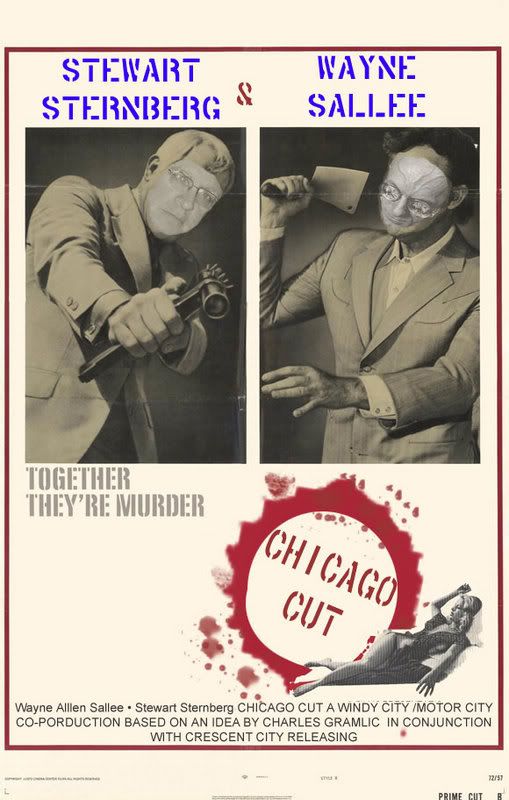
Charles suggested--and Kate seconded, I think-- that a great high concept idea might be a battle between Wayne and Stewart.
My thoughts first went to a horror pairing a la Freddy vs. Jason, but then it occurred to me that Wayne and Stewart are from Chicago and Detroit.
Of course it would be a manly action picture. Two fierce competitors squaring off. Two men enter, one man leaves and all that.
Click the pic for a larger view.
(I know, I could have spent more time on the faces, but that wouldn't be as much fun would it?)
(No rights to original image implied.)
Wednesday, August 01, 2007
Is the concept high?
Dean Koontz recently released a podcast regarding his new novel, The Good Guy, and he notes it's one of several high concept books he's offered up of late. It's sort of a "put your typing fingers where your advice is" exercise, he explains.
He tells beginning writers that high concept--something that can be summed up in a sentence or two--is easier for publishers to latch onto. Faced with those who noted many of his books aren't so simple, he decided, starting with Velocity to turn out some thrillers that are both worthwhile and high concept.
Velocity - Guy gets a call from a killer who forces him to choose the killer's next victim.
The Husband - Working man gets call his wife has been kidnapped and he has to come up with $2 million he doesn't have to save her. (Or maybe it's thriller meets Running With Scissors.)
The Good Guy - Wrong man is mistaken for hired killer and sets out to save the intended victim.
Koontz places an average guy at the core of each situation, offers a deep and involving look at his soul, and keeps the pages turning. That mixture certainly dovetails with Charles' recent discussion on the importance of character and thrills. (Who cares if the guy's running with scissors or from scissors if you don't know who he is?)
I think my new project is high concept though I won't jinx it by offering that sentence here.
Maybe I'll just throw out some random ones. Maybe, just maybe it's an exercise that can cure writer's block:
The Exorcist meets Die Hard.
Mr. Smith Goes to Washington meets The Devil's Rejects.
North by Northwest meets The Seventh Seal. (Think about it: Death in a crop duster chasing Cary Grant.)
Play along at home if you like and stop chuckling. This is how Frankenstein Meets the Wolf Man came about. Curt Siodmak was joking around about movie titles at the Universal commissary one day and wound up with an assignment.
He tells beginning writers that high concept--something that can be summed up in a sentence or two--is easier for publishers to latch onto. Faced with those who noted many of his books aren't so simple, he decided, starting with Velocity to turn out some thrillers that are both worthwhile and high concept.
Velocity - Guy gets a call from a killer who forces him to choose the killer's next victim.
The Husband - Working man gets call his wife has been kidnapped and he has to come up with $2 million he doesn't have to save her. (Or maybe it's thriller meets Running With Scissors.)
The Good Guy - Wrong man is mistaken for hired killer and sets out to save the intended victim.
Koontz places an average guy at the core of each situation, offers a deep and involving look at his soul, and keeps the pages turning. That mixture certainly dovetails with Charles' recent discussion on the importance of character and thrills. (Who cares if the guy's running with scissors or from scissors if you don't know who he is?)
I think my new project is high concept though I won't jinx it by offering that sentence here.
Maybe I'll just throw out some random ones. Maybe, just maybe it's an exercise that can cure writer's block:
The Exorcist meets Die Hard.
Mr. Smith Goes to Washington meets The Devil's Rejects.
North by Northwest meets The Seventh Seal. (Think about it: Death in a crop duster chasing Cary Grant.)
Play along at home if you like and stop chuckling. This is how Frankenstein Meets the Wolf Man came about. Curt Siodmak was joking around about movie titles at the Universal commissary one day and wound up with an assignment.
Subscribe to:
Posts (Atom)
