Showing posts with label H.P. Lovecraft. Show all posts

Wednesday, March 10, 2021

Giving The Lovecraft Investigations a Fair Listen

The Lovecraft Investigations
When I heard BBC radio was doing an adaptation of H.P. Lovecraft's "The Case of Charles Dexter Ward," I was interested. Then I realized when episodes written by Julian Simpson became available that the storyline was being updated.

I found that notion a bit off-putting. I'm usually open to adaptation and reinterpretation. I love Stuart Gordon's Dagon, though I would have loved to have seen his original, period adaptation of The Shadow Over Innsmouth he wanted to make. Something just didn't quite seem right about contemporary-set stories when I sampled.

Then, after two full series of The Lovecraft Investigations unfurled, a friend mentioned he was really enjoying it. That prompted me to revisit, and especially since it could be downloaded as a convenient podcast, I dived back in.

And found it addictive. The premise for the updating is that the stories are part of an ongoing show within a show, a true crime-investigative podcast. When the focal characters, Kennedy Fisher and Matthew Heawood, begin to look into the disappearance of Charles Dexter Ward their focus turns toward the paranormal.

Familiar elements of the original Lovecraft story prove to be the tip of a weird iceberg that incorporates Lovecraftian plot and characters and modern urban myth such as, later, the Rendlesham Forest UFO incident. Dashes of Aleister Crowley and rocketeer-occultist Jack Parsons go in the mix as well.

Once I'd surrendered my thinking the approach, I was absorbed and along for the ride and ready to country hop and roll with the found-footage-on-audio approach. Kennedy rarely turns off her digital recorder, and she frequently manages to get material uploaded for Matthew to listen to even if she's disappeared for a while, down a dark cavern or somewhere in the Middle East.

Deeply immersed, listening in a dark room without distraction, some genuine Lovecraftian shivers creep into the mix as well, and there's the fun game of deciding what's incorporated where. 

In Innsmouth, for example, it's Kennedy who catches a bus to the mysterious coastal burg, though references to a similar visit by one Robert Olmstead get stirred in. 

I'm a few episodes from the conclusion, and the bonus. 


All episodes are here or wherever you get your podcasts. 


Friday, June 28, 2019

Quoth the Raven Interview


Note: Tiffany Michelle Brown, who's also a contributor to Quoth the Raven, a contemporary reimagining of the works of Edgar Allan Poe, edited by Lyn Worthen, conducted this interview with me a while back. It had a lot of fun questions and brought back memories of my dad, so I thought I'd share it here.   


The Quoth the Raven anthology by Camden Park Press celebrates the eerie and influential legacy of Edgar Allan Poe. What is it about Edgar Allan Poe’s work that speaks to you (perhaps from the grave)? 

I think Poe strikes me on two levels. The full scope of his work conveys a mood. It captures the essence of shadow, the dark, grim recesses of the world and the psyche. I was telling someone else that when I was very young, four or five, my dad read me “The Raven.” I didn’t fully understand it, but I picked up enough to be terrified by the pervasive presence plaguing the narrator. That dark tone reverberates through all of Poe’s work in a remarkable way. I guess that’s the visceral impact. Knowing of Poe’s life and challenges, I think, strikes the rational mind. It’s fascinating to see the torments and trials filtered through his artist’s thinking. It’s a glimpse of literary alchemy, and it generates appreciation and sympathy at the same time. What a brilliant and tormented artist.

Pick three adjectives to describe the story/poem you wrote for the Quoth the Raven anthology.

Human. Dark. Infinite. I know those aren’t all labeled adjectives in the dictionary, but if you use them like this, they modify: A human story. A dark story. An infinite story.

Imagine you’re in an old-timey elevator, a rickety one that boasts a well-worn, rusty cage. There’s a man in all black in the elevator with you, and he asks what your story/poem is about. What do you tell him? 

It’s the story of a man who think’s he’s average and ordinary, but actions are swirling around him that will drive him to extraordinary measures using the tools he has at hand, the tools of which he's a master. Choices reveal an almost calm and unexpected cunning and suggest he may be tapping into the very darkest part of his own soul and some collective soul as well. Whew, how’s that? I think that’s something a man all in black in an elevator might relate to.

Okay, I’m continuing with this scenario thing. It’s 1849, and you’re at a gathering of literature lovers, a salon, if you will. Across the room, you spy Edgar Allan Poe, and you simply must go over to him to compliment his work. What is the story or poem of his that you laud to excess? And why? 

I have a second to think, right? I’d be very prone to babble, because I can imagine the look I’d get back from Poe as I touch his shoulder and interrupt his thoughts. I think I’d babble also because there are so many stories and poems that come to mind and possibly I might say something goofy like: Do you know your name is also the first three letters of poem? Oh, you’ve heard that? With a moment to compose myself, I’d settle on mentioning “The Cask of Amontillado,” which is the antecedent for my Quoth the Raven story “A Cooler of Craft Brew.” I encountered it first in high school, and it’s the first Poe story I approached on that visceral and intellectal level at once, and having approached it again, I see the depth of its horror even more in its concise length and the brilliance of its execution as well. There are elegant, grim choices that really set its hook deep, perhaps more so a few seconds after the last words are read.

As a writer, what do you think are the most important elements of dark fiction?

Stephen King writes of what he calls “The Terror” in Danse Macabre, kind of the ultimate level of horror fiction and impact. We feel a breath, turn but there’s nothing there, as he puts it. I think that level really involves suggestion and providing a reader’s imagination just enough to work with. It’s about dropping a hint that invites visualization and contemplation. H.P. Lovecraft was an afficianado of Poe. I think he saw and distilled some of that dark essence from Poe’s work. Shocks are good. Shocks are punctuation points that throw us off balance, but ultimately, forcing the mind and imagination to work and keep working are where dark fiction is at its most powerful.

Ray Bradbury does it in “The October Game.” He doesn’t focus directly on gore. He provides building blocks so that we have an impression of something happening in the dark, then literally he leaves us to look on the horrible scene in the light with the story’s very last line. In a bit of rare restraint, because it stems from Bradbury’s pen, I suppose, the EC Comics adaptation of that story from the fifties gets it right. We’re left with a final panel of shocked faces instead of a typical EC final panel, and that gives us something we can’t escape by closing our eyes. We know what they’re seeing. We’re imagining it. It’s like Bradbury’s channeled the old Zen maneuver: “Whatever you do, don’t think of a pink elephant.”

As a reader, why are you attracted to dark fiction? Why do you think we like to read about the things that terrify us?

I think it’s because my father scarred me by reading me Edgar Alan Poe when I was four. But seriously folks, Kafka said we should read stories that wound and stab us and that if the story doesn’t break through the ice within us or deliver a blow to the head that wakes us up, why are we bothering? Many meditations about conflict and catharsis have been written as well. Deep down, I think there’s a logic to dark fiction and that resonates and satisfies us. It kind of offers a capsule of a bigger, messy, complicated world, a snapshot of a dark moment we can contemplate and from which we stand to glean some understanding.

What’s a story or poem – by any author – that has truly creeped you out (in the best way possible, of course)? What was it about that particular story that just got to you?

Wow, I guess, top of my head, it’s “The Raven” that I mentioned earlier. It put me in that lonely, isolated room with the narrator, and in that isolation and darkness when the tapping begins so does the terror. It’s so pure and basic, and it’s with me years and years and years later.

Who are some of your literary inspirations?

Poe really is an early one. I guess, at least when I was a young person, he was a staple for parents and educators. We had a collection from Whitman, the publisher that did all the TV tie-ins when I was a kid and offered Trixie Belden and Tarzan and the like. Edgar Rice Burroughs thrilled me when I was a kid, the books and comic book adaptations that my father also read to me. This could be a long list, H.G. Wells, Sir Arthur Conan Doyle, Robert Bloch. Later Raymond Chandler and Ross MacDonald. Lovecraft and Stephen King come a little later still. Ray Bradbury, August Derleth, Seabury Quinn, the Weird Tales writers who were collected in horror paperbacks when I was in junior high. Like everyone who puts pen to paper, I think there are countless influences.

I’ve always loved the dedication page to the novel Logan’s Run that touches on everything from The Green Hornet to Dangerous Dan McGrew. So, that.

What are you currently working on right now?

I’ve been working on a New Orleans noir novel for a while. It’s called Fool’s Run. I’ve finished a draft, done the heavy lifting, so I’m letting it sit a bit. I think if you do that, then you can delve back into a work and see if it really says what you thought you were saying. I picked up the notion of something growing cold to the author’s eye from an online conversation with thriller author Joseph Finder, so I should acknowledge that. I like to say at the moment I’m on a bit of a vacation as well, writing short stories such as “A Cooler of Craft Brew.” Short fiction’s fun and statisfying. I get back to short stories whenever I can.

Sunday, November 18, 2018

Eldritch Horror of A Rural Kind - New Lovcraftian Tale


One of my students graduated a while back and set to work launching a very nice publication called Aphotic Realm. It's always filled with full color art and stories.

He asked me for a story a while back to fit the theme for an Eldritch issue. Sometimes a request triggers a burst of fresh creative energy. I sat down and wrote a story called "Shotgun Wedding" that I'm very proud of. 

It's a bit of a rural eldritch tale that riffs off a bit of folklore and tips a hat to the Cthulhu Mythos. 

It's Halloween night and a knock at a family's door leads to an invasion by armed men with whole-head animal masks.

Family secrets and much more unfold from there. 


Sunday, March 05, 2017

Disciples of the Serpent Lovecraftian Novel Cover Reveal


Order from:


Here's the cover art for my new novel Disciples of the Serpent with artwork from multiple Hugo-winner Bob Eggleton.

My entry in the O.C.L.T. series is a Lovecraftian tale set in Ireland. Here's the full synopsis:

In Dublin, Ireland, academics and historians are dying. An unidentified venom is to blame. Strange markings from deep in the Emerald Isle’s past suggest adherents to lost and forbidden knowledge may have reorganized. Detective Aileen O’Donnell of Ireland’s National Police Service, An Garda Síochána, has never heard of the agency’s sub rosa unit devoted to investigation of the strange and paranormal. That is, until a shooting incident leads to her suspension from the Special Detective Unit.

While awaiting disciplinary proceedings, she’s pressed into service by the secret division to investigate the deaths and what might be the tip of a conspiracy and academic cover-up. Soon O’Donnell’s teamed with Geoffrey Bullfinch and Wendell "Mack" Macklemore of O.C.L.T. On a race through medieval ruins and holy sites, she must collect puzzle pieces, fragments from a forgotten pulp writer and bits of secret Druid history to stop the shadowy band of disciples before it awakens something long sleeping beneath one of Ireland’s most famous landmarks, something modern technology and firepower can’t defeat.

 This novel, which stands alone, is a tie-in with the ongoing O.C.L.T. series. There are incidents and emergencies in the world that defy logical explanation, events that could be defined as supernatural, extraterrestrial, or simply otherworldly. Standard laws do not allow for such instances, nor are most officials or authorities trained to handle them. In recognition of these facts, one organization has been created that can. Assembled by a loose international coalition, their mission is to deal with these situations using diplomacy, guile, force, and strategy as necessary. They shield the rest of the world from their own actions, and clean up the messes left in their wake. They are our protection, our guide, our sword, and our voice, all rolled into one.

They are O.C.L.T.

 Other books in the O.C.L.T. series include the novella "Brought to Light," By Aaron Rosenberg, the novel The Parting, by David Niall Wilson, the novella "The Temple of Camazotz," also by David Niall Wilson, and the novel Incursion, by Aaron Rosenberg (in which the existence of the O.C.L.T. as a cohesive unit is finalized). Another stand-alone adventure can be found The Noose Club, by David Bischoff (writing with David Niall Wilson). 

Thursday, July 10, 2014

A Lovecraftian Serial

My story Lovecraftian story "Sleepers" is being serialized over at Paper Tape.

It began when I was thumbing through vinyl albums one afternoon in an antique store. I ran across a Broadway cast album for a show I'd never heard of, and my mind started turning that over.

What if there was a show that had opened and closed very quickly, and what if most materials related to it such as the sheet music disappeared?

What might be behind that?

I started playing with the notion, and I started to think about Aubrey Slater, a woman employed to find obscure items that couldn't be located on ebay.

What if the only remnants of a lost play could be found in London, where the original version was staged in the fifties in the West End?

I sent Aubrey to find out, feeling for her the whole time as I realized she was a mother estranged from her child for a variety of reasons, some her fault, some not. But she was also a researcher on a quest, with clues gradually pointing to more than a failed musical of interest to a few fans.

The result starts here and will continue in four parts over the next four weeks. It's kind of fun to be doing a little literary experiment like this. Check it out if you get a chance. 

Sunday, January 05, 2014

The Maze - 1953 Atmospheric Horror


Trailer

A friend's post on Facebook recently pointed me to the 1953 film The Maze, an atmospheric thriller with a Lovecraftian feel.

The story is based on the novel of the same name by surrealist Maurice Sandoz and was directed by William Cameron Menzies. 

I liked it. There's plenty for a contemporary viewer to take exception to, but if you're in the right mindset, it's a moody and interesting little ride, originally offered in 3D.

The story focuses on Kitty Murrary played by Veronica Hurst. She and her aunt are hanging out on the Riviera with her fiancé Gerald (It Came from Outer Space's Richard Carlson). They're obviously beautiful people of the day, those people Tom Ripley would love to hang out with.

Gerald's unfortunately called home to the old family castle when his uncle dies just weeks before he wedding date. 

In one of the obvious 3D moments, a bellman thrusts a cable at Kitty a short time later. Gerald writes that he can't marry her, though he promises to always be faithful to her. Have a nice life.

Kitty's not one to let a fiancé off that easily, so with her aunt in tow, they head to the cable's return address to find Gerald greying at the temples, a sure sign he's been under a good deal of stress.

He's not particularly welcoming, but Kitty offers enough excuses for an overnight stay, then connives to get a letter out inviting friends including a physician to come for a few days. The mysterious male servants lock people into their rooms at night, but otherwise it's an interesting spot for a few days' stay.

Oh, and the castle overlooks the maze of the title, a network of hedges where at least one female servant's perished under mysterious circumstances.

Without spoiling too much the plot points toward the payoff in the third act, so the journey is in the buildup. Your enjoyment of the film will be affected by your ability to accept that style of storytelling as well as your ability to tolerate classic Doctor Who-style special effects.

If you can reset just enough, the shocks are kind of fun and creepy, and, well, again if you're in the right viewing mode, kind of shocking.

If you like atmospheric horror and you have a little patience, check it out.

Aside with mild spoilers

The novel upon which the film is based is apparently inspired by the legend of The Monster of Glamis, also inspiration for Joseph Payne Brennan's "The Horror at Chilton Castle."


Saturday, August 21, 2010

Ouroboros - A New Book That Intrigues Me

They really had me at "small coastal town," when the announcement from Dark Regions press hit my in-box.

Ouroboros, co-written by Michael Kelly and Carol Weekes, is coming out in trade paper soon, and it's going on my wish list.  

It's set in said small coastal town, and revolves around  "an ancient force" that  "stirs, drawn by the cumulative power of life and death, grief and sorrow, and ultimately, endless love."

Coastal towns, those post-card-familiar places, have always seemed perfect for tales of fright. Maybe it's because one of the first scary stories that captured my imagination was "The Shadow Over Innsmouth," title story in a Scholastic book club collection, though Captain Company in the back of Famous Monsters of Filmland had teased me with H.P. Lovecraft
titles for some time before that.


It was OK with my parents to order from TAB, The Teen Age Book Club, if not from Famous Monsters back pages.

Dark Regions reports Ouroboros  is the tale of Tom Christiansen whose wife of 35-yearshas passed away. As he grieves, the lines blur between real and unreal, and a strange, pale girl shows up in his back yard.

Sounds like a perfect autumn read, so maybe I'll get it for my birthday

Wednesday, December 13, 2006

Times it will always be

A meditation by the narrator of A Separate Peace by John Knowles notes there are moments that essentially get frozen in the memory. For him it's the era of his school days. Roosevelt will always be president, he'll always be in high school, he says, and so on.

I keep thinking about that passage as I contemplate a favorite story I need to re-read, Sticks, by Karl Edward Wagner. Wayne Sallee, who was close to Karl, has written eloquently about him in a couple of posts, including this one.

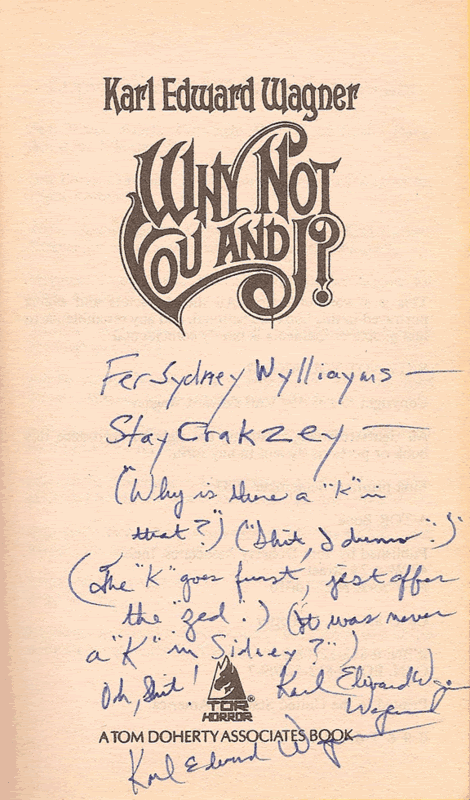
Wayne's notes and going through my books, still for Library Thing, thumbing my paperbacks of In A Lonely Place and Why Not You and I, have me thinking about the days I went to a lot of conventions. Karl Edward Wagner always seemed to be there, everywhere, and doing something crazy.

I remember him coming into a panel room once and grabbing a table cloth to throw it around his shoulders or opening a panel discussion on monsters by affecting an instructor's monotone and saying: "We are here today to discuss the care an maintenance of the CXL small engine..."

I remember him acting like a professional wrestler and trading insults, boasts and challenges with Charles L. Grant

In my mind, that's a time it will always be. A floating universe somewhere, where time hasn't moved along so rapidly.

I read "Sticks" first in that big collection of horror stories edited by David G. Hartwell. It's collected in In a Lonely Place, which I bought along with a couple of the Kull books right after KEW died, selfishly worrying they would quickly become hard to find.

Related Posts Plugin for WordPress, Blogger...