Showing posts with label Favorite Stories. Show all posts

Monday, October 21, 2013

Favorite Short Stories: The Hospice by Robert Aickman

I've discovered a new favorite thanks to a friend on Twitter.

It's one of those tales that keeps you pondering while causing a subtle touch of eeriness.

It perhaps delivers that kind of imaginary fear Stephen King dubs "the terror" in Danse Macabre. That's the feeling that comes not when a machete is raised but when, as King notes, a tingling wisp of breath tickles the back of your neck. You turn around to find no one there.

I'm speaking of "The Hospice," a tale by the late Robert Aickman, British purveyor of horror without definition.

 It should come as no surprise to me. I read "The Swords" in Cold Hand in Mine years ago, and its final lines have lingered with me ever since, proving the collections epigram: "In the end, it's the mystery that lasts and not its explanation."

It's a thought not unlike Kelly Link's answer to the first question on her FAQ. Why don't your stories have endings? With an ending, you might find satisfaction. With a question, a mystery, you keep pondering.

I've done that with "The Swords" since about 1978. I may not have as many years left in me to ponder, but I'll mull "The Hospice" for a while thanks to Jared Sandman aka @JaredSandman.

I shared a "favorite short stories" post with the Twitterverse, and we got into a "that story reminds me of this story" conversation.

He mentioned a Joseph Payne Brennan story I'd cited from Shadows 7 made him think of "The Hospice" found in the hefty Masterpieces of Terror and the Supernatural.

Happily I owned that volume, so I pulled it out and read the Aickman tale.

It's strange and ambiguous, of course. A British traveling salesman named Maybury is forced by an associate to take one of those short cuts that never work out.

Lost and low on gas, he happens upo the hospice of the title and opts to stay the night. It's no run of the mill road side rest stop, but it's not Hostel either.

Before long, Maybury's sitting for a meal and discovering the staff's not happy when you don't clean your plate even though they're delivering substantial portions. Coffee they're short on, however.

Things only get stranger. There's no phone for Maybury to call his wife when he determines he'll have to stay the night, and when he stays over, rooming with a longtime resident, he hears mysterious cries in the night and experiences other eeriness. Was that his roommate that returned after a wee hours departure or someone else?

The reader can make an obvious choice about the hospice and about Maybury's fate, especially since there's deep symbolic suggestion in the final scene, but Aickman does not connect the dots.

He leaves it all for the reader to contemplate, just as he does the meaning in "The Swords." That resonates and delivers a little more satisfaction than an ax murder. 

Thursday, October 10, 2013

Favorite Short Stories: The Calamander Chest by Joseph Payne Brennan

Once upon a time, I was asked to read a scary story for a grade school class. I think I'd written some young adult stories by then, but I didn't think I had anything appropriate for kids in single digits.

I set out to find something suitably spooky that might chill without traumatizing. I took a trip to the library and browsed collections in the children's section until I ran across Thrillers and More Thrillers edited by Robert Arthur. I honed my reading skills on the Arthur-created The Three Investigators, so I was drawn to his name.

Thumbing through the pages that promised to present phantom stagecoaches and more, I ran across Joseph Payne Brennan's "The Calamander Chest."

I'd read Brennan but never that tale, which appeared first in Weird Tales. Perhaps the illustration of a ghostly hand caught my attention first.  I took the book home and curled up with the story, and I soon decided it should work well for what I needed.

It told  of Ernest Maxx who, while browsing a second hand shop, happens upon a chest of "genuine Calamander wood" from the Indies. The proprietor seems happy to part with it for a pittance, but Maxx dismisses that hint, thinking the next time he changes housing, the chest will prove useful.

Never, never, never buy a mysterious chest the shopkeeper wants to get rid of. Before long, Maxx is awaking in the wee hours to notice a ghostly hand slowly rising from the box:

"He sat motionless, overwhelmed with sudden horror, his eyes riveted on this appalling object.
It just hung there unmoving, a long, pale finger with a heavy knucklebone and a black nail."  

It happens again and again until Maxx, angered at first by the intrusion, eventually tries to fight the finger and then to get rid of the chest. He ultimately must learn of the dark secrets it once contained.

What's Maxx's fate? To say more would spoil the fun.

The image of that ghostly hand tweaked my imagination, and it enthralled the kids in the classroom when I read it as well, and I revisit the tale from time to time.

With my imagination engaged and most of the lights turned out in the room, it can still bring a shudder.

It's a great choice for Halloween reading whether you're a kid or not.

Tuesday, August 06, 2013

Favorite Short Stories: The April Witch by Ray Bradbury

Long before paranormal romance had been named, Ray Bradbury imagined his Elliott family, a clan of supernatural beings that rings a little like the Addams Family with a deeper tinge of melancholy. The tales are collected in the fix-up novel From the Dust Returned. 

I read a while back--all right it was a year ago, time flies--that a movie might be developed from the stories.

That might be fun.

The tales are filled with Bradbury's special magic, which can be at its best when sadness is acknowledged as a part of all things.

In "Homecoming," a core piece in the cycle, there's sense that once frequent reunions are becoming sporadic for the Eliotts, and bits of decorative black crepe paper flutter through subsequent stories, suggesting remnants of grander days as we learn more about the winged Uncle Einar and about the magical Cecy.

She's often pivotal to the tales but never more so than in "The April Witch." Told that the family can't marry humans without a loss of magic, the teen Cecy is devastated. She wants more than anything to be in love.

Since her abilities allow her to inhabit humans and things, she decides she'll experience love second hand.

As a leaf, she flutters into the world of Ann, a young woman in a farming community. Then, leaping into Ann, she forces a rekindling of interest with a young man named Tom.

Ann's resistant, to any romance, even to an outing, but with effort Cecy is able to override some decisions. That means a dance and enough proximity to Tom for Cecy to fall in love,  if it doesn't work for Ann.

The longing impels the story toward a culmination as poignant as Bradbury's other small masterpiece "The Foghorn."

It's fantastical, odd, eerie, offbeat and wonderful, a contemplation like no other of a "what might have been."

Wednesday, May 09, 2007

Favorite Stories: Don't Look Now by Daphne du Maurier

(On this eve of The Daphne du Maurier International Centenary Conference, it seems an appropriate time to discuss another of my favorite horror short stories.)

I was introduced to the works of Daphne du Maurier at my aunt's house on a visit. She had a book club edition of The Scapegoat in which a man becomes the dupe of his identical twin.

I knew nothing of Rebecca at that point nor of the author's short stories including "The Birds" which have an even darker tone than her novel-length thrillers which frequently attracted Alfred Hitchcock.

"Don't Look Now" is of course the basis for an intriguing, eerie thriller directed by a different auteur, Nicholas Roeg, most notorious for its extended, steamy love scene between Donald Sutherland and Julie Christie.

That scene stems from a single sentence in the source material, but it's generally a faithful adaptation of du Maurier's short story of a couple vacationing in Venice and vicinity. (In the film it's a working vacation as the husband works on a church restoration project. Incidentally there's word that a remake is coming, but why?)

In the story it's simply a holiday and a somber one as the couple copes with the death of a daughter. One son remains in boarding school, but the loss of their little girl has been devastating to the wife, Laura. The "girl meant everything," notes John, the husband.

The story opens with the couple making jokes about elderly twin sisters at a nearby restaurant table, but Laura's encounter with one of the twins who is blind and claims to be psychic sends their holiday on a strange, eerie course.

It is a story of questions. Is the blind twin really seeing the spirit-world version of the lost daughter as she claims? Or is she a con artist?

John is skeptical, but as they wander old world streets, they catch site of a child who could be a ghostly version of their daughter.

Everything is interrupted by word that their son is in need of appendicitis surgery. They decide Laura will go home immediately, and John will follow with their car.

But as he returns to their hotel, John sees Laura on a passing boat with the twins and begins a frantic search to find hear amid rumors that a "maniac" is prowling the city.

The ending comes with a pair of twists, one odd and bizarre, and evokes an eerie, unsettling chill.

I like the tale because it's like many of those pieces that's more than it seems at a glance. It offers strong mood and perplexes. It's quiet horror to be sure, one of those tales that keeps you contemplating long after you've finished it.

(Pictured is the short story collection I own, which includes both "Don't Look Now" and "The Birds.")

Tuesday, February 20, 2007

Favorite Short Stories: Talent by Robert Bloch

Try thinking of Robert Bloch but not getting "author of Psycho" on the same brainwave.

If you're schooled at all in the classics of the horror genre that's a double bind roughly like "don't think of a pink elephant."

Certainly Psycho is a major jewel in his crown, but its sparkle blinds the eye to many other fabulous works including the humorous Bloch, which I discovered on those Sunday afternoons of my early teens that I devoted to reading scary tales between Sunday dinner and the end of my parents' naps when it was OK to go outside again.

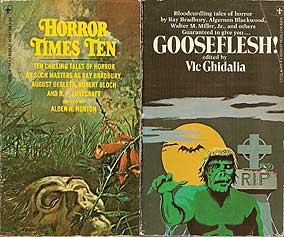
After Horror Times Ten and Gooseflesh, another collection came along, purchased from the paperback rack at the local drug store because the fiery red face of Dracula himself graced the cover. I'd read an interview with Christopher Lee in Monster Times around the same time, so I knew he was a reader of scary tales as well as a star of Hammer Films.

From the Archives of Evil features 10 tales, all introduced with a few paragraphs from Lee, though it is co-edited by Michael Parry. Alas, it is the first of two collections, but I never ran across the second.

In the cauldron
Stirred into that cauldron is Bloch's Talent, a 1960 story about Andrew Benson, a war orphan left on the steps of a Pasadena children’s home. The tale unfolds very matter-of–factly.
What is Andrew’s Talent? He’s a mimic. He can do Groucho Marx, other kids and the villains--always the villains--from Western movies.

Fortunately, the nuns at the orphanage are selective in what they let Andrew watch, so he's not exposed to excessive violence.
Until he's adopted, perhaps because he makes himself resemble the first child of the grieving couple who've come in search of a replacement.

Shapeshifting?
Is Andrew a shapeshifter? Word has it from one childhood friend he had a Jekyll and Hyde quality.
The narrator cannot offer proof of dark deeds on Andrew's part. He can only offer parallels.
Not long after the release of Man in the Attic--featuring Jack Palance as a Jack the Ripper-type--several similar murders occur in Andrew's area.

Then there are werewolf killings in the mid-'50s, roughly the time the Universal horror movies are being revived on television. That's just the start.

"Talent" is a brief masterpiece from Robert Bloch, dark of humor and sly of style with a final line that, like so many of Bloch's, wraps everything up fabulously.

Thomas Montleone once wrote a column listing Bloch among the overrated in the horror genre, postulating that because he was a very nice man he was granted a degree of grace.

I beg to differ. "Talent" is a fine exhibit to refute that contention. A fine example of Bloch's talent.

Tuesday, December 12, 2006

Favorite Short Stories: Charles Beaumont - The Howling Man

Since we've been having fun discussing classic horror short stories and Richard Matheson and all that and since it's on my mind because I've been working on my Library Thing catalog, I thought I'd mention another of my favorites - "The Howling Man" by Charles Beaumont.

It's included in Charles Beaumont: Selected Stories from Dark Harvest, and was adapted into one of the most kick-ass episodes of The Twilight Zone ever.

If you've never seen it, wait up for it on Sci-Fi Channel the next time it airs! Seriously.

Originally published in 1959 in Rogue, which can be found on ebay listed as a "vintage men's magazine," it's a study of evil.

On a walking tour of Europe, the tale's protagonist encounters a group of monks who have the devil imprisoned, of course he's in his "angel of light" guise to the hero.

From outward appearances it seems they monks are a little off and the poor guy they have trapped is the victim of mistaken identity who won't shut the hell up! Hence the howling man nickname.

I finally got to see the TZ episode on WGN in the '80s and I've watched a few more times on Sci Fi re-airings. It's a wonderful black and white rendering with plays of light and lightning, skewed camera angles and SPFX as well.

The story is rich and symbolic, faithfully interpreted for TV but it should be read as well. If you've loved Beaumont, leave me comments.

If not get to a bookstore, mail order house or library. Now, do it. Don't just sit there.

Sunday, December 03, 2006

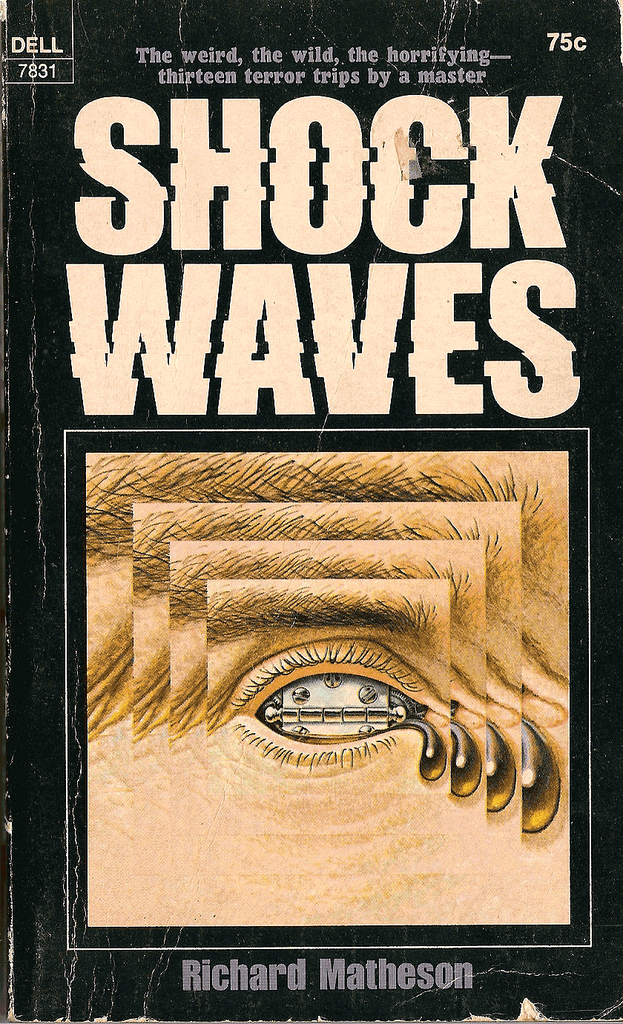
Shock Waves

One of my favorite collections of horror short stories or horror and suspense stories is Richard Matheson's Shock Waves.
I don't know that it contains his best tales for there are many including a number of stories that became Twilight Zones.

But it's a book that got me through a whole lot o' boredom once, so I hold it in high regard.

It was near Christmas one day in the '90s and I was called for jury duty. I'd bought the Matheson book used fairly recently so I tucked in my jacket when I left home that morning.

And while I sat through the preliminary selection process and voir dire, I read Matheson stories - "A Visit to Santa Claus," "Finger Prints" and a host of others.

One that I remember vividly still is "A Drink of Water." It's not a horror story exactly, but it at least is a tale of desperation.
It's about a guy who's been to a movie one hot August night, had some popcorn and upon arriving home decides he needs a drink of water since the popcorn was salty.

Sounds simple, but when he reaches his apartment he finds the water's been shut off due to one problem or another.

He's got no water in the fridge, and every avenue he pursues fails him for the next six or seven pages. I was right along with him in that tale, desperate in my own way, trapped in one of those processes from which there's no escape.

You just have to endure and hope you come out the other side.

A good book full of cool stories can make the trip more bearable.

Did the story's hero ever get a drink? Well, I suggest you look up Shock Lines. It's well worth a read.

Friday, September 15, 2006

Great Horror Short Stories - A Psychical Invasion by Algernon Blackwood

I love pyschic investigator stories, forerunners to the X-Files and Kolchak, many penned in an era of spiritualism and mysticism around the turn of the 20th century.

One of my favorites is "A Psychical Invasion" (1908) by Algernon Blackwood. It features Fox Mulder's spiritual grandfather, John Silence. (Read it online here.)

Silence is one of those physicians who stretches his intellect beyond the challenges of his medical practice, and "Psychial Invasion" is one of his most exciting cases.

Lucy in the Sky With Diamonds
Silence is called on to help a haunted writer who, following essentially a psychidelic drug experience, is hearing colors and having conversations with inanimate objects not to mention being opressed by an unseen presence who compells him to draw her likeness.

Silence sets out to dehaunt the young writer's house using a collie named Flame and cat named Smoke, animals being highly attuned to spiritual activity.

The dehaunting is a task as challenging as just about any besides Shirley Jackson's Hill House.

Saturday, August 26, 2006

Favorite Short Stories: The Lonesome Place by August Derleth

"The Lonesome Place" is a classic horror short story that's always stayed with me. It's about fear breeding fear essentially, and it really leaves the horror to your imagination.

It's from the pen of August Derleth, who's a recognizable name to most serious horror fans but may not be to casual readers of today. If you have not read him, catch up.

He became the custodian of the Cthulhu Mythos after H.P. Lovecraft's death and carried it on, founding Arkham House. He also penned stories about Solar Pons, a Sherlock Holmes-like detective. Then there are also Sac Prairie tales of the Midwest and much more.

I read "The Lonesome Place" first in the great horror collection I've mentioned before "Horror Times Ten." It originally appeared in a1948 issue of the pulp magazine Famous Fantastic Mysteries.

Once upon a time, I read a story from Horror Times Ten every Sunday afternoon, or from the collection Gooseflesh I bought along with it. Guess that went on for 20 weeks at most but it seems like a whole chunk of my early teen years.

Reading for a lonely October
"The Lonesome Place" is chilling even for afternoon reading, but it's perfect for any midnight and perhaps well suited for a chilly autumn night -- the kind of night describe in the story or at least that I think of when I read it.

It's set sometime in the early mid-20th century, when kids might still be sent to a corner grocery for a loaf of bread after dark and where monsters of supernatual origin fueled fears more than say John Mark Karr.

The first-person narrator's opening line explains:

"You who sit in your houses of nights, you who sit in the theaters, you who are gay at dances and parties--all you who are enclosed by four wall--you have no conception of what goes on outside in the dark. In the lonesome places."

There's one spooky spot by a grain elevator that all the kids have to pass, and everyone is convinced a monster lives there.

Derleth takes us running and terrified past that spot in the narrative, then recounts the later discussions amid friends about the thing that lives there.

Everyone adds a layer, a tail, scales and more.

And I won't say where it goes from there. I'll just say again it's, to me, one of the perfect chiller stories that focuses on the power of imagination.

I'm almost certain it was floating around somewhere in the back of Stephen King's mind or in his subconscious when he conceived It.

Seek it out if you like stories that make you shudder.

Further reading
August Derleth autobiography

August Derleth bibliography

Tags:

, , ,

Thursday, August 10, 2006

Favorite Short Stories: The Ship That Saw A Ghost by Frank Norris

When I used to hang out at conventions more than I do now, horror writers were always arguing about quiet horror vs. I, don't know, noisy horror. That's horror achieved with a whisper vs. horror achived with a chainsaw.

I ran across a piece of quiet horror last summer, penned by an author not particularly noted for his ghost stories. The Ship That Saw a Ghost sails from the pen of Frank Norris, best known to me at least for McTeague, a novel my friend's class had to read in college. I didn't have to read it. I went to a different college.

On the good ship Glarus
The short story tells the tale of men aboard a tramp steamer named Glarus on a secret and nefarious mission off the coast of South America in 1902. A visit to a lost and dangerous island promises to make the crewmates rich.

Fate has other plans, however, and to give much away would spoil the story which is available free at the link above.

I suppose the relationships of the sailors including the key mates known as the Black Crows as well as the reports of their San Francisco port of call all mesh with other Norris work.

The sense of sea life and of sailors at home is captured, but the core premise and the chills provided the imaginative reader make it a great late night read.

Put on a candle, imagine the creak and moan of a ship topping constant waves, far away from anything, then imagine being stuck in the middle of nowhere in a dead calm.

It's quite horror but its chilling.

Tags: , , , ,

Saturday, July 29, 2006

Ray Bradbury The October Game - major spoiler

Read my interview with Ray Bradbury

Really, don't read this if you plan to read the short story "The October Game" by Ray Bradbury and you don't want the surprise spoiled.

It's a really good story and I mentioned it here a while back, so I get hits from Google for "October Game Meaning Of" and stuff like that.

Since you land on the band The October Game if you do the "I'm Feeling Lucky" search in your Goo Diligence, and you otherwise get a lot of hits about degrees of success of various sports teams in the month of October, apparently there's not a definitive critical analysis of the Bradbury story out there online. (Not that this is going to be, but I do what I can.)

Cosmic Ray
Many people think of Cosmic Ray as a science fiction writer, and he did his share of Martian tales and things from outer space, but in the pulp days especially--and if you watched The Ray Bradbury Theater you know this--he penned his share of tales of terror.

"The October Game" is copyrighted 1950 in the collection I own (Gooseflesh pictured with my other favorite old time horror collection above.), although Wikipedia lists it as 1948. At any rate, the story is a masterpiece of suggested horror. It evokes literally visceral imagery without stating it and leaves a chilling, unsettling after effect. For many readers--me, me I'm one of those--remember it for years.

"Revenge is the best way of gittin' even." -- Archie Bunker
It's a tale of revenge, a horror achieved without graveyards or magic and with ghosts and witches only in costume or imagination.

It's Halloween, you see, and the bow-tied and cufflink wearing protagonist, Mich Wilder, I think, is contemplating a way to hurt his wife, Louise, as the tale opens. He rules out murder because he's seeking revenge with "duration." Killing her won't hurt her enough.

Every unhappy family is unhappy in its own way
We get the impression this is a middle class family. Bradbury tells us they live in a "warm two-story house," but, relations are frigid and, by the way, Mich wanted a boy. The couple has an eight-year-old daughter, Marion, and a big Halloween party is planned. Louise has showered her affections on Marion since her birth.

A.B.C. - Marion loves the daughter very much, Mich has a bad case of cabin fever and an eight-year case of a male post partum depression.

As the party planning goes on, Mich's sense of being trapped in his existence unfolds. There's mention of failed business ventures and we are told October means winter is coming and he just can't face another Northern one.

So eventually everyone shows up for the party, and "the husband" decides to take everyone to the cellar which he proclaims "The Tomb of the Witch."

The real October game
That's where the impromptu game begins. It's one played in the dark. Traditionally grapes are passed around and the kids are told they're feeling the dead witch's eyes.

Then they get a bowl of spaghetti and that's described as "the witch's innards" and so on.

Here's where the spoiler comes in -- don't read on unless you've read the story or just don't care --

Bradbury has established the shoddy emotional state of the Wilders, the depression of the husband, the desire to produce a lasting hurt of Louise who adores their daughter. The tale is a brief portrait of a very dark domestic situation.

I really mean it - spoiler, close your eyes now...
:
:
:

Dude, those weren't grapes and spaghetti!

Order books by Ray Bradbury.

My interview with Ray Bradbury.

Tags: ,,,,
Related Posts Plugin for WordPress, Blogger...