Showing posts with label Ray Bradbury. Show all posts

Wednesday, October 19, 2022

Reviewing the Great Ray Bradbury's Home to Stay! - Tales from EC Comics

The cool folks at Fantagraphics Books are dropping a collection of Ray Bradbury's stories adapted for EC Comics publications such as Tales from the Crypt and The Witch's Cauldron. It's called Home to Stay!: The Complete Ray Bradbury EC Stories.  

It's a nicely complete volume with a rich assortment of extras surrounding Bradbury's affiliation with the shunned and banned and later celebrated EC line.

I did a review of the volume for Wicked Horror. 

Stories are reproduced mostly in black and white, though they original tales were in color. Some pieces are reminiscent of the later Warren Magazine like Creepy inspired by EC.

The book's dropping now. Here's a sample page from the adaptation of "The Lake."

Ray Bradbury EC Comics The Lake - Home to Stay!
It really is a great volume for any Bradbury fan's library. 


Tuesday, October 23, 2012

Favorite Short Stories - The Emissary by Ray Bradbury

In an essay from J.N. Williamson's How to Write Tales of Horror, Fantasy and Science Fiction,"  Ray Bradbury discussed the writing of many of his chilling stories collected in Dark Carnival from Arkham House, his first book. Many would later go into The October Country (1955).

In that piece, "Run Fast, Stand Still, Or The Thing at the Top of the Stairs, or New Ghosts from Old Minds,"  Bradbury wrote that he developed a list of nouns in his early writing life and set out to pen a story for each of those. "The Dwarf," "The Crowd," "The Jar" and many others followed.

One of my favorite of his noun tales is "The Emissary," a touching and beautifully written story that chills.

It's tells of a young boy with an illness that keeps him in bed, and the emissary of the title is his dog. Since he can't get out, he sends his the pet on missions, to bring back scents and signs and occasional friends from the outside world.

Of course, being a Bradbury story, it features the crisp and vivid sense display of autumn.


 Lying there, Martin found autumn as in the old days before sickness bleached him white on his bed. Here was his contact, his carry-all, the quick-moving part of himself he sent with a yell to run and return, circle and scent, collect and deliver the time and texture of worlds in town, country, by creek, river, lake, down-cellar, up-attic, in closet or coal-bin. Ten dozen times a day he was gifted with sunflower seed, cinder-path, milkweed, horse-chestnut, or full flame-smell of pumpkin. Through the loomings of the universe Dog shuttled; the design was hid in his pelt. Put out your hand, it was there…

It's a tale with touching moments, and it creates well the feeling isolation and illness in a past era.

Things go well until Dog fails to come home. There's worry, of course, and much more before the brief tale concludes. To say anything beyond would be to give away too much, but it is perfect reading for Halloween and for the fall and for the late night when the mind is open to suggestions of things not otherwise accepted.

It's a story to be read not with jaded, nothing-scares-me rigidity, but with a sense of dark wonder and willingness.

Check it out. It's a must in the original prose form, but it can be found in many adaptations. It was a Ray Bradbury Theater episode, was read by Tom Baker as a Late Night Story on British television and is a part of many other collections including The Stories of Ray Bradbury. Go on, give it a look, and come back and tell me what you think.

Bradbury's essay also appears in his Zen in the Art of Writing. 

Sunday, January 21, 2007

Fear and Colors

I had to get my oil changed yesterday morning since we were having a brief reprieve from rain and sleet, so I grabbed Ray Bradbury's Long After Midnight collection for the waiting room. Recently, Charles touched off some interesting discussion on the use of color to set tone and mood in fiction, noting Robert E. Howard made good use of the color black, while Stewart had some interesting comments on color in Something Wicked This Way Comes. I allowed how weather can serve in a similar fashion to set mood and tone.


While they replaced oil and wiper blades at the oil exchange, lo and behold I found myself reading a story that juggled all those elements.

The color white is used to make things eerie and ultimately redemptive in The Wish, a bit more upbeat variation of the Monkey's Paw set on a snowy Christmas Eve.

It begins with two writers in a huge, old, creaking house talking over life, death and miracles as they share wine and popcorn while the window is swept by "a whisper of snow."

The imagery continues with many wonderful poetic Bradbury touches:

  • "It was a proper night for ghosts of whiteness to visit windows and wander off."
  • "Is there a language of night and time and snow?"
  • "A gust of snow rattled the window, clung like a shroud, unraveled away."
  • "The graveyard resembled the scattered ruins of an ancient fort, blown up lifetimes ago, its monuments buried deep in some new Ice Age."

Tom, the narrator's Christmas Eve wish is to see his long-dead father again and the story unfolds from there, a story of the undead that's ghostly and touching, creating that magical Bradbury blend.

Variations of snow and white are mentioned repeatedly, like Howard's black--as Charles noted-- there without being noticed unless you're a bit primed for it.

I wish I'd discovered the tale for my pre-Christmas reading, but given the week we've had in Texas, it's nice for general winter reading as well.

Friday, January 12, 2007

Something Wicked

A major chunk of the novel The Club Dumas didn't make it into the still excellent film The Ninth Gate with Johnny Depp.

It deals with a group of obsessed fans of The Three Musketeers and its sequels, a strange, European literary underground of readers driven to celebrate the characters and intrigues of the classic Dumas works.

I thought of that enthusiasm for a classic when Stewart mentioned the culling of great works from library shelves in the interest of titles with higher circulation. It's a bookseller's approach with an effect not unlike the fire in the library at Alexandria.

Since I used to be a librarian of sorts, I was dismayed by that report. I always had the sense we were preserving knowledge in our battles against mold, dust and non-returns.

I've been re-reading Ray Bradbury's Something Wicked This Way Comes this week, perhaps one of the tales pulled from some shelves. Portions of it are set in a library, I suppose because Bradbury haunted libraries in his younger days, enjoying the titles A to Z.

Knowledge preserved proves beneficial in the fight against Mr. Dark and his evil carnival.

More and more, with everything from the culling of classics to the fragmentation of television and movie audiences, we are not sharing the same dreams en masse like the Dumas fans. We are not experiencing as much serendipitously as a culture any more if it's not Paris Hilton mania.

I don't know that I'm exactly alarmed by that, but I mull it over from time to time.

What will be the cost of that? The loss of the campfire and the shared myth? The collective dream.

What will come of us if we lose the richer language of shared metaphors? If we don't get the references to the dash of D'artagnan when it's referenced or the treachery of Milady de Winter?

What language will we speak then?

Saturday, July 29, 2006

Ray Bradbury The October Game - major spoiler

Read my interview with Ray Bradbury

Really, don't read this if you plan to read the short story "The October Game" by Ray Bradbury and you don't want the surprise spoiled.

It's a really good story and I mentioned it here a while back, so I get hits from Google for "October Game Meaning Of" and stuff like that.

Since you land on the band The October Game if you do the "I'm Feeling Lucky" search in your Goo Diligence, and you otherwise get a lot of hits about degrees of success of various sports teams in the month of October, apparently there's not a definitive critical analysis of the Bradbury story out there online. (Not that this is going to be, but I do what I can.)

Cosmic Ray
Many people think of Cosmic Ray as a science fiction writer, and he did his share of Martian tales and things from outer space, but in the pulp days especially--and if you watched The Ray Bradbury Theater you know this--he penned his share of tales of terror.

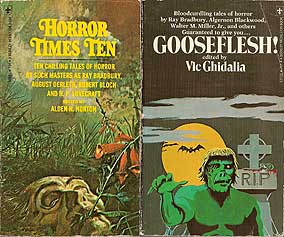
"The October Game" is copyrighted 1950 in the collection I own (Gooseflesh pictured with my other favorite old time horror collection above.), although Wikipedia lists it as 1948. At any rate, the story is a masterpiece of suggested horror. It evokes literally visceral imagery without stating it and leaves a chilling, unsettling after effect. For many readers--me, me I'm one of those--remember it for years.

"Revenge is the best way of gittin' even." -- Archie Bunker
It's a tale of revenge, a horror achieved without graveyards or magic and with ghosts and witches only in costume or imagination.

It's Halloween, you see, and the bow-tied and cufflink wearing protagonist, Mich Wilder, I think, is contemplating a way to hurt his wife, Louise, as the tale opens. He rules out murder because he's seeking revenge with "duration." Killing her won't hurt her enough.

Every unhappy family is unhappy in its own way
We get the impression this is a middle class family. Bradbury tells us they live in a "warm two-story house," but, relations are frigid and, by the way, Mich wanted a boy. The couple has an eight-year-old daughter, Marion, and a big Halloween party is planned. Louise has showered her affections on Marion since her birth.

A.B.C. - Marion loves the daughter very much, Mich has a bad case of cabin fever and an eight-year case of a male post partum depression.

As the party planning goes on, Mich's sense of being trapped in his existence unfolds. There's mention of failed business ventures and we are told October means winter is coming and he just can't face another Northern one.

So eventually everyone shows up for the party, and "the husband" decides to take everyone to the cellar which he proclaims "The Tomb of the Witch."

The real October game
That's where the impromptu game begins. It's one played in the dark. Traditionally grapes are passed around and the kids are told they're feeling the dead witch's eyes.

Then they get a bowl of spaghetti and that's described as "the witch's innards" and so on.

Here's where the spoiler comes in -- don't read on unless you've read the story or just don't care --

Bradbury has established the shoddy emotional state of the Wilders, the depression of the husband, the desire to produce a lasting hurt of Louise who adores their daughter. The tale is a brief portrait of a very dark domestic situation.

I really mean it - spoiler, close your eyes now...
:
:
:

Dude, those weren't grapes and spaghetti!

Order books by Ray Bradbury.

My interview with Ray Bradbury.

Tags: ,,,,

Sunday, October 06, 1996

Ray Bradbury Interview - Part 1

(A long time ago - 1995 to be exact, I wrote a feature story on Ray Bradbury, based on an
interview and remarks he made at Centenary College in Shreveport. Since a lot of people drop by here to read my post on "The October Game," I thought this might be of interest. In several parts - here is my story on Cosmic Ray from The Alexandria Daily Town Talk, Feb. 25, 1995.)

Ray Bradbury created the Illustrated Man for a 1951 short story collection. The man was a fellow whose flesh had become the canvas for a carnival witch who tattooed him with multi-colored scenes.

Anyone studying the elaborate mosaic on skin sees the tattoos swirl into stories. This happens to a young man on a walking tour of Wisconsin. When the man meets the Illustrated Man and becomes fascinated, unable to look away even though he's been warned against gazing too long.

The tattoos show the young man tales of technology gone awry, examinations of social attitudes, chillers about mankind's darker side.

You realize in talking with Bradbury that he is an illustrated man, this chap soetimes called Cosmic Ray. His career has stretched from the days of the pulp magazines to the present and encompassed not just the science fiction and fantasy stories for which he is best known -- about one-tenth of his total output -- but also detective fiction, memoirs, poetry, plays and essays.

Not covered with a frightening maze of images, he is nonetheless a man with a multitude of stories, which spring instead from his imagination, illustrations of a thousand wonders. The silver-haired author who also penned The Martian Chronicles, Green Water, White Whale, Something Wicked This Way Comes and more, confirms in conversation that the office portrayed in the opening moments of television's "The Ray Bradbury Theater" is indeed the land of imagination where he labors, filled with mementoes of 40 years. His favorite item: an 8-foot Bullwinkle, a gift from his daughters. ("You can imagine them carrying that in.")

He sits in that "magician's toy shop" for a telephone interview conducted in advance to coincide with his appearance at Centenary College, Shreveport, to discuss "One Thousand and One Ways to Save the Future."

I ask about beginnings, recalling an essay about a certain summer of his youth in which those in his hometown knew to steer clear because he was destined to regale them with enthusiastic accounts of tales he'd been reading. He doesn't respond to that specifically, though he answers. The year he was 8, the total field of science fiction struck his imagination. Buck Rogers was new and Edgar Rice Burroughs had already given the world not only Tarzan but John Carter of Mars, a swashbucker thrust into an almost medieval world on the red planet.

"I think Burroughs influences more young men than any other writer," Bradbury speculates. He's talked not just with other authors but scientists as well and found that shared interest with the likes of Carl Sagan and Arhur C. Clarke.

To be continued...

Saturday, October 05, 1996

Ray Bradbury Interview - Part 2

(This continues my interview with Ray Bradbury from 1995.)

It goes back further than that season of 8, back to the time he was 3 and collecting metaphors -- myths and fair tales and sips of dandelion wine. He offers those illustrations Tuesday night to the crowd of 1,500 at Centenary College's Gold Dome. Young and old have gathered. To some he's the longtime master of miracles, to others, he's required reading in the flesh; the freshman class has been studying Fahrenheit 451.

In his black suit, blue shirt and tie, Bradbury looks like a breathing version of his cover photos, standing beneath the dome's ceiling, a sky of white cubes. They seem appropriate as a backdrop. They look like building blocks for one of the futuristic cities of his dreams.

He draws laughter as he tells of how he "walked funny" after seeing Lon Chaney in The Hunchback of Notre Dame. "When I was 5, Lon Chaney made the Phantom of the Opera in 1925," he continues, then recalls the film's impact on his imagination -- he borrowed a relative's opera cape and fashioned it to his own needs, sported a set of fake fangs and dropped from trees to scare passers-by.

"There were plans afoot to drown me in Waukegan, IL.," he recalls with a chuckle.

When the laughter dies, he mentions the impact of King Tut's golden mask when he first saw it on a magazine cover in 1923. Color photos were a rarity then, and this served as his introduction to Egyptian myth.

"When I was 8 years old, science fiction magazines were beginning to appear," he recalls. "They had these fantastic covers with the fabulous cities of the future. I wanted to live in those cities."

For three months after the Buck Rogers comic strip debuted, he clipped it daily. "That changed my life forever," he says, though that change was born of pain. As he voiced fascination with the space man's exploits, friends began to taunt about guns and jet packs. "None of these things were ever going to happen," they told him, and with the stinging of their words, he tore up his collection.

"That was the dumbest thing I ever did," he recalls.

The next day he burst into tears as if he'd lost a loved one. "Who died?" he wondered and knew the answer. "I had killed myself. I had killed the future.

"I went back and collected Buck Rogers and made my life whole, and I've never listened to a damn fool after that."

He suggests audience members heed his advice in pursuing the things they love and the quest for that at which they can excel.

"The search begins in the next 10 minutes," Bradbury quips, and excuses any who need to leave and get on with it.

To be continued

Friday, October 04, 1996

Ray Bradbury Interview - Part 3

Read Part 1

Read Part 2

(Originally published in 1995)

It was when he was 12 and living in Tucson that myth and metaphor began to come together and his search moved on, he continues in his crisp Midwestern tone as our phone conversation rolls along.

He sat down that year to write his first novel.

From that illustration others would blossom and over time he would reach millions.

***
A breakthrough came as he wrote a story called "The Lake," he tells his Centenary audience. It was 1942. He'd been writing 10 years, but something was different, something had changed as that story flowed from his imagination. "I had learned to write instinctively. I was learning to write from the heart, the stomach, the soul," he says.

He began to look at things differently -- the night, the attic, a pumpkin -- and to write about them "and then proceed to scare the hell out of myself with each of these."

After a visit to his doctor, the idea for a story that became "The Skeleton" struck him, a tale of a man frightened by his own skeleton. He rushed home to write it.

"I learned when you get an idea like that you seize it," he tells his young audience with a straightforward admonition, passing on advice another writer once gave him. "Don't tell anyone what you're doing," he says.

Telling a story gives someone a chance to criticize it and to take away its joy and the energy of the enthusiasm.

"Just get it done," Bradbury says.

***
Has anyone escaped the reach of Bradbury's tales, those that came from his soul? He's touched people just as Buck and Burroughs. If there had been no Edgar Rice Burroughs, a television commentator once said, NASA might never have sent a probe to the Red Planet.

And what if there had been no Bradbury?

"The Veldt," the first story in The Illustrated Man tells of a family with a recreation center in their home that re-creates environments including the African veldt in a realistic and ultimately frightening fashion complete with man-eating lions. It was an anticipation of virtual reality, and virtual realists today call "Cosmic Ray" their father.

I ask if there are other things technological that have turned out as he once thought or feared.

Modern television is just what he worried it might become, he confides: "A lot of it is a sort of terrible horse manure that I thought it was going to be."

"I advise people almost every time I lecture not to watch local television," he says. Local news shows are all about rapes and murders and funerals and AIDS, he protests. He sees "nothing good, nothing positive" in that and warns that the weight of a thousand days of such adversities can break the spirit.

It's impossible to turn around without glimpsing the O.J. Simpson trial circus, he agrees. "The whole thing is odious."

That brings up another of his stories, "The Parrot Who Met Papa" which is collected in Long After Midnight. It's a whimsical tale which recounts the media frenzy generated when a parrot-- who perched in "Papa" Hemingway's favorite haunt-- is discovered. The world learns The Old Man and the Sea creator told the bird his last short story. Everyone wants the bird, and the story's hero has to resort to dark tactices to keep the tell-tale parrot safe.

"I love that story," Bradbury says, and it's true, it does seem to reflect the 15-minutes-of-fame culture. "We're all tempted to go kill the Queen of England and writea book about it," he says.

He's needed no such sensationalism for his own work, however. I ask someting I've always been curious about -- which came first, the concept or the title. Did he run across the phrase "something wicked this way comes" in Shakespeared and decided to write a story that suited it, or did he write a novel which seemed to fit the phrase.?

It was the latter, he answers. It all began when he met the carnival side show's Mr. Electrico.

To be continued.


Thursday, October 03, 1996

Ray Bradbury Interview - Part 4

Read Part 3

...It all began when he met the carnival side show's Mr. Electrico.

A grand tale that is as he expounds on it to the audience. "He sat in a chair and got electrocuted every night," Bradbury explains, painting this illustration so the crowd can envision the barker on a long ago carnival midway: "We are now going to put one million volts into Mr. Electrico's fragile body!"

Bradbury and friends went nightly, checking to see if one time the electric chair would work, but Mr. Electrico always survived to take up a sword and aim it at his amazed patrons.

As he pointed the sword, the guests hair would stand on end. When he aimed it at Bradbury one night, and the charge turned his hair into needles, Mr. Electrico said: "Live forever!"

Bradbury thought: "Gee, that's a great idea."

He went back the next day to ask how that could be done and encountered Mr. Electrico anew. The carnival man, a defrocked Presbyterian minister, befriended the young Bradbury and told him: "We've met before."

He saw in Bradbury the soul of a friend killed in the Argonne Forest in 1918, he said.

"What a double gift," Bradbury says. "He gave me the past and the future."

***

Another of his illustrations, more recent, comes to mind, a piece called "Banshee." I only recently learned it was based on his experiences with John Huston when they worked on "Moby Dick" in Ireland.

The story was adapted as an early "Ray Bradbury Theater" with Peter O'Toole as a film director haunted by the howl of the legendary portent of death.

Some of it really happened. Some was made up, but as with other works, Bradbury continued with the theme, crafting Green Water, White Whale about his experiences with Huston.

***

If the love of Buck Rogers was an impetus for the young Bradbury, a love of Huston's films would propel him even further on his search.

"I'd seen his `Maltese Flacon' 20 times. Paid twice," he tells his audience, explaining he once had a friend who owned a theater.

After he had three books to his credit, Bradbury asked his agent to set up a meeting with the director. That occurred Valentine's night 1951, and he handed Huston copies of The Illustrated Man, The Martian Chronicles and Dark Carnival.

In August 1953, Huston gae him a call. Bradbury's imitation of Huston's deep rasp is so accurate it's like hearing the director's old RCA commercial.

Huston asked: "How'd you like to come live in Ireland and write the screenplay for Moby Dick?"


"Gee Mr. Huston," Bradbury responded. "I've never been able to read the damned thing."

Huston told him to read as much as he could that night, and "Tell me if you'll help me kill the white whale."

By 3 a.m. Bradbury had covered about 150 to 200 pages, but more importantly he'd found the metaphors; they spoke to him, and he went in the next day and took the job, again following the path of his enthusiasm.

Huston revealed later that the story "The Lighthouse" in one of the books had led him to hire Bradbury. The piece, basis for The Beast from 20,000 Fathoms in which Bradbury worked with his childhood pal, dinosaur builder Ray Harryhausen, tells of a sea dwelling dinosaur who comes to believe a light house's fog horn is the call of a mate only to "discover it was only a damned lighthouse and a damned foghorn."

"It was that short story of yours about the dinosaur falling in love with the light house," as Huston put it, and Bradbury is imitating him again. "I thought I smelled the ghost of Melville in that story."

He learned, aside from the metaphors, he hand Melville had similar influences, he terms them midwives. Both read Shakespeare and the Old Testament.

And Bradbury's love of dinosaurs from his youth had served him well.

To be concluded

Wednesday, October 02, 1996

Ray Bradbury Interview - Part 5

Read Part 4

Science is not going in a direction that makes hopeful the Bradbury who once longed to live in futuristic cities and loved the 1933 World's Fair for its exhibits that matched SF magazine covers.

"Not as far as space travel is concerned," he says when interviewed. "That's our own fault. We've given up our space flights to the moon, which is a terrible mistake."

The space shuttle, he says, has been relegated to a role that's like delivering mail.

Maybe another space race is what the world needs, and there's still one superpower left.

"I hope that some time in the very near future, we pick a semi-fight with Red China," he says. Then maybe they'll start heading to the moon, and the U.S. will get back on the launch pad. "WE all need competition," he stresses.

The voyagers of history, those explorers who first touched American soil competed. The same is needed for explorers of the stars.

***

He talks of stars and reaches heavenward as he speaks in the Gold Dome. This generation will not meet the people who populate other worlds. They're, alas, too far away, he says.

But the human race can be the seed people, the people who go out to populate lands beyond the stars. "The gift of life resides in us," he says.

And as he begins to wind up his recollections, his illustrations, Bradbury begins to offer advice in keeping with his address title ("One Thousand and One Ways to Save the Future.")

While optimism and pessimism are equally foolish, he calls for "optimal behavior," mentioning a visit to an orchestra performance for a re-mastered Fantasia because he was known to love the Disney film. Ultimately the orchestra applauded him.

"What were they applauding but a mad fool who loved what they were doing?" he asks. "That's just an example of the way I want you to behave."

Pursue the joys and stay away from those who would taunt them. "I want you to make enemies of people who are jealous of your joy," he says.

Young and old he urges onward with an expression of what he's worked for in his life.

"Before I go out the exit," he says, leaning forward against his podium, "I want to leave a fiery trail."

***

I make my way through the crowd after he's finished speaking and introduce myself, that Southern voice he talked to long distance.

"You stayed for the whole thing," he jokes, offering his hand.

I had to.

I open the book I'm carrying, a spine-cracked paperback, the 30th printing of The Illustrated Man which I read first in junior high.

He signs his name on the title page just below the bold black letters:

Ray Bradbury
The Illustrated Man.


Saturday, February 25, 1995

Ray Bradbury Interview Complete

(A long time ago - 1995 to be exact, I wrote a feature story on Ray Bradbury, based on an interview and remarks he made at Centenary College in Shreveport. Since a lot of people drop by here to read my post on "The October Game," I thought this might be of interest. From The Alexandria Daily Town Talk, Feb. 25, 1995.)

Ray Bradbury created the Illustrated Man for a 1951 short story collection. The man was a fellow whose flesh had become the canvas for a carnival witch who tattooed him with multi-colored scenes.

Anyone studying the elaborate mosaic on skin sees the tattoos swirl into stories. This happens to a young man on a walking tour of Wisconsin. When the man meets the Illustrated Man and becomes fascinated, unable to look away even though he's been warned against gazing too long.

The tattoos show the young man tales of technology gone awry, examinations of social attitudes, chillers about mankind's darker side.

You realize in talking with Bradbury that he is an illustrated man, this chap soetimes called Cosmic Ray. His career has stretched from the days of the pulp magazines to the present and encompassed not just the science fiction and fantasy stories for which he is best known -- about one-tenth of his total output -- but also detective fiction, memoirs, poetry, plays and essays.

Not covered with a frightening maze of images, he is nonetheless a man with a multitude of stories, which spring instead from his imagination, illustrations of a thousand wonders. The silver-haired author who also penned The Martian Chronicles, Green Water, White Whale, Something Wicked This Way Comes and more, confirms in conversation that the office portrayed in the opening moments of television's "The Ray Bradbury Theater" is indeed the land of imagination where he labors, filled with mementoes of 40 years. His favorite item: an 8-foot Bullwinkle, a gift from his daughters. ("You can imagine them carrying that in.")

He sits in that "magician's toy shop" for a telephone interview conducted in advance to coincide with his appearance at Centenary College, Shreveport, to discuss "One Thousand and One Ways to Save the Future."

I ask about beginnings, recalling an essay about a certain summer of his youth in which those in his hometown knew to steer clear because he was destined to regale them with enthusiastic accounts of tales he'd been reading. He doesn't respond to that specifically, though he answers. The year he was 8, the total field of science fiction struck his imagination. Buck Rogers was new and Edgar Rice Burroughs had already given the world not only Tarzan but John Carter of Mars, a swashbuckler thrust into an almost medieval world on the red planet.

"I think Burroughs influences more young men than any other writer," Bradbury speculates. He's talked not just with other authors but scientists as well and found that shared interest with the likes of Carl Sagan and Arhur C. Clarke.

It goes back further than that season of 8, back to the time he was 3 and collecting metaphors -- myths and fairy tales and sips of dandelion wine. He offers those illustrations Tuesday night to the crowd of 1,500 at Centenary College's Gold Dome. Young and old have gathered. To some he's the longtime master of miracles, to others, he's required reading in the flesh; the freshman class has been studying Fahrenheit 451.

In his black suit, blue shirt and tie, Bradbury looks like a breathing version of his cover photos, standing beneath the dome's ceiling, a sky of white cubes. They seem appropriate as a backdrop. They look like building blocks for one of the futuristic cities of his dreams.

He draws laughter as he tells of how he "walked funny" after seeing Lon Chaney in The Hunchback of Notre Dame. "When I was 5, Lon Chaney made the Phantom of the Opera in 1925," he continues, then recalls the film's impact on his imagination -- he borrowed a relative's opera cape and fashioned it to his own needs, sported a set of fake fangs and dropped from trees to scare passers-by.

"There were plans afoot to drown me in Waukegan, IL.," he recalls with a chuckle.

When the laughter dies, he mentions the impact of King Tut's golden mask when he first saw it on a magazine cover in 1923. Color photos were a rarity then, and this served as his introduction to Egyptian myth.

"When I was 8 years old, science fiction magazines were beginning to appear," he recalls. "They had these fantastic covers with the fabulous cities of the future. I wanted to live in those cities."

For three months after the Buck Rogers comic strip debuted, he clipped it daily. "That changed my life forever," he says, though that change was born of pain. As he voiced fascination with the space man's exploits, friends began to taunt about guns and jet packs. "None of these things were ever going to happen," they told him, and with the stinging of their words, he tore up his collection.

"That was the dumbest thing I ever did," he recalls.

The next day he burst into tears as if he'd lost a loved one. "Who died?" he wondered and knew the answer. "I had killed myself. I had killed the future.

"I went back and collected Buck Rogers and made my life whole, and I've never listened to a damn fool after that."

He suggests audience members heed his advice in pursuing the things they love and the quest for that at which they can excel.

"The search begins in the next 10 minutes," Bradbury quips, and excuses any who need to leave and get on with it.

It was when he was 12 and living in Tucson that myth and metaphor began to come together and his search moved on, he continues in his crisp Midwestern tone as our phone conversation rolls along.

He sat down that year to write his first novel.

From that illustration others would blossom and over time he would reach millions.

***
A breakthrough came as he wrote a story called "The Lake," he tells his Centenary audience. It was 1942. He'd been writing 10 years, but something was different, something had changed as that story flowed from his imagination. "I had learned to write instinctively. I was learning to write from the heart, the stomach, the soul," he says.

He began to look at things differently -- the night, the attic, a pumpkin -- and to write about them "and then proceed to scare the hell out of myself with each of these."

After a visit to his doctor, the idea for a story that became "The Skeleton" struck him, a tale of a man frightened by his own skeleton. He rushed home to write it.

"I learned when you get an idea like that you seize it," he tells his young audience with a straightforward admonition, passing on advice another writer once gave him. "Don't tell anyone what you're doing," he says.

Telling a story gives someone a chance to criticize it and to take away its joy and the energy of the enthusiasm.

"Just get it done," Bradbury says.

***
Has anyone escaped the reach of Bradbury's tales, those that came from his soul? He's touched people just as Buck and Burroughs. If there had been no Edgar Rice Burroughs, a television commentator once said, NASA might never have sent a probe to the Red Planet.

And what if there had been no Bradbury?

"The Veldt," the first story in The Illustrated Man tells of a family with a recreation center in their home that re-creates environments including the African veldt in a realistic and ultimately frightening fashion complete with man-eating lions. It was an anticipation of virtual reality, and virtual realists today call "Cosmic Ray" their father.

I ask if there are other things technological that have turned out as he once thought or feared.

Modern television is just what he worried it might become, he confides: "A lot of it is a sort of terrible horse manure that I thought it was going to be."

"I advise people almost every time I lecture not to watch local television," he says. Local news shows are all about rapes and murders and funerals and AIDS, he protests. He sees "nothing good, nothing positive" in that and warns that the weight of a thousand days of such adversities can break the spirit.

It's impossible to turn around without glimpsing the O.J. Simpson trial circus, he agrees. "The whole thing is odious."

That brings up another of his stories, "The Parrot Who Met Papa" which is collected in Long After Midnight. It's a whimsical tale which recounts the media frenzy generated when a parrot-- who perched in "Papa" Hemingway's favorite haunt-- is discovered. The world learns The Old Man and the Sea creator told the bird his last short story. Everyone wants the bird, and the story's hero has to resort to dark tactices to keep the tell-tale parrot safe.

"I love that story," Bradbury says, and it's true, it does seem to reflect the 15-minutes-of-fame culture. "We're all tempted to go kill the Queen of England and write a book about it," he says.

He's needed no such sensationalism for his own work, however. I ask someting I've always been curious about -- which came first, the concept or the title. Did he run across the phrase "something wicked this way comes" in Shakespeare and decided to write a story that suited it, or did he write a novel which seemed to fit the phrase.?

It was the latter, he answers. It all began when he met the carnival side show's Mr. Electrico.

A grand tale that is as he expounds on it to the audience. "He sat in a chair and got electrocuted every night," Bradbury explains, painting this illustration so the crowd can envision the barker on a long ago carnival midway: "We are now going to put one million volts into Mr. Electrico's fragile body!"

Bradbury and friends went nightly, checking to see if one time the electric chair would work, but Mr. Electrico always survived to take up a sword and aim it at his amazed patrons.

As he pointed the sword, the guests hair would stand on end. When he aimed it at Bradbury one night, and the charge turned his hair into needles, Mr. Electrico said: "Live forever!"

Bradbury thought: "Gee, that's a great idea."

He went back the next day to ask how that could be done and encountered Mr. Electrico anew. The carnival man, a defrocked Presbyterian minister, befriended the young Bradbury and told him: "We've met before."

He saw in Bradbury the soul of a friend killed in the Argonne Forest in 1918, he said.

"What a double gift," Bradbury says. "He gave me the past and the future."
***
Another of his illustrations, more recent, comes to mind, a piece called "Banshee." I only recently learned it was based on his experiences with John Huston when they worked on "Moby Dick" in Ireland.

The story was adapted as an early "Ray Bradbury Theater" with Peter O'Toole as a film director haunted by the howl of the legendary portent of death.

Some of it really happened. Some was made up, but as with other works, Bradbury continued with the theme, crafting Green Water, White Whale about his experiences with Huston.
***
If the love of Buck Rogers was an impetus for the young Bradbury, a love of Huston's films would propel him even further on his search.

"I'd seen his `Maltese Flacon' 20 times. Paid twice," he tells his audience, explaining he once had a friend who owned a theater.

After he had three books to his credit, Bradbury asked his agent to set up a meeting with the director. That occurred Valentine's night 1951, and he handed Huston copies of The Illustrated Man, The Martian Chronicles and Dark Carnival.

In August 1953, Huston gave him a call. Bradbury's imitation of Huston's deep rasp is so accurate it's like hearing the director's old RCA commercial.

Huston asked: "How'd you like to come live in Ireland and write the screenplay for Moby Dick?"

"Gee, Mr. Huston," Bradbury responded. "I've never been able to read the damned thing."

Huston told him to read as much as he could that night, and "Tell me if you'll help me kill the white whale."

By 3 a.m. Bradbury had covered about 150 to 200 pages, but more importantly he'd found the metaphors; they spoke to him, and he went in the next day and took the job, again following the path of his enthusiasm.

Huston revealed later that the story "The Lighthouse" in one of the books had led him to hire Bradbury. The piece, basis for The Beast from 20,000 Fathoms in which Bradbury worked with his childhood pal, dinosaur builder Ray Harryhausen, tells of a sea-dwelling dinosaur who comes to believe a light house's fog horn is the call of a mate only to "discover it was only a damned lighthouse and a damned foghorn."

"It was that short story of yours about the dinosaur falling in love with the light house," as Huston put it, and Bradbury is imitating him again. "I thought I smelled the ghost of Melville in that story."

He learned, aside from the metaphors, he and Melville had similar influences, he terms them midwives. Both read Shakespeare and the Old Testament.

And Bradbury's love of dinosaurs from his youth had served him well.
Science is not going in a direction that makes hopeful the Bradbury who once longed to live in futuristic cities and loved the 1933 World's Fair for its exhibits that matched SF magazine covers.

"Not as far as space travel is concerned," he says when interviewed. "That's our own fault. We've given up our space flights to the moon, which is a terrible mistake."

The space shuttle, he says, has been relegated to a role that's like delivering mail.

Maybe another space race is what the world needs, and there's still one superpower left.

"I hope that some time in the very near future, we pick a semi-fight with Red China," he says. Then maybe they'll start heading to the moon, and the U.S. will get back on the launch pad. "WE all need competition," he stresses.

The voyagers of history, those explorers who first touched American soil competed. The same is needed for explorers of the stars.
***
He talks of stars and reaches heavenward as he speaks in the Gold Dome. This generation will not meet the people who populate other worlds. They're, alas, too far away, he says.

But the human race can be the seed people, the people who go out to populate lands beyond the stars. "The gift of life resides in us," he says.

And as he begins to wind up his recollections, his illustrations, Bradbury begins to offer advice in keeping with his address title ("One Thousand and One Ways to Save the Future.")

While optimism and pessimism are equally foolish, he calls for "optimal behavior," mentioning a visit to an orchestra performance for a re-mastered Fantasia because he was known to love the Disney film. Ultimately the orchestra applauded him.

"What were they applauding but a mad fool who loved what they were doing?" he asks. "That's just an example of the way I want you to behave."

Pursue the joys and stay away from those who would taunt them. "I want you to make enemies of people who are jealous of your joy," he says.

Young and old he urges onward with an expression of what he's worked for in his life.

"Before I go out the exit," he says, leaning forward against his podium, "I want to leave a fiery trail."
***
I make my way through the crowd after he's finished speaking and introduce myself, that Southern voice he talked to long distance.

"You stayed for the whole thing," he jokes, offering his hand.

I had to.

I open the book I'm carrying, a spine-cracked paperback, the 30th printing of The Illustrated Man which I read first in junior high.

He signs his name on the title page just below the bold black letters:

Ray Bradbury
The Illustrated Man.


Related Posts Plugin for WordPress, Blogger...