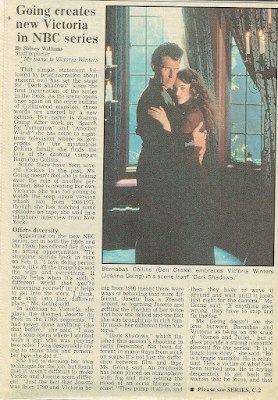
Here's another article from my file cabinet. I loved the original Dark Shadows as a kid, so I was happy when the chance came along to interview actors from the revival series in 1991. It was polished and atmospheric, drawing heavily on the film House of Dark Shadows, and sadly didn't last long on NBC.
Joanna Going was one of several cast members I interviewed as the show was cranking up. A couple of moves let the press kit for the series slip away, but it was cool when it arrived at the newspaper building.
The great shot of Going and Ben Cross as Barnabas Collins was just one of the color pics or slides that were included.
I'm pretty sure I watched The Midnight Hour when it first aired in 1985. I don't remember much about that first viewing except an okay-fine reaction. I wouldn't have been watching for deep analysis then, and everything other than a vague notion of its plot pretty much got tucked away in my memory.
I decided to revisit it via YouTube. Because: October. And because the Pure Cinema podcast spoke highly of it fairly recently in an assessment of solid TV movies.
So, what a pleasant surprise a re-watch proved to be.
In retrospect, it's heavily influenced by the Thriller video, coming down the pike just a couple of years after that event. It even has some of the same creative team involved in makeup and costumes.
But it's otherwise quite a bit of fun with a touch of camp and a sweet love story woven through its undead storyline with interspersed musical numbers and a comic performance by Fridays' Mark Blankfield as a zombie out to grab what he can of past life pleasures.
It also features LeVar Burton, Shari Belafonte, Lee Montgomery of Ben with Jonna Lee as a fifties teen returned to get one more chance at things she missed. Oh, and Kevin McCarthy of Invasion of the Body Snatchers on the flip side.
There's one great musical number fronted by Shari Belafonte and one great horror set piece with a vintage '50s auto overrun by the undead. A few other flourishes including Jonelle Allen as a colonial vampire shore it all up.
Wikipedia reports it received mostly negative reviews in the day. They're wrong or at least not taking everything it is now into full account.
It's not a fully satisfying feature experience for horror fans, but it's still worth a look for the intriguing package that it is.
Happily as I mentioned recently, the original Dark Shadows novels are being reissued. This is another adjacent, branded book from the original Paperback Library era. It includes classics such as John Polidori's early tale of a gentleman vampire,"The Vampyre." That was begun, of course, during the same writing challenge that produced Mary Shelly's Frankenstein. It seems an appropriate public domain choice for a collection adjacent to the world of Barnabas Collins.
For a while yesterday (April 18, 2020, in the time of quarantine), Cat Ladies of the Apocalypse edited by Lyn Worthen, which includes my story "Witch of Washington Park," had the Hollywood Squares spot right below Ray Bradbury's The Martian Chronicles, and we were on a diagonal from collected stories of Theodore Sturgeon, all in the Science Fiction Anthologies category. Or maybe it was the Zoom spot right below them. Or the Alice below Carol and Marcia.
I know, I know, new things climb into the Top 100 and stay a while, like the fog in a Carl Sandburg poem, and then move on, but it was still a thrill for me anyway. In good ways. Bradbury and Sturgeon are deservedly perennials in those slots. BUT STILL!!!! "...once there was a spot/
For one brief shining moment...Camelot..."
And sorta there's bad in me related to this...
Or a dark side, and the placement soothes an old contusion, I'll confess...
When I was a kid in junior high I gave a buck-twenty-five copy of The Martian Chronicles as a Christmas gift at school. It was the cool orange one with the sketch of Bradbury on the cover.
You drew a name, you had to buy for a $1 or so in those days. It was a while back.
When my present went to the guy, who was actually happy to get it, a look of disgust crossed this other kid's face. "You always give books," he muttered, spitting the word "books" with about as much contempt of a word as is humanly possible.
Yeah, I gave books, and I still do...
...some of them direct from my brain to yours if you choose.
Probably says more about me that I recall that dis, that utterance of contempt. But, uh, I guess I hold grudges sometimes. You know, for, uh, decades. Several decades. So that little thumbnail was fun!
For a limited time, you can get Cat Ladies of the Apocalypse via a special pre-launch offer. Cat Ladies includes my story "The Witch of Washington Park" and 9 other titles as special story bundle. Pay what you want for 10 titles with six of them exclusive ebooks.
They all feature cats, which are, of course, a great source of comfort. That's how they serve in my story as a heroine faces a brutal future and works to prepare an urban environment for agriculture in a devastated land.
There's also mystery, horror and suspense in this mix. As I'm writing this, 17 days remain on the offer, so act fast and get some great reading to fill your down time.
See the full cover of Cat Ladies edited by Lyn Worthen here.
I waited with a bit of trepidation the year my novel Azarius was in development. I'd sold it myself with a query followed by a complete manuscript, "over the transom," as they used to say, after an agent failed.
I'd fumbled my way along with Writer's Market and Writer's Digest and observation of what was on the bookstore shelves. Edward Lee's Ghouls alerted me that Pinnacle Books was alive again after Mack Bolan jumped ship for Harlequin, so I addressed my letter To the Editor of Ghouls. I'd read Stephen King had once sent a query To The Editor of The Parallax View. That must have been for the novel Rage and not Carrie, but I'm not sure.
As a newbie with just a few short stories published in literary and little magazines, I had little say in the cover art, and there'd been a good bit of negative buzz about crass paperback covers with skulls and demonic children.
The Postman Rings
When a packet arrived unexpectedly in the mail one morning with a stack of cover flats, I was relieved and elated. The lettering was foil embossed but in a cool way, and the image of an eye in a broken mirror, mined from the book's pages, seemed perfect and subdued at the same time.
It's hard to believe that was 30 years ago.
Early 2019's been hectic for me with a move to Virginia, so it took a phone conversation the other night with Wayne Allen Sallee, author of The Holy Terror, Rapid Transitand much more, to note the anniversary year had arrived. It's the 27th for Holy Terror.
It seems long ago and like yesterday.
It started with a bad dream on the heels of three private eye novels I'd never felt were quite good enough to ship out plus a coming of age novel with crime undertones.
Letting Go of I
I switched over to third person from first and found it freeing, and the words flowed. A hundred thousand or so hammered out on a Commodore 64 in the wee morning hours after working a 1 p.m. to 10 p.m. shift at the newspaper where I was a reporter. I've always said past midnight was a good time to be writing a horror-mystery.
I had to take vacation time to do the edits requested by Ann LaFarge, who'd found it in the slush pile. A New Orleans-area murder-for-hire trial had been relocated to Central Louisiana, and I drew the straw of covering it. It was interesting but also a distraction.
Azarius Lives!
Crossroad Press re-issued Azarius a couple of years ago as I was rolling up my sleeves and preparing to devote my writing time to literary short stories.
The ebook edition cover was designed by David Dodd who does most of the covers for Crossroad . I was really pleased when it arrived in my inbox, bypassing the postman.
David had found a different but equally intriguing way to represent the novel's central, deceptive presence, leader of a horde of fallen angels all eventually confronted by a young reporter.
It touched off what I've come to think of now as the Aimsley Cycle of novels, all set in the fictional Louisiana city Aimsley and its surroundings where events traditionally supernatural and otherwise abound.
Looking back, that led to an interesting life for me.
I'd have never taught without Azarius, I'd never have made as many friends as I have around the world, never have bounced around as much. It's all a blur of course.
Endeavoring to do things right, I closed my eyes and tried to immerse myself in the world, created from a Hammer script by Anthony Hinds for the Christopher Lee Dracula series. It was abandoned in favor of Dracula A.D. 1972.
Re-imagined as Unquenchable with Mark Gattis directing, it proved to be an interesting experience, and I think I was successful in maximizing my immersion. I read of the Hammer films in The Monster Times and Famous Monsters of Filmland as a kid, long before I got to see any of them on late-night TV, so I have experience in visualizing the stories.
For the audio, I was quickly back in a Hammer Dracula world as soon as a young British woman named Penny just made it aboard a departing train, on her way in search of a cooler spot in 1934 India. A least that's what she claimed, upon meeting a pair of Indian teens and an Indian businessman.
It's pretty quickly clear Dracula's alive and embedded with an ancient Indian cult who are helping supply him blood as they plan rituals and nefarious activities.
The plot moves pretty fast with Penny and Prem, the young Indian man, working together to unlock Dracula's secrets and of course, survive, and it builds to some rousing moments and an appropriately chilling ending.
There's a bit of an in medias res feel, but then that's not unusual for a 90-minute feature that has to convey back story and character in fast order and get things rolling.
I enjoyed the aural descent into dark caverns and through twisting passages, and I was OK with the portrayal of the Count, though some reviews seem to complain about a lack of development. Your mileage may vary, as with much of horror.
Though it's narrated by the great Michael Sheen, that's where my disappointment kicked in, that it was narrated at all. Some of the voiceover sounds like it's straight from the original screenplay, perhaps a bit of preservation-thinking at work. That sometimes reminds that it's from a screenplay, a little like the Blacklist Table Reads.
It might have been more fun to let everything come to us by way of dialogue and effects, but it wasn't truly a spoiling impact.
Overall, I'm glad I got a chance to drop back into something almost part of the Hammer cannon. Apparently it'll be online another 28 or 29 days. Put it on while you wait for trick-or-treaters. SaveSave
I woke up while it was still dark this morning, so I put in my headphones and started watching Doctor Who "Knock Knock." Just the stereo version from iTunes and not the full 3D audio, I guess, but it was still pretty effective sitting in the dark.
Then Alexa turned on the lights. Christine had given the Echo the voice command from the other room, but I couldn't hear it with the headphones on, so it was a bit...abrupt.
Here's the cover art for my new novel Disciples of the Serpent with artwork from multiple Hugo-winner Bob Eggleton.
My entry in the O.C.L.T. series is a Lovecraftian tale set in Ireland. Here's the full synopsis:
In Dublin, Ireland, academics and historians are dying. An unidentified venom is to blame. Strange markings from deep in the Emerald Isle’s past suggest adherents to lost and forbidden knowledge may have reorganized.
Detective Aileen O’Donnell of Ireland’s National Police Service, An Garda Síochána, has never heard of the agency’s sub rosa unit devoted to investigation of the strange and paranormal. That is, until a shooting incident leads to her suspension from the Special Detective Unit.
While awaiting disciplinary proceedings, she’s pressed into service by the secret division to investigate the deaths and what might be the tip of a conspiracy and academic cover-up.
Soon O’Donnell’s teamed with Geoffrey Bullfinch and Wendell "Mack" Macklemore of O.C.L.T. On a race through medieval ruins and holy sites, she must collect puzzle pieces, fragments from a forgotten pulp writer and bits of secret Druid history to stop the shadowy band of disciples before it awakens something long sleeping beneath one of Ireland’s most famous landmarks, something modern technology and firepower can’t defeat.
This novel, which stands alone, is a tie-in with the ongoing O.C.L.T. series.
There are incidents and emergencies in the world that defy logical explanation, events that could be defined as supernatural, extraterrestrial, or simply otherworldly. Standard laws do not allow for such instances, nor are most officials or authorities trained to handle them. In recognition of these facts, one organization has been created that can. Assembled by a loose international coalition, their mission is to deal with these situations using diplomacy, guile, force, and strategy as necessary. They shield the rest of the world from their own actions, and clean up the messes left in their wake. They are our protection, our guide, our sword, and our voice, all rolled into one.
They are O.C.L.T.
Other books in the O.C.L.T. series include the novella "Brought to Light," By Aaron Rosenberg, the novel The Parting, by David Niall Wilson, the novella "The Temple of Camazotz," also by David Niall Wilson, and the novel Incursion, by Aaron Rosenberg (in which the existence of the O.C.L.T. as a cohesive unit is finalized). Another stand-alone adventure can be found The Noose Club, by David Bischoff (writing with David Niall Wilson).
I like blockbusters as much as the next aging geek. I went to see Jason Bourne on Sunday because I knew it was going to be fun and frenetic. Other than one car chase that goes on from the third act until the next feature time, I was right.
I'm always intrigued also by films that sometimes get dubbed chamber pieces in keeping with theater tradition and terminology for small cast and limited setting.
Those chamber piece films are those that that go the other direction from the blockbuster. Instead of globe hopping, like a lot of TV viewers, they stay in the living room.
Alfred Hitchcock's Rope with it's real time storyline and Leopold and Loeb-inspired psychopaths is a stunning example. I think Hitchcock liked the challenge of developing thrills in tight settings because what are Psycho or Dial M for Murder as well?
I've enjoyed several variations on the streaming services of late, all eerie and effective, never making us feel just like we're stuck on one set but making that one set or location essential. These are some very weird living rooms if you will.
Coherence was conceived apparently in part by James Ward Byrkit as a respite from blockbusters, and it gives us a dinner party on the night of a comet that soon slides into a night of weirdness as it becomes apparent timelines in the many worlds theory are criss-crossing, and mistakes and missed opportunities drive some characters to desperation.
Time Lapsefrom Bradley King plays different games with time to good effect. What might be a grim crime drama without its science fiction conceit becomes a cool and compelling nail-biter when three friends (The Flash's Danielle Panabaker, Matt O'Leary and George Finn), one with a gambling addiction, discover a dead scientist who's left behind a camera in his apartment that snaps Polaroids one day in the future. It's aimed at their living room. What can it hurt to post race results in the window?
If movies have taught us anything, it's that men who dabble in the realm of God reap a big and complicated mess.
That's what the heroes of Time Lapse soon discover. Is the camera creating self-fulfilling prophecies, or are other forces at work? Between dangerous bookies, double crosses and the challenge of keeping secrets and sticking to time's rule's, their world's soon awry, and the tale offers many twists and surprises before its revealing conclusion.
The Invitation has been getting just a bit of buzz upon its Netflix debut, and I think it's deserved.
It's the story of Will (Logan Marshall-Green of Prometheus) the grief-stricken father of a child killed by a playmate. He and new love Kira (Emayatzy Corinealdi) are on the way to a reunion with his ex-wife (Tammy Blanchard) and her new husband (Khaleesi boy toy Michael Huisman.) The latter couple met in grief counseling and fled to Mexico for an Est-like (or not) experience that's replaced grief with joy.
Now they want to make amends to Will, so he and a host of old friends have received the invitation to join in, and the evening gets creepier and creepier in a slow burn buildup that engages and refuses to relent. Can any party with John Carroll Lynch as an unexpected guest go any other way, whether or not he's decked out as Twisty the Clown?
These films won't allow just vegging on the sofa, but they will make your living room viewing a bit breathless for a few hours. Check them out via Amazon or Netflix.
I finished the adaptation of "Locke and Key" while on a walk this morning.
I got the free download from Audible a while back, and the 13-hour experience took me a while. It's a great way to re-visit the world of Lovecraft, Mass., and the Locke family envisioned by writer Joe Hill and artist Gabriel Rodriguez.
I say re-visit, because I think experiencing the comic/graphic novel in its original form is essential for full enjoyment of the audio. And it's a great horror-mystery excursion that really should be on any horror aficionado's "To Read" list. It's a saga in comics form that's comparable to Michael McDowell's "Blackwater" multi-part novel.
As a character notes in the opening of the tale, it's impossible to understand what's going on if you come in in the final chapter of a story.
As the story's protagonists, the Locke children Tyler, Kinsey and Bode, discover as the tale unfolds, a lot has gone on in their ancestral home where they seek refuge after their father's murder. Relevant events stretching back years, even centuries.
Various mysterious keys and a dark and mysterious woman living in the house's well gradually reveal the details over six collected volumes of comics.
The audio follows that and all of the spooky encounters with giant shadow creatures, vicious wolf-creatures, demons and deadly possessed characters.
The power of audio to stimulate the imagination is true and grand, but at times that's where the audio falls down. At times it seems you're hearing powerful action in a dark room. You know something's happening, but you can't quite ascertain what's going on. Contemporary audiodrama writing eschews the old technique of having characters spell out their actions in dialogue: "I've reached the gate, Shadow. I'm aiming my gun at the lock." But at times just a little more guidance would be fun in "Locke and Key."
I think the ideal experience would be reading the graphic novels first. They're all available in book and digital forms. Then listen to the audio as a way of reliving and appreciating the intricate plotting and the finely crafted characters.
The cover art's come in for my all new novel Dark Hours. It's the work of David Dodd, who's done covers for several of the reprint editions of my books for Crossroad Press.
The novel follows a brilliant but overzealous student journalist whose pursuit of an interview with a fugitive killer leads her into a maze of traps and puzzles that forces her to confront secrets she's tried to leave behind.
No word on a release date yet. I'm working through the copy edits on the manuscript at the moment, though I'm getting close.
I've found a couple more Netflix titles disturbing of late. You know, in a good way.
I've learned that for horror films to be most effective for me, it helps if I watch in the dark without distractions, other than the nagging demands of my brain for sleep.
So propped on my pillow with my iPad recently, I screened In Fear and Mr. Jones, both 2013 releases.
Modestly budgeted, they made great use of suggested peril and creepy atmosphere to give me a shiver. The storylines are quite different. The buttons they push are similar.
In Fear, from Ireland and featuring Downton chauffeur Allen Leech, had the biggest impact. Ever get lost on a road trip? The film suggests one of the worst possible scenarios for what might happen when an Internet printout map fails you.
Of course there's no mobi coverage once Tom and Lucy (Iain De Caestecker and Alice Englert) leave the main road and follow the signs toward the inn they're seeking. Soon they're driving in circles, and as darkness settles, they grow increasingly nervous while their situation seems to grow more and more bleak.
Occasional stops, to don parkas or make other car checks, begin to suggest someone might be lurking in the shadows.
The ambiguity, for me, produced a growing sense of unease mingled with flashes of real eeriness as a figure in a white mask lurked in the shadows, never quite fully defined.
Tom and Lucy aren't quite as interesting as characters as Leech's Max, who might be a savior or might be more sinister, and the tale may wind up in familiar territory for horror viewers, but the journey's dark and chilling enough to make the trip worthwhile.
The first hour or so of Mr. Jones also delivers some chills coupled with an intriguing premise tied to a Lovecraftian dreamscape.
Another young couple here, Scott and Penny (Jon Foster and Sarah Jones of Alcatraz), head to the wildness to work on a documentary. That sets up found footage possibilities with one twist. Scott's rigged his camera for a FaceTime-like view of the operator's face.
Shocked expressions mingle with what the camera's main lens sees. Just as Scott's plans and inspiration begin to crumble, he stumbles on odd nature sculptures by his neighbor, a shadowy and trench-coated figure who never quite comes into focus. Makes him scarier, just like the guy in white mask, though he prefers black.
Penny recognizes the sculptures as the work of Mr. Jones, an unknown artist who once shipped nine of his odd totems to various art dealers and others across America. Clearly she and Scott have stumbled on his studio.
Scott heads to New York to conduct interviews with Mr. Jones authorities including David Clennon who plays a gallery owner, recipient of one of the first sculptures. A more cynical recipient warns strange things transpire once a sculpture is received.
Meanwhile Penny's exploring Mr. Jones' studio and taking note of new work plus strange nooks and crannies. She gradually develops a theory that Mr. Jones sculptures may have a purpose.
When Scott returns, things begin to get more and more surreal. Whether it's because he's stopped taking medication or because something mystical is afoot, the final third of the film kind of explodes into an open-to-interpretation excursion.
Does the conclusion live up to the tantalizing possibilities the mysterious sculptures pose? Perhaps not. Maybe the last half hour's a little too overwhelming, but the building creepiness and the intriguing look of a scene created in Mr. Jones' underground lair kept me engaged for much of the film's length.
Above all, in spite of my jaded and desensitized perspective, a few ripples of fear crept through me. That made the films stand out.
I read some Richard Laymon including The Cellar while he seemed to be a well-kept secret in the horror community, more popular in Great Britain than the U.S.
Sadly he passed away too soon, at age 54, in the early aughts with several books still in the publishing pipeline.
I picked up some of his titles as they appeared in U.S. paperback editions, but someone I missed Night in the Lonesome October until Googling information on A Night in the Lonesome October by Roger Zelazny as I prepared for my re-read.
The Laymon title's great Halloween season reading. It's almost like Haruki Murikami wrote a horror story. It's not quite as surreal as The Wind-up Bird Chronicle, but it's got a bit of that kind of flavoring, though there's no spaghetti-eating.
Night is narrated by Ed Logan, a college kid who's just been jilted by his girlfriend Holly who met a guy named Jay over the summer break and decided not to come back to school.
Despondent, Ed takes long walks in the little community of Wilmington near his school's campus. On a long hike through various neighborhoods on his way to the all-night Dandi Donuts, he's captivated by a girl who seems to be sneaking back into her house following a late-night assignation.
Hoping to learn more about the girl, Ed soon gets distracted by Eileen, Holly's sorority sister who thinks Holly treated him shabbily.
Soon things are steamy with Eileen, though Ed's not willing to give up on the wandering girl. Continuing searches connect him with a degenerate named Randy who's spotted Eileen and would like to have Ed lure her into his clutches.
When Ed escapes from Randy, his world gets progressively weirder. Is there something about October in Wilmington?
What's up with the homeless figures under the bridge? And what's up with the girl who Ed soon learns slips into different houses each night.
With some genuinely chilling horror scenes and a heart-pounding finale, Night is a fabulous, moody excursion with well-realized characters and a creepy town for them to exist within.
Not to be a prude, but my one quibble is that even for its strangeness, there's a bit at the end that leaves dreamlike and edges into male fantasy territory. So be it.
Overall the tale's rich, atmospheric, chilling and exciting.
Had a fun chat with some of the folks involved in this show yesterday. The skits are wrapped around some cool, festival-winning horror films. More info's on their website here.
I've discovered a new favorite thanks to a friend on Twitter.
It's one of those tales that keeps you pondering while causing a subtle touch of eeriness.
It perhaps delivers that kind of imaginary fear Stephen King dubs "the terror" in Danse Macabre. That's the feeling that comes not when a machete is raised but when, as King notes, a tingling wisp of breath tickles the back of your neck. You turn around to find no one there.
I'm speaking of "The Hospice," a tale by the late Robert Aickman, British purveyor of horror without definition.
It should come as no surprise to me. I read "The Swords" in Cold Hand in Mine years ago, and its final lines have lingered with me ever since, proving the collections epigram: "In the end, it's the mystery that lasts and not its explanation."
It's a thought not unlike Kelly Link's answer to the first question on her FAQ. Why don't your stories have endings? With an ending, you might find satisfaction. With a question, a mystery, you keep pondering.
I've done that with "The Swords" since about 1978. I may not have as many years left in me to ponder, but I'll mull "The Hospice" for a while thanks to Jared Sandman aka @JaredSandman.
I shared a "favorite short stories" post with the Twitterverse, and we got into a "that story reminds me of this story" conversation.
He mentioned a Joseph Payne Brennan story I'd cited from Shadows 7 made him think of "The Hospice" found in the hefty Masterpieces of Terror and the Supernatural.
Happily I owned that volume, so I pulled it out and read the Aickman tale.
It's strange and ambiguous, of course. A British traveling salesman named Maybury is forced by an associate to take one of those short cuts that never work out.
Lost and low on gas, he happens upo the hospice of the title and opts to stay the night. It's no run of the mill road side rest stop, but it's not Hostel either.
Before long, Maybury's sitting for a meal and discovering the staff's not happy when you don't clean your plate even though they're delivering substantial portions. Coffee they're short on, however.
Things only get stranger. There's no phone for Maybury to call his wife when he determines he'll have to stay the night, and when he stays over, rooming with a longtime resident, he hears mysterious cries in the night and experiences other eeriness. Was that his roommate that returned after a wee hours departure or someone else?
The reader can make an obvious choice about the hospice and about Maybury's fate, especially since there's deep symbolic suggestion in the final scene, but Aickman does not connect the dots.
He leaves it all for the reader to contemplate, just as he does the meaning in "The Swords." That resonates and delivers a little more satisfaction than an ax murder.
Once upon a time, I was asked to read a scary story for a grade school class. I think I'd written some young adult stories by then, but I didn't think I had anything appropriate for kids in single digits.
I set out to find something suitably spooky that might chill without traumatizing. I took a trip to the library and browsed collections in the children's section until I ran across Thrillers and More Thrillers edited by Robert Arthur. I honed my reading skills on the Arthur-created The Three Investigators, so I was drawn to his name.
Thumbing through the pages that promised to present phantom stagecoaches and more, I ran across Joseph Payne Brennan's "The Calamander Chest."
I'd read Brennan but never that tale, which appeared first in Weird Tales. Perhaps the illustration of a ghostly hand caught my attention first. I took the book home and curled up with the story, and I soon decided it should work well for what I needed.
It told of Ernest Maxx who, while browsing a second hand shop, happens upon a chest of "genuine Calamander wood" from the Indies. The proprietor seems happy to part with it for a pittance, but Maxx dismisses that hint, thinking the next time he changes housing, the chest will prove useful.
Never, never, never buy a mysterious chest the shopkeeper wants to get rid of. Before long, Maxx is awaking in the wee hours to notice a ghostly hand slowly rising from the box:
"He sat motionless, overwhelmed with sudden horror, his eyes riveted on this appalling object. It just hung there unmoving, a long, pale finger with a heavy knucklebone and a black nail."
It happens again and again until Maxx, angered at first by the intrusion, eventually tries to fight the finger and then to get rid of the chest. He ultimately must learn of the dark secrets it once contained.
What's Maxx's fate? To say more would spoil the fun.
The image of that ghostly hand tweaked my imagination, and it enthralled the kids in the classroom when I read it as well, and I revisit the tale from time to time.
With my imagination engaged and most of the lights turned out in the room, it can still bring a shudder.
It's a great choice for Halloween reading whether you're a kid or not.
Since we were just talking about slasher pics, I have news of a new horror thriller, Anna: Scream Queen Killer that's streaming on Amazon. It's from Chemical Burn, and it might be extreme.
The producers are calling it a "sexy horror exploitation film with a twist." It sounds like it might be in the vein of American Mary.
Here's the official synopsis and trailer. From here it's really up to you. (Trailer contains some nudity.)
The ultimate in actress exploitation, Scream Queen Killer takes you on a journey into the world of indie grindhouse film auditions with a mind bending twist. Anna is a young actress desperate to make it in the movies. She is invited to a series of filmed auditions, playing out various scenarios on camera. The problem is, the director is a perverted psychopath with only one thing on his mind. As Anna progresses through an ever more bizarre series of roles she slowly realizes that something is horribly wrong with this audition. Forced to strip and perform carnal acts in the name of the art, she eventually flips and takes matters into her own hands. A scenario many actresses may recognize in the industry, Scream Queen Killer is brutally realistic and superbly acted by Melanie Denholme (Lady of the Dark). How far is too far? And how far would you go to get the role?