Showing posts with label comics. Show all posts

Wednesday, October 19, 2022

Reviewing the Great Ray Bradbury's Home to Stay! - Tales from EC Comics

The cool folks at Fantagraphics Books are dropping a collection of Ray Bradbury's stories adapted for EC Comics publications such as Tales from the Crypt and The Witch's Cauldron. It's called Home to Stay!: The Complete Ray Bradbury EC Stories.  

It's a nicely complete volume with a rich assortment of extras surrounding Bradbury's affiliation with the shunned and banned and later celebrated EC line.

I did a review of the volume for Wicked Horror

Stories are reproduced mostly in black and white, though they original tales were in color. Some pieces are reminiscent of the later Warren Magazine like Creepy inspired by EC.

The book's dropping now. Here's a sample page from the adaptation of "The Lake."

Ray Bradbury EC Comics The Lake - Home to Stay!
It really is a great volume for any Bradbury fan's library. 


Friday, March 05, 2021

5 Tips for adding noise to your comics script

Comicbook Sound Effect SFX Text - Blam


Have you ever sat in a coffee shop making odd sounds? Then you might be a comics writer. 
Way back in the day, when my wife was still my girlfriend, and I used to sit at her kitchen table with my typewriter working on comics scripts, she’d give me funny looks as I tried to devise phonetic spellings for words.

It was part of the job, though. Sound effects, often written in comics scripts as SFX, are a useful part of the comics and graphic novel universe. They're a component to help your comics come to life. 

The 1960s Batman series harnessed them with humor in all of those episode-ending battles. Remember POW and TWOCK as Batman punched out The Joker and The Riddler? While they’re obvious and a part of pop-culture, many beginning writers don’t think about them as they script, but they’re important and they really are part of the writer’s job. 

They’re fun too. For all of the bold colors and exciting visuals on the comic book page, the medium is a static, two-dimensional one. Sound effects are one element that makes a story more dynamic. So, what are some tricks for crafting good sound effects?

 1. Be aware of what’s being done out there. 
It’s about social scanning as I mentioned in my previous post on comics scripting. When you read comics, take note of how effects are being used. Take particular note of how they’re being used in comics similar to yours. Sound effects are word art, and letterers are artists. They have many new graphics tools they’re just waiting to put to work. Those transparent-letter sound effects that let us look through the word as action transpires are an innovation of a few years ago. 

Letterers keep coming up with new ways to make words visually interesting. You might even want to seek out and watch a few lettering tutorials. Seeing how letterers work and what they can do can inspire you. You can always drop in a note and suggestion to the letterer in a comics script if you see something you like. 

 2. Sound it out.
As I mentioned above, it really helps in creating SFX words to try making the sounds, even if it inspires funny looks at the coffee shop or from your pal or significant other. SFX actually allow you to create words. Though that might not make the most diligent English teacher’s happy, that’s how we got some words such as crunch. They’re considered “of imitative etymology” meaning they imitated natural sounds when they were devised back in the 19th century or so. 

3. Don’t just fall back on restating what’s happening,
It’s tempting to just use a verb for a sound effect or fall back on a crack or thump. It’s more interesting to be imaginative and strive for a word that’s really appropriate to the scene and that gives the reader a sense of the audible sound that’s transpiring. 

4. Don’t forget there are tools that can help you.
All of these sound effects are technically onomatopoeia. There are actually onomatopoeia dictionaries out there, and Written Sound is a fairly handy online version. Another handy one is Comic Book FX - The Comic Sound Effect Database.

If it doesn’t have exactly what you need, it may be handy guide to get you started. 

5. Work to develop a good ear for sound. 
Really listen as you walk through the world, and stop and think how you’d write various sounds. As the dryer tumbles your stuff, what is the combination of whir and rattle that transpires? How’s your car sound when you turn the ignition? Or what's the approach of your bus sound like? What about your electric toothbrush? 

Like all creation, sound effects work improves as you flex that creative muscle, and it’s something that will enhance the reader’s experience. That’s the goal after all. Give the reader a wow!

Friday, February 26, 2021

5 Things You're Doing Wrong in Your Comic Book or Graphic Novel Script

Writer's Laptop Keyboard


I've been doing some freelance comics script editing because it fits my schedule. The work coming my way varies. Some of it's very professional and complete. Often I get scripts that don't take even the comics world's not-particularly-set-in-stone formatting into account, however.

It seems to be happening organically. I see great storytelling and characterization in a shotgun blast of text. I'm not sure why that's so in a world where Google offers access to thousands of samples and examples including many provided by publishers. Regardless of that, almost every day I get submissions with very little distinction between elements. 

Description co-mingles with dialogue, quotation marks are used where they aren't needed and little regard to basic terminology is shown. Inevitably tacked to one of these polyglot scripts is a note. Do you think this will sell to a publisher? Short answer: "Uh, no." That's a different matter, but still, no. 

A little bit of formatting can offer the scriptwriter a lot more control, and it makes things easier on everyone else. A letterer doesn't have to extricate text from a shotgunned mass. An artist can get a clear vision, and it's easier to edit for errors as well. Tools that can make the two-dimensional world of comics more dynamic can also be deployed.

So what can be done to turn your great storytelling into a functional script? Here are a few thoughts that have come to my mind. Maybe instead of dwelling on what's wrong, we should say these are actually things you can do right.

1). Find some sort of format and use it 

Many are available, and if you do a bit of scanning, you'll find ways to convey your vision easily to an artist while making your work easy on the eye. 

Some easy resources include Dark Horse's sample script and many more on the Comics Script Archive

Check out a number of them, and try not to zero in on the worst, non-standard example you can find as an excuse to do your own thing. 

Here's a guide to basic comicbook terminology as well. 

2.) Be descriptive and keep in mind only one major event can occur in a panel. It's a still frame, a snapshot if you will.

A guy can't rush to the window, tear off his civilian clothes and jump out in one panel. Don't ask an artist to draw that. Artists will often interpret your words and develop a sequence, but you're the writer. Make it clear and precise and make the most of every panel.

3.) Sound effects (SFX) enhance a story. 

A comic's a flat page, but you're seeking to convey action and excitement. One of the tools you have to make the experience dynamic for the reader is sound effect text, and the writer can come up with those words.

Many great and innovative flourishes have developed in recent years, taking the comics world beyond the Pow! and Zaps! parodied in the old Batman series. Scan the comics you have on hand and take note of what's being done. 

Develop a good ear, and harness sites such as Written Sound, the onomatopoeia dictionary

4.) Lettering isn't just about words.

Good letterers can add special emphasis to key words, do interesting things with speech bubbles and add many more flourishes. Take note of that as well as you scan your favorite comics. Add a special note to the letterer if you have a phrase you really want to punch up in some way. Break up a character's long monologue in a couple of speech bubbles if it's a mouthful. 

Dave: Longwinded remark.

Dave: Longwinded remark continued.

Look for natural breaks in the dialogue to suggest a new bubble. 

5.) Use art references.

We all think about things a little differently. When I was in college, I asked an artist to draw a burglar with a mask. To me a domino mask like The Hamburglar wears. She drew a guy with a bag of loot over his shoulder wearing a bandanna tied around his face. To me, that's a train or bank robber's mask. If there's something specific or even something that sets a tone or a mood, find a reference via Google Images and paste a link into the script. 

You might even develop a private Pinterest board with a collection of images as a lookbook like filmmakers use and share that with the artist. That can go a long way toward developing a world that fits what's in your imagination while stimulating an artist's visual creativity. 

Conclusion
Think of these points as shortcuts. If a script's well formatted, an editor is free to focus on storyline, character and world-building details and offer meaningful suggestions that can guide you toward meaningful tweaks and revision that lead toward a satisfying experience for readers. 


Saturday, September 05, 2015

Steampunk Graphic Novel Kickstarter - Citizens


My buddy, comics writer and former Marvel editor Roland Mann has a Kickstarter campaign going for a steampunk graphic novel called "Citizens." It will be drawn by Joe Badon, who's done work for a number of comics companies since 2009.

"Citizens" is the tale of an injured soldier who must accept a government-sponsored, biologically fabricated body following war injuries. It's all in pursuit of acceptance and the love of a girl. The world created for this story looks intriguing.

Donations have been good so far, but there's a ways to go and there's still time to kick lend your support.

Head over to the Citizens Kickstarter page.

Tuesday, December 31, 2013

Comics Catchup

I make no pretense of being caught up or well-informed about comics these days. There are too many great titles, and too many temptations for an eclectic like myself.

I bounce around among the titles that capture my interest. I've read some of the New 52, and bit of the Red Hulk and other Marvel goings on, and I'm a fan of Locke and Key and much more.

Lately a few other things have grabbed my attention, and a mention on a friend's Facebook timeline sparked some discussion last night. So, some things I've liked recently on my iPad via Comixology include:

Dark Shadows/Vampirella
Crossovers are inevitable in comics, and when characters from different corners of my youth converge, it's hard to pass up the adventure.

Barnabas Collins, the Maine blue blood vampire meets the girl from Draculon in this outing, that pits them against Elizabeth Bathory, she who bathed in the blood of virgins. Liz has enlisted the help of Jack the Ripper, and they're both alive in contemporary Manhattan.

They're responsible for some deaths, and they've kidnapped and caged several victims as well. One of those is the descendant of a woman Barnabas destroyed before he learned to control his vampirism, so he owes a debt.

Barnabas is portrayed as a bit unhip, having been penned up in a coffin for a few hundred years, so venturing from Maine into New York City is challenging. His werewolf cousin Quentin is happily on hand to help out, and then there Vampi.

The fight, as heroes, or even antiheroes must in crossovers, but then they team up and face off against the real evil. Dracula has a place in Vampi's world these days, but Bathory is so evil, he's not an obstacle as this five-issue arc builds to its climactic battle.

It's penned by Marc Andreyko who created Torso, based on the Cleveland's Mad Butcher of Kingsbury Run, and it really had me flipping through the frames.

Army of Darkness vs. Re-Animator
Lovecraftian meets Lovecraft in more ways than one in this entry in this entry of the ongoing Army of Darkness crossover series, and it's a bit of a brilliant mix.

Ash from Army gets committed after his return to the S-Mart where shotgunning an ancient sorceress isn't viewed with the understanding film viewers might be willing to grant the one-armed stalwart. Who should be at work at the institution where he's housed but Lovecraft's Herbert West himself, the Herbert of the Re-Animator films at least.

He's still up to his efforts to thwart death with obstacles still plaguing him, but he's also assisting those bent on opening doorways to Lovecraft's Elder Gods.

Hideous, tentacled beings abound, and Ash must avert cataclysm in his usual style.

Sherlock Holmes and the Liverpool Demon
Who said Sherlock in his own time couldn't be successful today? Updatings Sherlock and Elementary get all the attention. Well, I suppose the Robert Downey Jr. movies are true to period, but this series gives us Holmes and Watson almost as Sir Arthur Conan Doyle's readers know them.

Their challenge is sensational, a series of murders in which the victims are clawed by what many believe to be the Springheel Jack of legend.

But the series remains true to the spirit of Doyle's original stories  throughout. Holmes and Watson are in Liverpool wrapping up a case, and soon become involved in the murders. A homeless man's one of the victims, and he seems to have ties to other things afoot. Is the supernatural at play, or is a gangster's imported panther alone the culprit? The way things wrap up with various plot threads converging in the final issue makes this mystery mini-series enthralling.

These titles plus a news series from Marvel featuring Michael Morbius, who I used to read in black and white in the Vampire Tales days, have been keeping me busy.

I know some who dismiss the digital age of comics, but I find it handy. There's not a worry about missing an issue at the drug store when every title's just a download away.


Friday, July 26, 2013

Storage Wars Meets Area 51 - A Kickstarter

Wes Locher was an up and coming comics writer before he took a class from me, but I mention that he's a past student in the interest of full disclosure.

I wanted to share news of his Kickstarter project regardless. Yeah, he's a former student, but it also looks cool.

It's comedy sci-fi hinging on an interesting and humorous high concept. Here's the word on his Unit 44:


Oh, and contributors can earn cool rewards. 

Friday, April 11, 2008

What's on The IPod - The Ten Cent Plague

Speaking of horror comics, as I was in the last post, there's a new and really good book about the history of the four-color pages called the Ten-Cent Plague by David Hajdu. Everyone from Slate to the New York Times has talked about it so I know this is a news flash to all.

It's practically required reading for comics aficionados. I've certainly learned a lot listening to the audio version, authoritatively narrated by Stefan Rudnicki. (Listen to a sample at Audible.)

I first read of Fredrick Wertham and his book Seduction of the Innocent in the introduction to Jules Feiffer's The Great Comic Book Heroes, purchased for its plethora of Golden Age reprints when I was a kid.

My parents--who lived through the '50s but missed out on the comics hoopla, probably focused more on concerns of Communism and atomic war--were appalled by the discussions and the suggestion Batman and Robin and Wonder Woman might have subtext on homosexuality and bondage respectively.

Historic Detail
The Ten Cent Plague offers great details on the history of illustrated narratives with quotes and insights from some of the early creators before it gets around to its examination of Wertham and the gasps about EC style horror comics.

I'm a casual student of comics history, but as I mentioned the book offers up great details and tidbits I'd never encountered, everything from tales early newspaper syndication to facts about Will Eisner, Bob Kane and William Gaines of Mad Magazine fame.

A few things I probably should have picked up before now:

  • Eisner's The Spirit--one of my favorites--had a lookalike rival named Midnight. That he had a different name was unique. Rights not being what they are today in the early days of pen and ink storytelling, you might have rival newspapers each running their own version of The Yellow Kid or the later tales of errant immigrant youth The Katzenjammer Kids.
  • Wonder Woman's creator William Moulton Marston really did have a thing for bondage and he had a wife and another woman living with him.
  • M.C. Gaines and his son William didn't get along all that well.
There's much more to learn as Hajdu follows the post war evolution of true crime stories, self-regulating boards and early cries for restraint in a day when everyone, not just kids with broken XBoxes, read funny books.

Tuesday, April 08, 2008

Free Comics Get the Bump

Updated - see below


Roland turned me on to WOWIO, a site for advertising-sponsored ebooks. It includes quite an array of comics as well as novels and non-fiction.

Basically after you sign up and prove you're you for the advertisers by one verification method or another, they generate .pdf files with a full-page ad up front. I used a permanent e-mail address to qualify myself and that took about a day.

The eproducts are customized with your name, so they know if you passed the book on, kind of like those screener DVDs from the Academy, I suppose. You can download three items a day, by the way.

I was pleasantly surprised by the comics selection. Moonstone even has a few titles in the mix including a couple of its graphic novels featuring The Phantom--the ghost who walks in purple--and an adaptation of the original Kolchak novel/movie.

Bump
My discovery in the mix is a comic book adaptation of a film called Bump. It's apparently in the works with Tobin Bell slated to star. Apparently he's the only one cast so far, but they're working on that according to the official website.

The comic, from The Scream Factory, is a beautifully drawn horrorfest. At first I was thinking, "Well this is another The Hills Have Eyes," but things twist and turn pretty quickly with a scary prologue focusing on a killer reminiscent of the real life Ed Gein who also inspired Psycho and The Texas Chainsaw Massacre.

Then we jump ahead 30 years to a group of people who wind up trapped in the killer's farmhouse where he's not dead and neither are his victims.

I suspect reading the book on-screen as a .pdf is a plus especially when you get to the action portions where I got a sense of movement, scrolling upward as large, flashing panels revealed chases and scares.

I was a little dissatisfied with the ending, but all in all a nice--though be warned: gory-- four issues.

I've also snagged a few other titles so far including a Moonstone adaptation of The Mysterious Traveler, a new spin on the old radio series giving the traveler a role more significant than host, and a series called Carnival of Souls that seems to be more than an adaptation of the classic early indy horror flick with waltzing zombies. I should mention there are also some '50s classics in the mix. EC-flavored if not actual EC titles, and some of the artists represented include Jack Kirby and Joe Kubert. You'll also find, I think, the complete run of Clive Barker's Tapping The Vein, comic adaptations.

And I haven't even gotten around to checking out the mystery novels yet.

Addendum
(Posted 4/10/08)
Troy Brownfield from The Scream Factory dropped by to comment earlier in the week that more Bump casting news would be coming soon. He wasn't kidding.

Young Indiana Jones
himself Sean Patrick Flanery will be playing Bret and Hellraiser's Ashley Laurence will be Elaine. They are now attached to the film according to The Scream Factory's My Space Blog. They're a troubled couple who get stranded in the horribly haunted house where much of the story takes place.


Friday, July 27, 2007

Whysoserious.com - Out the corner of my eye


I don't have anyone on the ground at Comicscom in San Diego, but from the corner of my eye I'm watching the activity on whysoserious.com, a promo for the new Batman Movie.

An "I Want You" poster featuring Heath Ledger as the Joker appeared this morning with cooridnates of where to go for a big henchperson recruitment gathering.

Commonreview.com is steadily solving and posting clues and they do have people on the ground.

Is this viral marketing or something beyond? Any way you slice it, it's COOL!

(No rights to image implied.)

Thursday, April 19, 2007

I used to have that issue they were discussing on Lost

On the Lost episode "Catch 22" there's a Tarrantinoesque exchange between Hurley and Charlie - what if Superman and The Flash had a race?

Apparently they've raced many times over the years, but my dad bought me the first matchup back in the '60s. I don't have a theory about the allusion like the fabulous Jeff Jensen at Entertainment Weekly. I'm just sayin'.

I can remember sitting on our back steps and reading it. It does indeed feature The Flash vibrating through a wall as discussed by Hurley, though the comic is long gone and I would be pressed to tell you who won that round or what else happened other than passes by exotic world scenes.

It takes me back, though. My old man bought me "Superman" comics sporadically. I replaced a few of those a while back by mail order, but if I'm recalling the Superman-Flash race was expensive as such issues tend to be.

It's a little cheaper to get Gold Key "Tarzan" issues. They adapted Edgar Rice Burroughs novels in multi-issue arcs, and we managed to follow those, purchasing them at a 7-11 near our house.

My dad read them to me along with issues of "Ripley's Believe it or Not," and things like "The Gold Bug." He inadvertently scared the shit out of me with "The Raven" too.

And that's when the spell of imagination was cast over me too.

Good times.

Wednesday, January 31, 2007

Comics Resources

For those lured here by the siren song of the search engine and such keywords as comics, there's a great post today by Jason Thibault of Optimum Wound Comics on the company's My Space Blog.

He offers tons of links to information on comics writing, comics art and some sample comics scripts from great writers.

Monday, January 29, 2007

Birth of the Marauder

I read comics and loved them as a kid and I was fortunate enough to make a pass through the comics universe as a writer, never DC or Marvel but I did have titles published by Malibu and Caliber, a couple of the major minors.

Looking back on Marauder, the third comic book miniseries I wrote, there are some things I'd do differently today, but as Cliff notes, hmmmm I'm sure he's never heard that before, as Cliff writes in his blog a story is written by who you are now not who you're going to be as a writer.

Anyway, today I'd try to delve deeper into characters, I believe.

The no spandex rule
Marauder
is the closest I came to writing a super hero comic. It was originally slated for Caliber but an overabundance of properties there shifted it to Silverline, the lable created by Roland Mann, my comics editor and packager and also creator/author of the wowfully--I made that word up-- successful Cat and Mouse series for Malibu.

Roland didn't want to do another spandex-clad protagonist, so Kirk Connell aka the title character did not have a uniform. He had an equipment-laden suit because he was first a thief.

He was not just an everyday robber, though. He was part of an ancient thieves guild devoted to recovering things for their rightful owners, though their ranks were becoming progressively corrupt. I'd read books and stories with orders of assassins but never of theives with their own codes, systems and councils that stretched from the Middle Ages.

The dramatic jewel heist that kicked things off is an action scene of which I've always been proud.

The idea started when I was a kid. A local jewelry store brought in a huge uncut diamond, eighth argest in the world I think. They displayed it in a glass case with a rattlesnake. The snake was more hype than protection, I'm sure, because it just lay there in the case as snakes in captivity and cold air are wont to do.


That snake became a host of king cobras in Marauder, an obstacle Kirk and Lumley had to overcome to grab the objective jewel in the opening panel.

As they worked to procure it with finesse, the supervillain's minions crashed the power with excessive firepower, dispersing cobras and blasting Kirk's mentor as he dangled helplessly from a rapelling rope.

Kirk managed to snatch a snake and finish one of the attackers, but the worst of the bad guy's escaped, prompting him to break with the guild in order to pursue them.

Having been a member of a street gang called the Marauders before Lumley rescued him, Kirk took that name for his new base of operation, a small ship which allowed him to skirt around to different locales.

I wound up writing a spec screenplay based on the comic. It had a different, more science fiction oriented plot but I kept the snake scene as the opener. I think it would have been a blast on celluloid


Tuesday, July 18, 2006

Another page from one of my horror comics

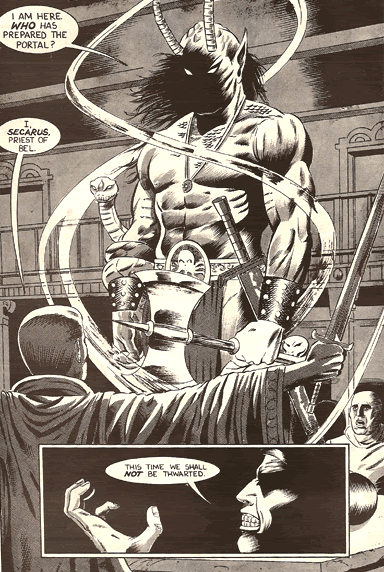
This is from the hard to find--if anyone was looking--fourth issue of The Mantus Files, a comic book mini-series I wrote for Malibu Graphics back in ancient times. It was edited by my buddy Roland Mann and drawn by Thomas Giles.

Horror Comic Scene - The Mantus Files from Sidney Williams and Thomas Giles

This page comes near the end of the tale, right before the story's version of "all Hell" breaks loose with a twist about the dragon talked about and anticipated through most of the series. I thought we came up with kind of a cool way for Mantus, our occult investigator hero, to kill him. The guy in the pic's not the dragon, by the way. He's a guardian from the dark side.

Hmm, guess that dialog could have been a little better.

The defeat of the rampage involved some saintly relics that we made up, though the course to them took Mantus through a lot of real New Orleans locations.

Mantus files can be ordered from The Nostalgia Zone

Tags:

Sunday, January 15, 2006

Movie Options that Didn't Happen - The Scary Book


This was a long time ago. I'd just had a conversation with someone about how comedy and horror never mixed well, and we'd cited numerous movies that proved that fact. Then I got a call from my comics editor, Roland Mann.

"I want you to write a comedy horror comic," he said.

"Well," I said. "That's probably impossible to do well, but I'll give it a try."

It wound up being something I feel is one of my most interesting pieces. It died at one comics company, bloomed again at two others and was considered as a treatment at 20th Century Fox once upon a time.

Laugh at the devil
When I began the first outline, I decided to brew a mixture of every zany horror element I could find. The devil, usually no laughing matter, became a key figure along with is goat-horned office manager Baalberith.

In the story, due to a shipping error, the scary book of the title, fell into the wrong hands. It was a sorcery tome that really worked and was meant only for the most accomplished adepts.

Quickly, the wannabe sorcerers of the world shared it, invoking all of the demons from the pits at one time and bringing Hell itself to a standstill.

Angered by this problem, Satan ordered the hapless bookstore clerk who sold the book on the open market in the first place to get it back or face fiery retrobution. He sent a beautiful but damned soul to help him.

Proper British form
Malibu Graphics, later to be swallowed by Marvel, optioned it initially and had me script it in a British comic style with frequent cliffhangers in hopes of re-selling it abroad after its U.S. run.

Developing complications
I think we developed the complete four-issue miniseries, written by me and pencilled by Steve Willhite and inked by Dan Schaefer. Then some shakeup at Malibu killed it.

Roland felt so good about the project that he shuffled it over to Caliber, publisher of The Crow.

They put out two issues then stopped.

The Scary Book - The Graphic Novel
So Roland, not to be defeated, eventually formed a publishing arm of Silverline Comics which had previously been a packager for other publishers.

He brought out a complete-in-one-volume graphic novel version of The Scary Book.

Having worked for a while at Malibu, Roland knew quite a few people in the comics industry and he and Warren Ellis talked over a Silverline book with a title to be named later.

So flash forward to Comics-Con in San Diego: a Hollywood person stopped by Roland's table that year, caught wind of a possible Ellis property and started talking to him.

The result: 20th Century Fox asked for a list of Silverline titles and from that list they asked for a treatment of The Scary Book, which we gladly produced.

And that's about as far as it went, but it was certainly a fun and exciting experience and educational about how things happen.

I guess The Scary Book would not have been quite right for prime time or Pixar but it would have been fun to see what came about with say: Danny DeVito as the devil, Mike Myers as the hero and Jennifer Love Hewitt as his sultry sidekick (the cute one in the fedora in the sample page).

Oh well. Life goes on.
Related Posts Plugin for WordPress, Blogger...