Monday, March 29, 2021

Biblioholic's Bookshelf - Death Trap - John D. MacDonald with a Gothic Adjacent Look

When the paperback gothics were hot in the women running from houses era, many other paperbacks got similar looks, even tales from crime novelists like John D. MacDonald, creator of the Travis McGee series and tough tales with gritty covers earlier from Gold Medal

This stand-alone originally released in 1956 has a distinct gothic look with trees that resemble castle-stone and a flowing overcoat for the woman resembling the Victorian dresses on historical gothics. 


John D. MacDonald Gothic Adjacent Death Trap


Death Trap Back Cover


Sunday, March 28, 2021

In the Arm


I was able to get my first vaccine shot this past week. I have to keep reminding myself I've taken a step. 

I'll feel better after the second shot and the wait for immunity to kick in is up, but I do feel a bit more upbeat, maybe lighter than I realized I wasn't. 

I had grown numb to the sense of existential dread we've been enduring for a year. 

I felt some anxiety leading up to the shot. It was never about the stick. I think I feared the appointment wouldn't hold, that somehow there'd been a mistake and a kink in the supply chain would force a further wait.

I'd been qualified for a while to receive in Virginia, but it was feeling like the day and the opportunity would never come. 

It all went smoothly, though. The pharmacy I went to had things planned well, and I had only a three-minute wait for software to allow me to check in precisely 15-minutes before. Even with Siri's assist, it's hard to calculate drive time. I damn sure didn't want to be late, either.

The guy giving injections asked which arm. 

"My left is to you," I said. 

"It can be in either."

I told him left was fine. I had no side effects on this first one other than the sore arm everyone reports.

I'm not sure how we--all of us--will remember the day as time passes, but it will perhaps be one of those moments we look back on as this long slog becomes a blur somewhere behind us.

My list of things to do after is limited and infinite. 

I'd always had the notion seeing the next Bond movie in the theater might be something to look forward to. I realized if all goes well with the second shot and a two-week wait, the planned release of Black Widow would come just as my immunity should kick in.

Then the date of Black Widow was moved to July, so almost certainly that will be a possibility if local theaters open.

Beyond that, dinner out, visits here or there with less concern, the grocery story. Christine and I have been doing curbside pickup. Browsing in the store and planning meals accordingly seems like something that will be fun. 

Beyond that, what will normal be? I'll have to see. But one step closer's not too bad. 


Tuesday, March 23, 2021

The Nigh Forgotten Private Eye Film P.J.

Apparently I'd never seen the film P.J. (Universal, 1968)I missed the NBC debut, but watched on late-night TV as a kid in the seventies. Word on the 'net--and the new Kino Lorber Blu-Ray commentary track from Howard S. Berger and Steve Mitchell--is that's only a sanitized version with omissions and alternate scenes. Far less gritty.

That must be true. I remember a couple of cool set pieces and George Peppard's turn as down-on-his-luck private investigator P.J. Detweiler, but in re-watching, I see there's more blood and a few steamy scenes including a credits sequence that didn't ring any bells.

On the down side in rewatching, location filming mixes with sound stage footage, diminishing the set pieces a bit.

For much of the film, P.J.'s guarding Maureen Preble (Gayle Hunnicutt), mistress of Raymond Burr's eccentric millionaire William Orbison.

When a car's cut break line sends it speeding out of control as cut break lines were wont to do in P.I. films and TV shows of the era, P.J. has to stop it by side swiping a rock wall with sparks flying. The stunt still impresses, but this is all while he's pressing Maureen behind him. It's 1968 and not every car has seatbelts.

Things get exciting, but George and Gayle are obviously in a simulator if you're watching in 2K. That didn't detract for me in rewatching the out-of-control car in Alfred Hitchcock's Family Plot a while back. Here I found the seams a distraction. 

The other great set piece comes when Orbison carts family and mistress alike to the Cayman Islands. Some exteriors look authentic, but the jungle chase and gun battle fixed in my memory was clearly on a well-designed set as well.

That's all a matter of watching with 2021 eyes in HD and not on an old black and white portable TV, I suppose. 

That's not to say the film's isn't a fun watch. It's surprisingly whimsical early on with an upbeat score and loopy behavior by skinflint Orbison. When not flaunting his mistress, he saves cigar stubs and worries about wasted office paper. 

SEE ALSO: Biblioholic's Bookshelf - Tony Rome AKA Miami Miami Mayhem - Early Sixties Private Eye

The film turns gritty and arguably gets better as a thriller at the midpoint. I don't remember a few flourishes from the tough side of the run time. 

In what today seems a non-PC turn, P.J.'s lured to a gay bar by Preble's stereotypically gay assistant (Severn Darden). It must have been viewed as a edgy variation on the requisite private eye beating in 1968. It definitely reveals American film's attitude toward LGBT characters at the time. Blake Edwards updating of Craig Stevens' hero Gunn (1967) featured a trans character, and Tony Rome (1967) and They Only Kill Their Masters (1972) would include lesbian characters, the latter's not too charitably treated.

The bar here is peopled with more gay stereotypes plus Anthony James, behind the counter once again following 1967's In the Heat of the Night. Everyone in the bar has sharp nails, heavy jewelry or belts with big buckles. All the better to pummel P.J. with, and they do in bloody fashion.

The other steam's delivered in a tame but risqué turn with P.J. and Preble on a pile of cash. 

Still more grit's served up in a subway battle, happily on location with no seams showing. It's a yikes even today.

A final confrontation is also shot on location with blazing guns, interesting angles, twists turns and other surprises. It ends things well.

By the way, you should watch for Susan St. James and Arte Johnson in small roles. 

Really P.J. is like watching two films, and as mentioned it gets better as the murderous conspiracy swirls. Don't except too much of the mystery plot. 

Remember it's not Tony Rome. It's definitely not Harper, but it's worth a look for private eye aficionados. 

Monday, March 22, 2021

Biblioholic's Bookshelf - Watchdog by Faith Sullivan

Faith Sullivan is a versatile author who has written a number of novels sometimes harnessing genre elements or myth. This signet edition is dated February, 1983.


Watchdog Signet Edition - Fath Sullivan Paperback Horror


Watchdog by Faith Sullivan Back Cover

I picked it up in a shop I often remember fondly here, The Book Nook, operated by a very cordial lady named Lena Cortello in Alexandria, LA.

It was a go-to spot for me, tucked in a corner shop off a major thoroughfare. It was a corner crammed with paperbacks of all varieties and comics too. 

I miss it and the era of shops like it, when there were more obscure gems than multiple copies of week-old bestsellers, but time marches on. 

I picked up some titles for 5 cents each when The Book Nook closed and inventory when to another, short-lived used book store in the '90s. I was glad for the bargains in the moment, but I should have paused to mourn. 


Monday, March 15, 2021

Biblioholic's Bookshelf - Markham The Case of the Pornographic Photos by Lawrence Block

I've probably mentioned on this blog before that I read Lawrence Block's fiction writing column in Writer's Digest in my formative years. His blog today still gives a taste of what that used to be like. 

I segued to Evan Tanner, Matt Scudder and Bernie Rhodenbarr from mentions in the column or in the "about" section at the bottom of the page. I also read his stories in Alfred Hitchcock's Mystery Magazine and Ellery Queen's Mystery Magazine and picked up Ariel in hardcover from Arbor House. 

Some things were harder to find. He mentioned once how he'd come to write a novel about a private eye named Ed London because he'd been commissioned for a TV tie-in for a show called Markham with Ray Milland. 

Lawrence Block Markham CoverHe began with the detective being asked to solve the murder of a woman found on a friend's living room floor. The detective rolled the body in a Persian rug, moved it to a park then set off to solve the crime. There was even a John Caldwell cartoon to illustrate the stroll with the carpet over the shoulder in the WD column. 

Block and his agent ultimately decided the book was a better stand alone novel than a TV tie-in, so it became Death Pulls a Double Cross aka Coward's Kiss featuring a detective named Ed London. I eventually got to read that when a slim paperback was reissued while I was working at a library. 

Block still had to turn in a Markham novel, so he sat down and wrote another.  That became The Case of the Pornographic Photos (Belmont, 1961). Since then, it has been reissued as You Could Call it Murder.
The book was not to be found in The Book Nook used book store of my youth, but I picked it up for just a couple of bucks a few years ago in a pretty nice edition.


Markham Lawrence Block Back Cover Mystery

A few Ed London short stories, along with many more short tales can be found in Block's One Night Stands and Lost Weekends. You'll also find a more detailed account of the transformation of a Roy Markham novel into an Ed London novel via meetings with Knox Burger of Gold Medal Books. Burger is also the guy who talked John D. MacDonald into writing Travis McGee books. 


Wednesday, March 10, 2021

Giving The Lovecraft Investigations a Fair Listen

The Lovecraft Investigations
When I heard BBC radio was doing an adaptation of H.P. Lovecraft's "The Case of Charles Dexter Ward," I was interested. Then I realized when episodes written by Julian Simpson became available that the storyline was being updated.

I found that notion a bit off-putting. I'm usually open to adaptation and reinterpretation. I love Stuart Gordon's Dagon, though I would have loved to have seen his original, period adaptation of The Shadow Over Innsmouth he wanted to make. Something just didn't quite seem right about contemporary-set stories when I sampled.

Then, after two full series of The Lovecraft Investigations unfurled, a friend mentioned he was really enjoying it. That prompted me to revisit, and especially since it could be downloaded as a convenient podcast, I dived back in.

And found it addictive. The premise for the updating is that the stories are part of an ongoing show within a show, a true crime-investigative podcast. When the focal characters, Kennedy Fisher and Matthew Heawood, begin to look into the disappearance of Charles Dexter Ward their focus turns toward the paranormal.

Familiar elements of the original Lovecraft story prove to be the tip of a weird iceberg that incorporates Lovecraftian plot and characters and modern urban myth such as, later, the Rendlesham Forest UFO incident. Dashes of Aleister Crowley and rocketeer-occultist Jack Parsons go in the mix as well.

Once I'd surrendered my thinking the approach, I was absorbed and along for the ride and ready to country hop and roll with the found-footage-on-audio approach. Kennedy rarely turns off her digital recorder, and she frequently manages to get material uploaded for Matthew to listen to even if she's disappeared for a while, down a dark cavern or somewhere in the Middle East.

Deeply immersed, listening in a dark room without distraction, some genuine Lovecraftian shivers creep into the mix as well, and there's the fun game of deciding what's incorporated where. 

In Innsmouth, for example, it's Kennedy who catches a bus to the mysterious coastal burg, though references to a similar visit by one Robert Olmstead get stirred in. 

I'm a few episodes from the conclusion, and the bonus. 


All episodes are here or wherever you get your podcasts. 


Tuesday, March 09, 2021

Playmate - A New Short Horror Mystery Story Now Available in Dark Dossier Magazine

Not long before I left Florida for my current home in Virginia, I went into my kitchen for my morning coffee. Some of you, especially if we're Facebook friends, may know how important that is to me. Let's call it a sacred rite. 

The previous evening, I'd poured out the remaining bird seeds from an old bag onto some paver stones for whoever wanted them, birds and beasts alike. I was in that "everything must go" stage of moving. The furniture was already gone, I was working on boxes for a desk and sitting in a lawn chair. I had one other lawn chair destined for Goodwill. That was for my cat Ollie in the moment.

Anything left in the house was going to have to fit into my car for the trip north, so I was purging.  

I hadn't thought about our friend the opossum as liking bird seeds. But who had pulled up a chair to the paver stones and tied a napkin around his neck but one pale grey marsupial. 

Fair enough, I thought. The seeds were for anyone.

But an eerie sensation crept over me as I sipped and did a partial turn from the window. Something struck me as strange. It was in that uncanny valley of not quite right.

I stared a little longer and realized two possums, as we say in the South, were enjoying a birdseed breakfast and angled so that they were hard to see and distinguish in early morning light.

That brief, eerie feeling of criss crossed bodies, visible limbs and pale faces made me wonder what I'd feel like if I looked out to see a disheveled person crouched among the elephant ears and other semi-tropical plants?

What if it was a person too frightened to communicate, but who would accept food left outside in a Playmate cooler?

A few elements from inside reality and out began to converge along with urban myth, and my story "Playmate" was born.

It's available in the new issue of Dark Dossier magazine, No. 56. You can order from Amazon if you want a Kindle or print copy, or you can read it free on the publication website


Monday, March 08, 2021

Biblioholic's Bookshelf - The Most Deadly Game Novelization No. 2 - The One-Armed Murder by Richard Gallagher

As mentioned here before, I loved the brief series The Most Deadly Game when I was a kid. It's remembered less fondly on the Thrilling Detective website, so my youthful zeal may have been overrated. 

It seemed cool to me back in the day, anyway, and starred George Maharis of Route 66, Yvette Mimieux of The Time Machine and Ralph Bellamy of everything. 

This one has a different author than the first, possibly a pseudonym. It's copyright Aaron Spelling Productions, 1971. 

Friday, March 05, 2021

5 Tips for adding noise to your comics script

Comicbook Sound Effect SFX Text - Blam


Have you ever sat in a coffee shop making odd sounds? Then you might be a comics writer. 
Way back in the day, when my wife was still my girlfriend, and I used to sit at her kitchen table with my typewriter working on comics scripts, she’d give me funny looks as I tried to devise phonetic spellings for words.

It was part of the job, though. Sound effects, often written in comics scripts as SFX, are a useful part of the comics and graphic novel universe. They're a component to help your comics come to life. 

The 1960s Batman series harnessed them with humor in all of those episode-ending battles. Remember POW and TWOCK as Batman punched out The Joker and The Riddler? While they’re obvious and a part of pop-culture, many beginning writers don’t think about them as they script, but they’re important and they really are part of the writer’s job. 

They’re fun too. For all of the bold colors and exciting visuals on the comic book page, the medium is a static, two-dimensional one. Sound effects are one element that makes a story more dynamic. So, what are some tricks for crafting good sound effects?

 1. Be aware of what’s being done out there. 
It’s about social scanning as I mentioned in my previous post on comics scripting. When you read comics, take note of how effects are being used. Take particular note of how they’re being used in comics similar to yours. Sound effects are word art, and letterers are artists. They have many new graphics tools they’re just waiting to put to work. Those transparent-letter sound effects that let us look through the word as action transpires are an innovation of a few years ago. 

Letterers keep coming up with new ways to make words visually interesting. You might even want to seek out and watch a few lettering tutorials. Seeing how letterers work and what they can do can inspire you. You can always drop in a note and suggestion to the letterer in a comics script if you see something you like. 

 2. Sound it out.
As I mentioned above, it really helps in creating SFX words to try making the sounds, even if it inspires funny looks at the coffee shop or from your pal or significant other. SFX actually allow you to create words. Though that might not make the most diligent English teacher’s happy, that’s how we got some words such as crunch. They’re considered “of imitative etymology” meaning they imitated natural sounds when they were devised back in the 19th century or so. 

3. Don’t just fall back on restating what’s happening,
It’s tempting to just use a verb for a sound effect or fall back on a crack or thump. It’s more interesting to be imaginative and strive for a word that’s really appropriate to the scene and that gives the reader a sense of the audible sound that’s transpiring. 

4. Don’t forget there are tools that can help you.
All of these sound effects are technically onomatopoeia. There are actually onomatopoeia dictionaries out there, and Written Sound is a fairly handy online version. Another handy one is Comic Book FX - The Comic Sound Effect Database.

If it doesn’t have exactly what you need, it may be handy guide to get you started. 

5. Work to develop a good ear for sound. 
Really listen as you walk through the world, and stop and think how you’d write various sounds. As the dryer tumbles your stuff, what is the combination of whir and rattle that transpires? How’s your car sound when you turn the ignition? Or what's the approach of your bus sound like? What about your electric toothbrush? 

Like all creation, sound effects work improves as you flex that creative muscle, and it’s something that will enhance the reader’s experience. That’s the goal after all. Give the reader a wow!

Monday, March 01, 2021

Biblioholic's Bookshelf - The Intruder by Thomas Altman AKA Campbell Black-Campbell Armstrong

Following the posts of the last couple of weeks on '80s domestic thrillers and Campbell Black's Thomas Altman books, here's The Intruder. It's from Bantam, October 1985. It brings a serial killer into the mix. It's, I believe, the last Altman title through a few more thrillers would be released under Campbell Black before Campbell Armstrong political and technical thrillers became the writer's major output. 

The Intruder by Thomas Altman aka Campbell Black

SEE ALSO: Biblioholic's Bookshelf - Kiss Daddy Goodbye by Thomas Altman


Friday, February 26, 2021

5 Things You're Doing Wrong in Your Comic Book or Graphic Novel Script

Writer's Laptop Keyboard


I've been doing some freelance comics script editing because it fits my schedule. The work coming my way varies. Some of it's very professional and complete. Often I get scripts that don't take even the comics world's not-particularly-set-in-stone formatting into account, however.

It seems to be happening organically. I see great storytelling and characterization in a shotgun blast of text. I'm not sure why that's so in a world where Google offers access to thousands of samples and examples including many provided by publishers. Regardless of that, almost every day I get submissions with very little distinction between elements. 

Description co-mingles with dialogue, quotation marks are used where they aren't needed and little regard to basic terminology is shown. Inevitably tacked to one of these polyglot scripts is a note. Do you think this will sell to a publisher? Short answer: "Uh, no." That's a different matter, but still, no. 

A little bit of formatting can offer the scriptwriter a lot more control, and it makes things easier on everyone else. A letterer doesn't have to extricate text from a shotgunned mass. An artist can get a clear vision, and it's easier to edit for errors as well. Tools that can make the two-dimensional world of comics more dynamic can also be deployed.

So what can be done to turn your great storytelling into a functional script? Here are a few thoughts that have come to my mind. Maybe instead of dwelling on what's wrong, we should say these are actually things you can do right.

1). Find some sort of format and use it 

Many are available, and if you do a bit of scanning, you'll find ways to convey your vision easily to an artist while making your work easy on the eye. 

Some easy resources include Dark Horse's sample script and many more on the Comics Script Archive

Check out a number of them, and try not to zero in on the worst, non-standard example you can find as an excuse to do your own thing. 

Here's a guide to basic comicbook terminology as well. 

2.) Be descriptive and keep in mind only one major event can occur in a panel. It's a still frame, a snapshot if you will.

A guy can't rush to the window, tear off his civilian clothes and jump out in one panel. Don't ask an artist to draw that. Artists will often interpret your words and develop a sequence, but you're the writer. Make it clear and precise and make the most of every panel.

3.) Sound effects (SFX) enhance a story. 

A comic's a flat page, but you're seeking to convey action and excitement. One of the tools you have to make the experience dynamic for the reader is sound effect text, and the writer can come up with those words.

Many great and innovative flourishes have developed in recent years, taking the comics world beyond the Pow! and Zaps! parodied in the old Batman series. Scan the comics you have on hand and take note of what's being done. 

Develop a good ear, and harness sites such as Written Sound, the onomatopoeia dictionary

4.) Lettering isn't just about words.

Good letterers can add special emphasis to key words, do interesting things with speech bubbles and add many more flourishes. Take note of that as well as you scan your favorite comics. Add a special note to the letterer if you have a phrase you really want to punch up in some way. Break up a character's long monologue in a couple of speech bubbles if it's a mouthful. 

Dave: Longwinded remark.

Dave: Longwinded remark continued.

Look for natural breaks in the dialogue to suggest a new bubble. 

5.) Use art references.

We all think about things a little differently. When I was in college, I asked an artist to draw a burglar with a mask. To me a domino mask like The Hamburglar wears. She drew a guy with a bag of loot over his shoulder wearing a bandanna tied around his face. To me, that's a train or bank robber's mask. If there's something specific or even something that sets a tone or a mood, find a reference via Google Images and paste a link into the script. 

You might even develop a private Pinterest board with a collection of images as a lookbook like filmmakers use and share that with the artist. That can go a long way toward developing a world that fits what's in your imagination while stimulating an artist's visual creativity. 

Conclusion
Think of these points as shortcuts. If a script's well formatted, an editor is free to focus on storyline, character and world-building details and offer meaningful suggestions that can guide you toward meaningful tweaks and revision that lead toward a satisfying experience for readers. 


Thursday, February 25, 2021

Fool's Run - The Audiobook Thriller Narrated by Josh Brogadir

Fool's Run by Sidney Williams Audiobook

I realized I hadn't done a post about the audiobook version of my newest novel, the mystery-thriller Fool's Run. It actually rolled out at the same time as ebook and trade paper editions

It's always exciting to have the world that was once just inside your head take new form. Certainly it morphs from imagination to manuscript and then to published work. There's a bit of a feeling that your child has come into the world when a book's released and when you see it in paper form.

SEE ALSO: The Obligatory Holding Up the New Book Photo - Fool's Run

Audiobooks are maybe the purest form of adaptation of the written word beyond that. There's an element of interpretation, a bit of dramatization even with a single narrator, but the words stand. 

It's hard for me to look back on anything I've done. I think it's much like actors who don't like to watch their own TV shows. There's always a word you might have chosen better, a phrase that could have had more of a twist. That's the nature of the game and some writers forgive themselves more than others.

I'm not particularly forgiving of myself, yet it's still fun if paradoxical to have the work out there, and I'm very pleased with the Fool's Run audio and having Josh Brogadir give voice to my noir protagonist/narrator Si Reardon. 

He makes Si come alive in a meaningful way, and lets the other characters speak as well, setting a great tone for the narrative. 

I understand it's not always the case, but Josh and I were in contact during his recording work, and I was able to provide my take on a few Louisiana names, locations and words. 

We also discovered there's one New Orleans location that locals know by different names. It's the kind of little detail you hate to miss. Happily I was able to talk to several New Orleans friends settle on the nickname someone from a particular part of the city might use and change the manuscript since the trigger hadn't been pulled yet on publication to the various platforms.

Fool's Run is the first tale featuring Silas Reardon, an ex-cop fresh out of prison and faced with a brutal series of challenges and hardships that force him to take on a dirty job. That leads to complications and a brutal game with a powerful businessman. 

Take a look and listen to an audio sample here


Monday, February 22, 2021

Biblioholic's Bookshelf - What About the Baby? by Clare McNally

A sub-genre of menaced brides, mothers and expectant mothers cropped up in the 1980s, perhaps an offshoot of the fading gothic surge. It seems to anticipate the current crop of domestic thrillers. 

Since Thomas Altman titles which fit in that vein have been mentioned in recent weeks, here's another in a similar style. What About the Baby by Clare McNally is from Bantam, September 1983.

Something About the Baby by Clare McNally

View more of Clare McNally's titles here

what about the baby back cover


Wednesday, February 17, 2021

The White Koi - A Poem Memoir in Free Verse


The White Koi 2007 

One of the koi 
Has all-white scales.
“He’s an albino,” an old woman says. 
She sits in a wheelchair 
Having found her way to the pond
On her own. 

“I think it’s just a white variety,” I say.
“The eyes are not pink.” 
Why does it matter? 
Why do I need to correct this 
Old woman I don’t know? 

She’s here just like I am 
Escaping the nursing home’s confines 
Where antiseptic smells
Fail to mask underlying odors. 
Defecation and death. 

Escaping the boredom 
And the waiting 
For one or the other
To catch up. 

I’ve brought my mother 
Pushed her wheelchair. 
Alone, she would not find the will or the way. 
She is indifferent to the 
Fresh air, sunlight, the koi pond. 

We might as well be in the place’s 
Unused Library, the shelves 
Lined with Reader’s Digest Condensed Books
Donated and warehoused because 
They don’t have further value. 

My mother’s decline was signaled by
Repeated questions 
And lost emotions. 
She showed no reaction 
At the news my father would die. 

Showed no interest In being by his side, 
Her husband of 49 years.
As he slipped away. 

Her memory has been edited. 
Condensed. 

I have no patience
With falsity. 
Not a good trait 
For this current role. 

Still, I correct genetic misinformation 
About the white koi. 
It’s not deficiency
But editing, called breeding. 

And tell my mother 
Her mother is not forgotten
Waiting in a hot car. 
She’s gone.
We remain. 

And I correct, though I can’t put back. 
I strive to make here 
More than a warehouse
At least.

For a person. 
If not for abandoned books. 
And a koi that the service 
Couldn’t place in ponds
Of more vocal customers 
In search of vibrant joy.


Monday, February 15, 2021

Biblioholic's Bookshelf - Kiss Daddy Goodbye by Thomas Altman aka Campbell Black aka Campbell Armstrong

Kiss Daddy Goodbye by Thomas Altman aka Campbell BlackKiss Daddy Goodbye (1980) is another from  Thomas Altman aka Campbell Black and Campbell Armstrong, following up on last week's post. If you think about it, the Altman novels kind of anticipate the  current domestic thriller era.

This is actually a hardcover book club edition I bought from a remainder house, Publisher's Central Bureau. The True Bride actually followed this one followed by Black Christmas, not a movie tie-in, though the author did write a tie-in to Dressed to Kill as Campbell Black. 


Dark Places followed this one and The Intruder rounded out the Altman novels. 

Monday, February 08, 2021

Biblioholic's Bookshelf - Mr. Apology by Campbell Black

As I've discussed here from time to time, I worked at a newspaper for many years. After a while in general news, I moved into the features department. They asked for me after my first novel came out because it seemed to indicate I could write descriptive prose. I was more interested in writing about arts and letters and entertainment anyway, but it never proved to be a good fit.

Surprisingly the editors were not particularly interested in arts and letters, movies, music, books or many of the things that usually go into, you know, the arts and entertainment section of a newspaper features section. 

Despite that attitude, I always tried to bolster book and author coverage when I could, since I was working in that vineyard and knew what that meant to writers as well as readers.

Often, in spite of that, I was peripheral to decisions. 

SEE ALSO: THE HUSTLER - FIFTIES MAINSTREAM FICTION

An author from, I believe, New Orleans came by one day with the cover art from his upcoming techno-thriller style book. He'd just received it from the publisher.

His selling point was a shadow of a helicopter, almost an Easter egg the artist happened to drop into the mix. It was maybe a stretch to get editors interested. Didn't work even though he was a Louisiana writer and had something new from a New York house in a popular genre.

Somewhere in the process they introduced him to me, though I wasn't getting assigned to review his book. I think they had me busy on something exciting like "People Who Own Dogs in Cenla." 

In the course of conversation, he mentioned a friend, Campbell Armstrong whose real name was Campbell Black. "He sometimes writes as Thomas Altman."

I'd read Black Christmas and The True Bride. I said, "Yeah, I've read him. He puts out some things as Campbell Black."

"NO, HE WRITES AS CAMPBELL ARMSTRONG," the guy said emphatically. Wouldn't hear of different.

I let it drop, but I knew my own book holdings, and I had the one pictured at my house though this is not my copy which is in storage at the moment. 

The editor never took an interest in the guy's cover nor his technothriller. 

He sent postcards a few times after as reminder, escalating his tough sell, but there were stories about refrigerator magnet collectors to be assigned. So it goes. Today we have this thing called the internet that at least settles disputes. 

All of that came back to me for some reason. Conflict sticks with you, I guess. 


 ADDENDUM

Got my copy from storage, so here's the back cover.


Monday, February 01, 2021

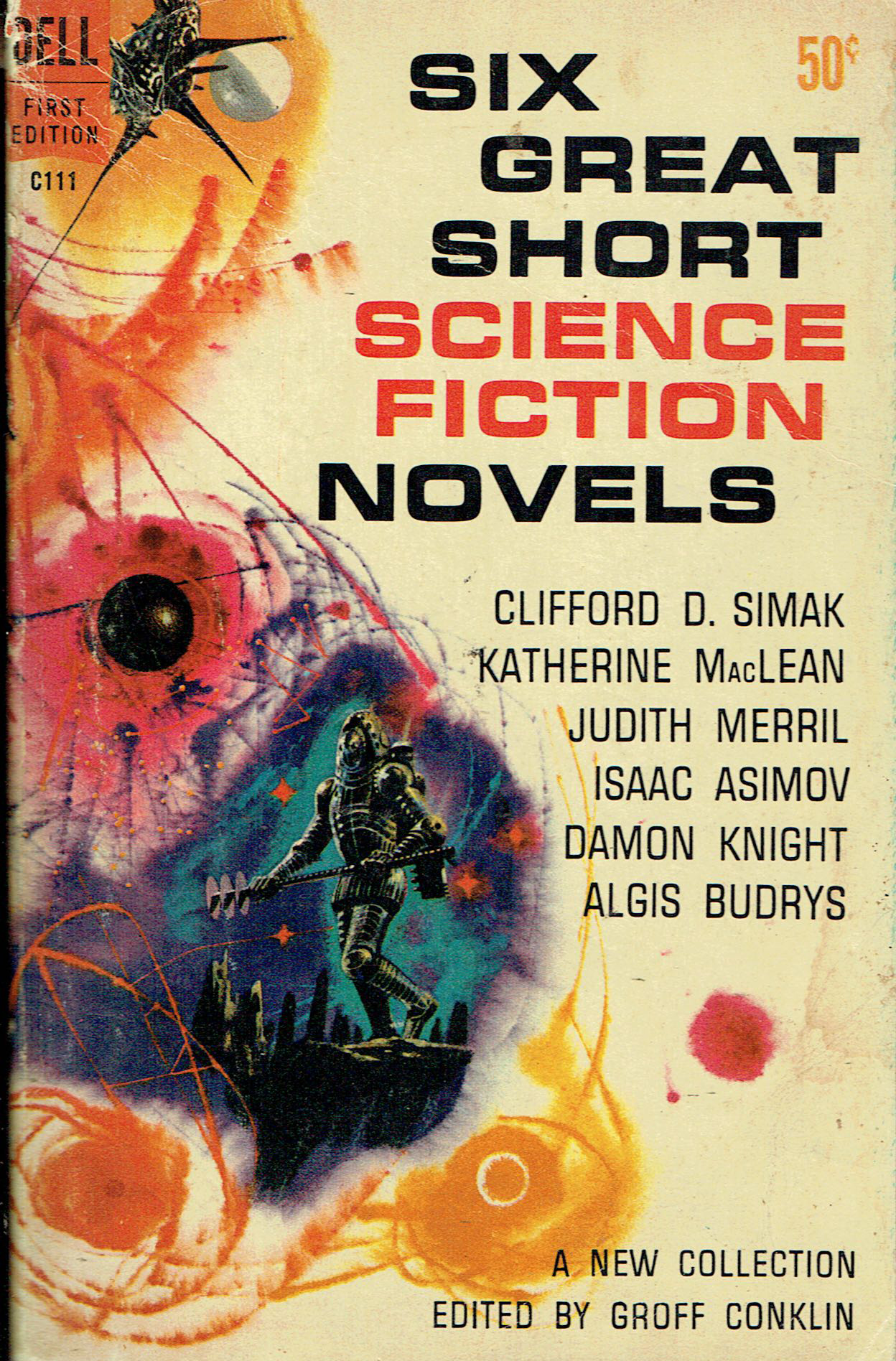
Biblioholic's Bookshelf - Six Great Short Science Fiction Novels

I got this one from my older cousin. It was in a stash with some issues of Galaxy and a book assessing the James Bond book series, things from his youth. I think he was out of college by then, and I was still a kid. 

It was tucked away in a corner of an abandoned house on his parents' property that was now being used for storage. 

The Asimov entry introduced me to the three laws of robotics. Well, actually my cousin had told me about that. I learned that's where he'd discovered them. 

Six Great Science Fiction Novels Front Cover


Thursday, January 28, 2021

There's Just Something About A Snow Day

The weather forecast made it sound iffy, but I walked into the home office this morning to find Christine peeking out the blinds. I thought she might have heard something like a dog howl, but she quickly announced we had snow and some of it was sticking. 

We have quite a bit in the vicinity of ye olde town home apartments this morning. 

Not an unpleasant way to begin the day.  


Sidney Williams in the snow

Tuesday, January 26, 2021

Zoë Moonshadow (Feline) Settles In

It's been a while since we've had a new cat in the household. As I've mentioned in one spot or another, Oliver Littlechap's death in 2019 ended a feline era stretching back to 1997 when Christine and I adopted Daisy and her brother, Cleo.

All of our cats lived out their lives with us, and in later years, they craved warm laps and companionship. Mostly warm laps. 

Zoë Moonshadow is about five and still has those bursts of energy that send her streaking across the living room up the stairs, around the second floor and back again in a heartbeat, with a thunder of footfalls that sound like a herd of wildebeest. She sits on laps but briefly before she's off on other business.

She's settling in with us and seems to like us. There is a bit of unwinding yet to do, though. One two many strokes of her head and coat results in a warning bite. Not too hard, but not a play bite either.

The humane society noted she'd been terrified of large dogs in her second household. Christine likens her situation now to PTSD. I've noticed Zoë's muscles tense as she cocks an ear to an unrecognized sound, as if a dog's approach might be imminent. 

Daisy never knew that kind of fear, but she had her own agenda early on, cuddling was a small part of it. You took affection when it came your way and let her move on when she announced the time for new business.

I'm reminded now of that time. 

I suspect in time we'll get longer, lazy lap sits, but there's no need to rush that. We can spend time in play and hijinks.


Christine read somewhere that Russian Blues like feathered toys, so we grabbed a card of those when we bought her a bed and scratching post. They proved so popular they quickly disappeared. Tucked away in a summer shoe or some other hiding place found and forgotten. 

I bought a few more and a feathered toy on a stick that proves a joy. She chases, nabs if lobbed in the air and if a toy misbehaves enough it gets a pummeling with the hind feet.

In the absence of toys, she likes to hop on the bed and paw wrinkles in the blanket. They seem alive to her and in needed of subduing. 

 "I'm so glad we got her," Christine said one Saturday morning as wrinkles were trapped beneath paws. 

I was reminded that cat ownership often involves sharing the world as much as immediate bonding, watching habits and instincts at work. Coping with a fearful moment if a dog strays too close to a window. Supplying food of course. Seeking to mute some instincts, of course.

With the world made small by pandemic, limited to the walls of home more than ever, having a friend sharing the space expands the universe. 


Monday, January 25, 2021

Biblioholic's Bookshelf - Dark of the Moon by Dan Ross

A gothic by Dan Ross aka WED Ross who wrote many Dark Shadows novels under the name Marilyn Ross. This one's copyright 1969.


Dark of the Moon back cover


Related Posts Plugin for WordPress, Blogger...